


Volume 67, Issue 2
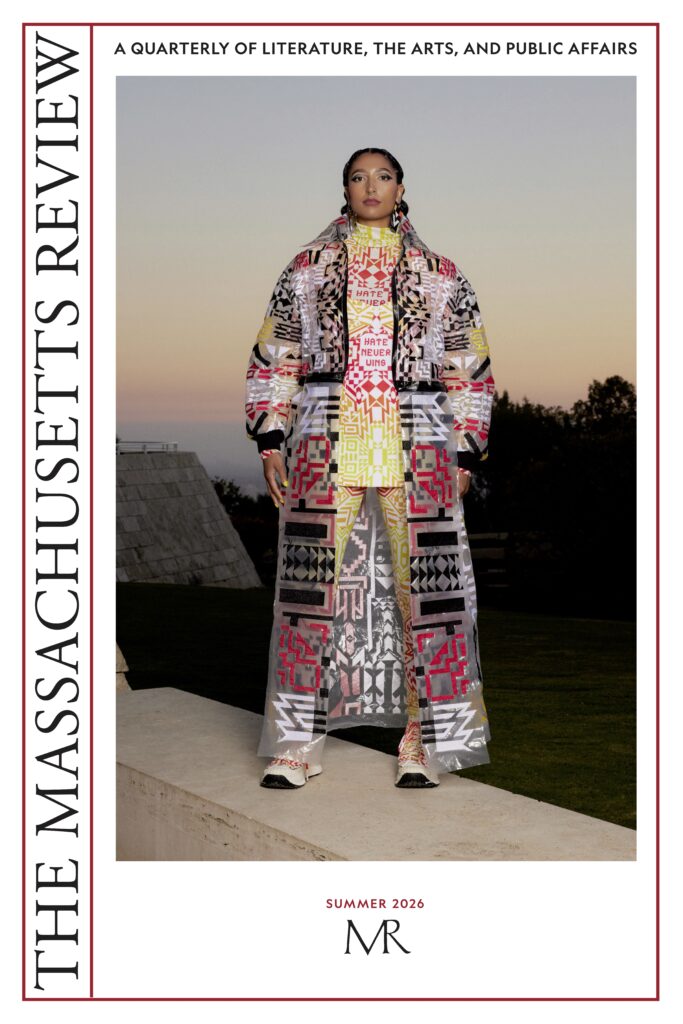
APRIL MAY BE THE CRUELEST MONTH, but summer has its own cruelties. It’s a season associated with vacation, sun, and relaxation, but, increasingly, it’s also a time of brutal heat waves and devastating fires. And from the long, hot summer of 1967 to the summer rebellions of 2020 in the aftermath of George Floyd’s lynching and so many other police killings, summer has also been a political boiling point for the colonized and the oppressed.
No breezy beach reads here, this issue instead encourages readers to think deeply about the political valences of leisure, recreation, desire, and reading itself. While waves and water somehow seem to elude the inexorable pull of history, Celeste Henery’s account of her lifelong love of swimming is interwoven with the story of her father’s complicated relationship to the water, a story that is also about the preciousness of family, the slipperiness of memory, and the segregation of both education and swimming facilities in the United States. Rhonda Mitchell’s “We Were a Practiced Act” dovetails beautifully with Henery’s essay, discussing her father’s illiteracy in the context of his denial of an education in the agricultural Black Belt of 1940s North Carolina, his undiagnosed dyslexia, and the damaging legacies of “bootstrap ideology” for African Americans then and now. Mitchell and Henery’s essays both return us to the scene of Jim Crow America, shadowed by the history of enslavement, reminding us of how racial dispossession and discrimination in the U.S. has often been facilitated by unequal access to public infrastructure and services, with lasting effects on future generations. But as Jina Kim notes in her recent book, Care at the End of the World: Dreaming of Infrastructure in Crip-of-Color Writing, people can be infrastructure too. Indeed, Henery and Mitchell write of fathers whose love, wisdom, and resilience constructed crucial infrastructures for their families in the face of what Ruth Wilson Gilmore calls “organized abandonment” by the state. As Mitchell powerfully closes, “My father didn’t just make his own boots and straps; he then stitched mine and my brother’s. We had to make our own before we could pull ourselves up. We are not victims. We are the proof.” These fathers also modeled forms of vulnerability that held countless lessons for their daughters.
Speaking of people as critical infrastructure, with this issue we say goodbye to Pam Glaven, who has served as MR’s production designer and art director for the past several decades. While no one (including Pam) will tell me, the relative newbie around here, exactly how long she has been with the magazine, I know that her contributions have been numerous: In addition to meticulously designing every print issue of MR, she has, in collaboration with Mario Ontiveros, selected art that beautifully represents MR’s vision, with a special interest in featuring emerging artists whose work is blazing important new pathways for-ward in the art world. She was also responsible for MR’s redesign in 2022. In a recent meeting, members of our editorial collective had the chance to thank Pam and to reflect on the significance of her contributions. They spoke of the clarity of her vision, called her an amazing ally, and mentioned her great taste and keen eye. I’ll add here that Pam is so cool and wickedly funny, and we will miss her terribly. I close here with some paraphrased words from translation editor Corine Tachtiris, who noted that Pam has been a fierce defender of what MR stands for; at the same time, she is unflinchingly forward-looking, an innovator who has never let us rest on our laurels but instead pushes us forward. We will be at a bit of a loss without you, Pam, but we will do our best to forge ahead into and in the name of a future that matters.
Britt Rusert
for the editors
Table of Contents
TREMOR OF FIRE, a poem by Humberto Ak’abal,translated by Michael Bazzett
TUNE YOURSELF, HIGHER SIGHTS, and IF YOUR FIRE, poems by Wallāda bint al-Mustakfī, translated by Will Pewitt
GHAZAL FOR THE FIRING SQUAD, a poem by Arthur Kayzakian
WHEN I CAME TO GERMANY and FROM SEARCHING AND FINDING, poems by Stefanie-Lahya Aukongo, translated by Ilse Meiler
GUAVA SEASON IN EXXON GUYANA’S CASH-GRANT LINE and REMEMORY REPEATING MYSELF, OR ALZHAIMA / LAANGH TAIM STOORII, poems by Joan Cambridge-Mayfield and Jeremy Jacob Peretz
THE SWIM TEST, an essay by Celeste Henery
CAMERA REVIEW, a hybrid piece by R. C. Blenis
SCHEHERAZADE, a poem by Fereshteh Sari, translated by Kaveh Bassiri
THE INTERPRETER, a story by Jennifer Delgadillo
DEMOLITION, a poem by Sophia Chong
JESUS MEETS HIS MOTHER, a poem by Jeanine DeRusha
THE MISSING PIECES, a story by Mathew Magro-Fry
MINUTES, a poem by İlhan Sami Çomak, translated by Jeffrey Kahrs and Mete Özel
FROM AGUSTINA PAZ, a novel excerpt by Emilio Jurado Naón,translated by Kelsi Vanada
WE WERE A PRACTICED ACT, an essay by Rhonda Mitchell
MY THERAPIST ASSERTS THAT MAYBE I FIND OFF-LIMITS TO BE EROTIC, a poem by Emily R. Daniel
RECENT WORK, art by Caroline Monnet
FOR OUR OWN GOOD, a poem by Steven Cramer
APOTHEGM POETICA, a poem by Nikelle
HELP ME TURN THE NIGHTLIGHT ON, HALF PAST FOUR, I WANT TO INTRODUCE YOU TO MEIMEI, and NOW I FEEL LIKE A POET,poems by Maniniwei, translated by Emily Lu
JALEE’S TOOTH, a story by Gulshan Majeed, translated by Azhar Wani
6.,7.,10., and 12., poems from Syriana by Leonardo Tonini, translated by Melissa Melpignano
XI. PILGRIM, XLIII. PURITANISM, and LXIX. THE BEGINNING OF A POLITICAL PAMPHLET . . ., poems by Cyprian Norwid, translated by Iain Higgins
ON MISTAKING FLOWERS FOR ACTIVE SHOOTERS, a poem by Jaimee Hills
GEOGRAPHICAL HISTORIES OF CENTRALIA, KANSAS, an essay by Jodi Cressman
CAN’T FLY, a poem by John Deming
COMMON TIME, a poem by Jennifer K. Sweeney
HOW TO REMAIN A MYSTERY, a poem by Paola Bruni
YOU AND YOUR BAFFLING SUBJECTIVITY, a story by Charlene Tzu Hsien Huang
GONE MISSING, a poem by Carol Potter
TOOLS FOR MANAGING YOUR ONLINE LIFE AFTER DEATH, a poem by Elizabeth Marie Young
YOU’VE BEEN HACKED, a poem by Timothy Liu
VALLEY OF THE HEART’S DELIGHT, a story by Robley Stephen Browne
ON SWANS, a poem by Annie Schumacher
FEAST: FRUITS OF THE LAND, a hybrid piece by Caroline Crew
—AND ALSO SEX, a poem by Patricia Waters
DEPTH OF FIELD, a poem by Lindsay Garbutt
NOTES ON CONTRIBUTORS
Contributors
HUMBERTO AK’ABAL (1952–2019) was a K’iche’ Maya poet from Guatemala. His book Guardián de la caída de agua (Guardian of the Waterfall) was named book of the year by Association of Guatemalan Journalists and received their Golden Quetzal award in 1993. In 2004, he declined to receive the Guatemala National Prize in Literature because it is named for Miguel Ángel Asturias, whom Ak’abal accused of encouraging racism. Ak’abal, a recipient of a Guggenheim fellowship, passed away on January 28, 2019.
WALLĀDA BINT AL-MUSTAKFĪ was a 5th century AH (11th century CE) Andalusian poet and daughter of the deposed Umayyad caliph Muhammad III al-Mustakfi of Cordoba. A significant literary figure in medieval al-Andalus, she established a prominent salon that attracted leading intellectuals and poets. Rejecting conventional social constraints, Wallāda remained unmarried and composed verse notable for its technical sophistication and personal expression. Her poetry, public persona, and correspondence with the poet Ibn Zaydun all contributed to her distinct legacy of self-representation.
STEFANIE-LAHYA AUKONGO is a Black, intersectional, interdisciplinary, and decolonial artist whose art and political works reflect on social realities. Lahya’s life is made up of One World Poetry Night, the books Kalugas Kind (2009) and Buschstabengefühleeine poetische Einmischung (2018), some zines, the e-book Sperrlinien (2022), and much more. Lahya’s works touch on themes of de:privilege, body healing, decolonization, the curative power of collective love, as well as the practice and vulnerability of autofiction. Lahya exists at the intersection of several identities which society seeks to marginalize and knows that embodying emotions and the poignancy of liberatory storytelling stir not only ancestors. Lahya’spronouns are Lahya, and when absolutely necessary she/her. Lahya’s bed can be found in Berlin.
KAVEH BASSIRI is an Iranian-American writer and translator. He is the author of 99 Names of Exile, winner of the Anzaldúa Poetry Prize, and Elementary English, winner of the Rick Campbell Chapbook Prize. His translations have appeared in the AmericanPoetry Review, The Kenyon Review, AGNI,Virginia Quarterly Review, Chicago Review,Guernica, and Colorado Review. Bassiri is also the recipient of the 2022–2023 Tulsa Artist Fellowship and a 2019 translation fellowship from the National Endowment for the Arts.
The recipient of National Endowment for the Arts fellowships in both poetry and translation, MICHAEL BAZZETT has published two book-length translations, a verse version of the creation epic of the Maya, The Popol Vuh (Milkweed), which was named by the NY Times as one of the best poetry books of 2018, and the selected poems of Humberto Ak’abal, If Today Were Tomorrow (Milkweed).
R. C. BLENIS is a nursing instructor and writer from Atlanta, GA. He holds degrees from Emory University and Georgia Tech, with clinical experience spanning psychiatric, emergency, and critical care nursing. His writing has appeared in JAMA, American Journal of Nursing, Heavy Feather Review, West Trade Review, Flyway, and Modern Haiku. He is currently at work on a creative nonfiction collection exploring the human dimensions of clinical practice.
ROBLEY STEPHEN BROWNE received his AA in film studies from De Anza College and has worked as a bookseller, cartoonist, and clerk at Kayo Books in San Francisco. He has also served as a volunteer reader for the Zoetrope All-Story Short Fiction Competition. His work has appeared in Midway Journal, Constellations, and Knee-Jerk Magazine, as well as the anthology Writers Studio at 30 (Epiphany). His story “You Know We’ll Have a Good Time Then” was recently featured on Canada’s The Short Story Show.
PAOLA BRUNI is originally from San Francisco and now lives in Aptos, California, by the sea. She began writing poetry in 2016 after a long marketing career. Her work has earned four Pushcart nominations and has been published in myriad journals and anthologies, including Ploughshares, The Southern Review, Five Points Journal, The Massachusetts Review, Rattle, Adroit, SWWIM, Poet Lore, and elsewhere. She is the winner of the Morton Marcus Poetry Prize and the Muriel Craft Bailey Poetry Prize.
JOAN CAMBRIDGE-MAYFIELD is an Afro-feminist environmental protector, former leading member of Guyana’s press corps, and author of the internationally acclaimed novel Clarise Cumberbatch Want to Go Home. Joan’s writing has appeared in the Antioch Review and Asymptote and has been anthologized in Daughters of Africa: An International Anthology of Words and Writings by Women of African Descent from the Ancient Egyptian to the Present and An Anthology of Non-Conformism: Rebel Wom!n Words, Ways and Wonders, and was nominated for a 2025 Pushcart Prize. Aunty Joan is also fellow traveler with and widow to Julian Mayfield, forever following his profound jumbi wisdom, strength, and guidance.
SOPHIA CHONG is a poet. A semifinalist for the Adrienne Rich Award for Poetry, her poetry has appeared/is forthcoming in Beloit Poetry Journal, The Massachusetts Review, Black Warrior Review, Sine Theta, among other places. Their criticism has appeared/is forthcoming in the Adroit Journal, Seneca Review, and fugue. They hold an MFA in poetry from Rutgers University-Newark.
ILHAN SAMI ÇOMAK was born in a town in eastern Türkiye called Karlıova in 1973. In 1994, while studying at prestigious Istanbul University, he was arrested and held in police custody for sixteen days, during which time he was tortured then charged with burning forests on behalf of the Kurdistan Workers Party—a charge he denied. Çomak was sentenced to death, but in 2000 his sentence was commuted to life imprisonment. He remained a political prisoner for thirty years until his release in 2024. During his years in prison, he wrote poems in Turkish and Kurdish and published more than a dozen books of poetry in both languages, his first book being Departure Like Wilted Flowers in 2004. In 2019 he won the prestigious Sennur Sezer Poetry Prize for I Came to You, and in 2022 he received the Metin Altiok Poetry Prize for his overall work as a poet and writer. That same year he was awarded the Norwegian Authors’ Union Freedom of Expression Award for his ability to remain committed to his work as a poet despite his circumstance. In 2025 he received the Jack Hirshman International Poetry Award.
STEVEN CRAMER’s Where Thoughts Come From: New and Selected Poems will be published by Lily Poetry Review Press in 2027. His chapbook, As If: Variations on Enrique Anderson-Imbert, was published by Lily in 2025. His previous books include Departures from Rilke (Arrowsmith Press), Listen (MadHat Press), Clangings (Sarabande Books), and Goodbye to the Orchard (Sarabande), a Sheila Motton Prize–winner and a Massachusetts Honor Book.
JODI CRESSMAN is professor of English at Dominican University in River Forest, Illinois. Her scholarly articles and books focus on the intersection of literature, medicine, and visual culture. Her creative work has been published or is forthcoming in Chicago Quarterly Review, Cincinnati Review, Terrain, Gordon Square Review, and others. She is an alum of The Kenyon Review and Bread Loaf writer’s workshops and a former fellow at the Virginia Center for the Creative Arts. She is currently at work on a hybrid memoir about slow violence in American towns named Centralia.
CAROLINE CREW is an assistant professor of creative writing at the University of Central Missouri, where she serves as editor-in-chief of Pleiades: Literature in Context. Her poetry and prose appear in POETRY, The Kenyon Review, and The Believer, among others. The author of the essay collection Other Girls to Burn, winner of the AWP Prize, she will publish her next poetry collection, Don’t Cut Your Own Bangs, with YesYes Books. Crew holds degrees from the University of St Andrews, the University of Oxford, the University of Massachusetts, and Georgia State University. Originally from Kernow (Cornwall), Crew lives in Kansas City, where she co-owns the bookstore Turnsol Books.
EMILY R. DANIEL’s chapbook Life Line was selected as a winner of the 2020 Celery City Chapbook Prize. Emily is a Best of the Net nominee, and her work can be found in The Penn Review, Beloit Poetry Journal, Waxwing, Porter House Review, and forthcoming in Crab Orchard Review among others. Emily lives with her family in Kalamazoo, MI, where she earned an MFA in poetry at Western Michigan University and was poetry editor for Third Coast Magazine.
JENNIFER DELGADILLO is a writer and artist from Mexico. She lives in Indianapolis where she is the arts and culture editor at local news nonprofit Mirror Indy. She has an MFA in creative writing, fiction, from Butler University and a BFA in painting from Herron School of Art and Design. Her work has also been published in Narrative, Booth, Indiana Review, and elsewhere.
JOHN DEMING is author of the poetry book Headline News (Indolent Books 2018). His work has appeared in Boston Review, Fence, New York Quarterly, New Orleans Review, A Public Space, and elsewhere. He lives in New York City, where he teaches at LIM College and co-curates KGB Monday Night Poetry.
JEANINE DERUSHA is a professor of English at Connecticut State Community College Manchester, where she coordinates the Poetry Program. She earned a BA in English from the University of Massachusetts (’94) and an MFA in poetry from the University of Washington. Her work has been published in several literary journals, including Puerto del Sol, American Literary Review, Crab Orchard Review, and Prairie Schooner.
LINDSAY GARBUTT lives in Chicago, where she is the deputy editor for POETRY. She studied comparative literature at Washington University in St. Louis and received an MA in art history from the School of the Art Institute of Chicago. Her writing has appeared in JSTOR Daily, As Seen: Exhibitions that Made Architecture and Design History (Yale University Press), and elsewhere.
CELESTE HENERY is a cultural anthropologist and memory worker, pursuing an MDiv for chaplaincy. She currently works as a research associate at the University of Texas at Austin and serves as a program advisor for the After Violence Project. Her work has been published in various academic journals and blogs, including Black Perspectives.
IAIN HIGGINS is a scholar, editor, translator, and poet who lives in the unceded territories of the Lək ̓ʷəŋən and WSÁNEĆ Peoples on Vancouver Island. His translations include The Book of John Mandeville, Xavier de Maistre’s Voyage Round My Room, and Adam Czerniawski’s selected poems.
JAIMEE HILLS is the author of How to Avoid Speaking (Waywiser Press), which won the Anthony Hecht Poetry prize. Her work has appeared in Mid-American Review, Blackbird, the Journal of Medical Humanities, and elsewhere. She holds an MFA from the University of North Carolina at Greensboro and an MA from the Johns Hopkins University Writing Seminars. She works in the College of Nursing at Marquette University and lives and writes in Milwaukee, WI.
TZU HSIEN (CHARLENE) HUANG is a writer originally from Taipei, Taiwan, and now based in Medford, Massachusetts. She attended Johns Hopkins University and received her MFA in fiction from Columbia University, where she was a Felipe P. De Alba Fellow and nominee of the Henfield Prize. Her work has received the 2023 Epiphany Magazine Prose Breakout! Prize as well as the Johns Hopkins’ Stephen Dixon Literary Prize for graduating seniors. She is presently at work on a linked short story collection and a novel.
JEFFREY KAHRS is the author of One Hook at a Time: A History of the Deep Sea Fishermen’s Union of the Pacific, a chapbook from Gold Wake Press, and a book of poems The Far Shore. He was also one of the winners of the Nazım Hikmet Poetry Contest in 2012. His poems, translations, fiction, and nonfiction have appeared in many publications, such as Talisman, Bosphorus Review of Books, PN Review, Modern Poetry in Translation, Asymptote, Circumference, the Los Angeles Review of Books, and Acumen. He lived in Istanbul for eighteen years.
ARTHUR KAYZAKIAN is the finalist for the 2024 Kate Tufts Award and the winner of the 2021 inaugural Black Lawrence Immigrant Writing Series for his collection The Book of Redacted Paintings (Black Lawrence Press), which was also selected as a finalist for the 2021 Philip Levine Prize for Poetry. He is the recipient of the 2023 creative writing fellowship from the National Endowment for the Arts. He is a founding member and serves as the poetry chair for the International Armenian Literary Alliance (IALA). His work has appeared in several publications, including The Adroit Journal, Chicago Review, Cincinnati Review, and The Southern Review, among other journals.
TIMOTHY LIU’s next book of poems, You Have Exceeded Your Cloud Storage Limit, will be published next year. He lives in Woodstock, NY.
EMILY LU is a poet, translator, and psychiatrist. Her work has been shortlisted for the Poetry in Translation Prize, nominated for the Pushcart, Best of the Net, and was selected for Best Small Fictions. She lives in Toronto.
MATTHEW MAGRO-FRY is a writer living in San Diego with his wife and cats. His fiction has appeared in the North American Review, and he is a member of The Woodshed, a local writers collective. He is currently working on a novel.
Professor GULSHAN MAJEED is a writer, poet, and critic from Kashmir. He is the author of the short story collection Tange Dolmut Barr. He has held teaching and administrative positions in the Centre for Central Asian Studies at Kashmir University.
MANINIWEI grew up in Malaysia and studied fine arts at university in Taiwan. Restarting her creative practice after the age of thirty as poet, writer, artist, she is the author of more than twenty books. Her first novel, Ghost Auntie, was selected for the Taipei International Book Fair Prize and was on Yazhou Zhoukan’s 2024 list of top ten novels from Asia. She lives in Taipei with two cats.
ILSE MEILER is a Massachusetts-based translator and interpreter. She was once a chemist and is now pursuing a PhD in comparative literature at the University of Massachusetts Amherst. Her work is focused on decolonial and ecocritical practices in literary translation. She translates Spanish, French, German, and Russian into English.
MELISSA MELPIGNANO is a writer, translator, and dance scholar-artist. She works as assistant professor of dance at the University of Texas at El Paso. Her work at large explores conflict, with a particular focus on the Middle East, through the lens of corpo-reality, movement, and choreography. She is the author of the poetry collection Lento Notturno (Alla Chiara Fonte) and of several academic articles on literature and performance (Narrativa, The Drama Review, Journal of Dance Education, Contemporary Choreography, among others).
RHONDA MITCHELL is a poet/writer driven by the importance of literacy, the arts, and social justice—passions that led her to spend thirty-two years of her adult life in public service. Her poetry has appeared in Voices of Leimert Park, and she’s shared her personal story in Essence Magazine. She’s now working on a hybrid collection of short stories and poems that brings together all the threads of her life growing up in the Crenshaw District.
EMILIO JURADO NAÓN was born in Buenos Aires in 1989. He holds a degree from and is a professor of letters at the University of Buenos Aires (UBA) and co-directs Rapallo, a magazine and publisher of poems and essays. He has published the novels A rebato (Blatt&Ríos) and Sanmierto (Leteo)—and, in the ongoing series “Los Roca y los yo,” the books Tópico de los dos viajeros (Palabras Amarillas), Zanja grande (Slimbook), Los Pincén (Omnívora), and Agustina Paz (Emecé). Jurado Naón coordinates the Hurlingham City Literary Workshop and is co-director of the American Poetry Festival in Hurlingham (FAPH).
NIKELLE is a Texan-born filmmaker and poet. She holds an MFA in literary arts from Brown University and a BA from The New School in dramatic writing and film production. She is interested in the sacred, the daily, and the many landscapes of the self. More of her work can be found in Callaloo, the Columbia Review, Poet Lore, and elsewhere.
CYPRIAN NORWID (1821–1883), writer and artist and an exact contemporary of Charles Baudelaire, Fyodor Dostoyevksy, and Gustave Flaubert, has not enjoyed posthumous success in the English-speaking world and indeed was slow to receive his due among readers of Polish, though he is now highly regarded. Vade-mecum (mid-1850s), a programmatic collection of lyrics, is now considered his masterpiece, though its existence was entirely unknown to the Polish-reading public until 1904, and the collection as a whole (which has not survived intact) was not reliably published until the 1960s.
METE ÖZEL is a Turkish writer and translator whose many essays and translations have appeared in a variety of Turkish journals. His first book, Ilgım Düş Esrar, was published in 2008, and he has worked on a variety of projects involving myth and the oral tradition. He is a founding partner of an international translation company called Mirora.
JEREMY JACOBS PERETZ’s scholarship, writing, and multimedia practice have been widely recognized with grants and fellowships including from the Yerba Buena Center for the Arts and the Fowler Museum at UCLA, as well as the Caribbean Studies Association’s biennial Best Dissertation Award. Jeremy’s essays, poems, and films are available through such publications as African American Review, Anthropology News, Capitalism Nature Socialism, Caribbean Quarterly, and Journal of Africana Religions. Jeremy holds a PhD from UCLA’s Department of World Arts & Cultures/Dance and teaches in the faculty of Education and Humanities at the University of Guyana.
WILL PEWITT is an educator, translator, and writer currently serving as assistant director of the Hicks Honors College at the University of North Florida. His work has appeared in such publications as The Oxford Anthology of Translation, North American Review, Arab Lit Quarterly, The Columbia Journal, and The Literary Review. He edits Crossing Currents, an undergraduate research journal, and oversees Shakespeare productions at UNF.
CAROL POTTER is winner of the 2021 Pacific Coast Series of Poetry from Beyond Baroque Books for her sixth book of poems, What Happens Next Is Anyone’s Guess. Other awards include the Field Poetry Prize from Oberlin College Press for Some Slow Bees, a Creation Grant from the Vermont Arts Council, the Cleveland State Poetry Center award, the Balcones Award for The Short History of Pets, as well as a Pushcart Award and residencies at Yaddo, MacDowell, The Fundacion Valparaiso, and Millay Colony of the Arts. Publications include poems in The American Poetry Review, Poetry, The Green Mountains Review, Hotel Amerika, Sinister Wisdom, The Kenyon Review, Hayden’s Ferry, The Massachusetts Review, The Los Angeles Review, Poet Lore, River Styx, Plume, The Cape Cod Review, Willow Springs, and the anthology of contemporary Vermont poetry, Roads Taken.
FERESHTEH SARI is the author of eight books of poetry, six novels, two short story collections, a children’s book, and a number of translations, including children’s and young adult stories as well as the selected poems of Boris Pasternak. During the Iran-Iraq War in the 1980s, Sari was one of the few poets to use simple observation and strong imagery to depict war’s devastating impact on ordinary citizens. Her poetry collection Days and Letters won the Parvin Etesami Prize in 2004. In 2009, Sari was given the Khorshid Lifetime Achievement Award, which recognizes established Iranian women writers. She has also received fellowship and awards from the International Parliament of Writers, a Hellman/Hammett Human Rights Watch grant, and the Erich Maria Remarque Prize.
ANNIE SCHUMACHER is a poet, writer, and translator. Her work has appeared in The London Magazine, Poet Lore, The Common, Poetry London, and elsewhere. She is currently pursuing an MFA in creative writing at NYU.
JENNIFER K. SWEENEY’s most recent books are Redwood Communal (forthcoming, Green Writers Press), Each Time You Carry Me This Way (forthcoming, Orison Books), the collaborative chapbook Dear Question: A Conversation, with L. I. Henley (Glass Lyre Press), and Foxlogic, Fireweed (Backwaters Press). Honors include a Pushcart Prize, the James Laughlin Award, the Perugia Press Prize, and the Terrain Poetry Prize. Jennifer teaches poetry at the University of Redlands in California.
LEONARDO TONINI is a writer and translator. He published his first collection of poems, Megalopoli, in 2014 with the Swiss publisher alla chiara fonte, for which he won the Virgilio Masciadri Award. He also published the poetry collections Sinué, Tutto il resto resta, Tra maggio e settembre, and A metà del vivere. Syriana is published in Spanish translation in the literary magazine De Sur a Sur Poesía y Artes Literarias. Excerpts from Syriana have been translated and published in German in Orte and in Arabic in The New Roman. A musical version by the composer Stefano Ghisleri has been per- formed at the Seetaler Poesiesommer Festival 2021 (Switzerland). He is a co-founder of the Sannixism artistic movement.
KELSI VANADA is a poet and literary translator. She is the author of the collection Optional Saint (Bench Editions) and the chapbook Rare Earth and the translator from Spanish and Swedish of seven books of poetry and creative nonfiction, including Day’s Fortune by Carlo Acevedo, The Visible Unseen by Andrea Chapela, and The Eligible Age by Berta García Faet. Kelsi was a 2024 NEA Translation Fellow and holds MFAs from the Iowa Writers’ Workshop and the Iowa Translation Workshop. She is the senior program director of the American Literary Translators Association in Tucson, AZ.
AZHAR WANI is a translator from Kashmir. He is currently a PhD student at New York University. His works have appeared in Fountain Ink Magazine, Trampset, VAYAVYA, Aleph Review, Inverse Journal, and Multitudes.
PATRICIA WATERS published two books of poetry with Anhinga Press: The Ordinary Sublime and Fallen Attitudes. Born and reared in Nashville, she lives in a small town in East Tennessee. A maker of small books and mail art, she completed graduate course work in book arts at UA Tuscaloosa and several book arts workshops at Penland School of Crafts. Having a history of collaboration with visual artists (Cy Twombly) and print artists (Goedele Peeters, Antwerp), she has had recent work published by Schirmer/ Mosel (Munich) and contributed to a gallery catalog and other texts for painter Max Renkel.
ELIZABETH MARIE YOUNG, a Boston-based poet and educator, is the author of the poetry collections An Inventory of Almost Everything (Subpress) and Aim Straight at the Fountain and Press Vaporize (Motherwell Prize Winner, Fence Books) as well as Translation as Muse: Poetic Translation in Catullus’s Rome (UChicago Press), a book about the ancient Roman understanding of lyric translation and literary creativity.