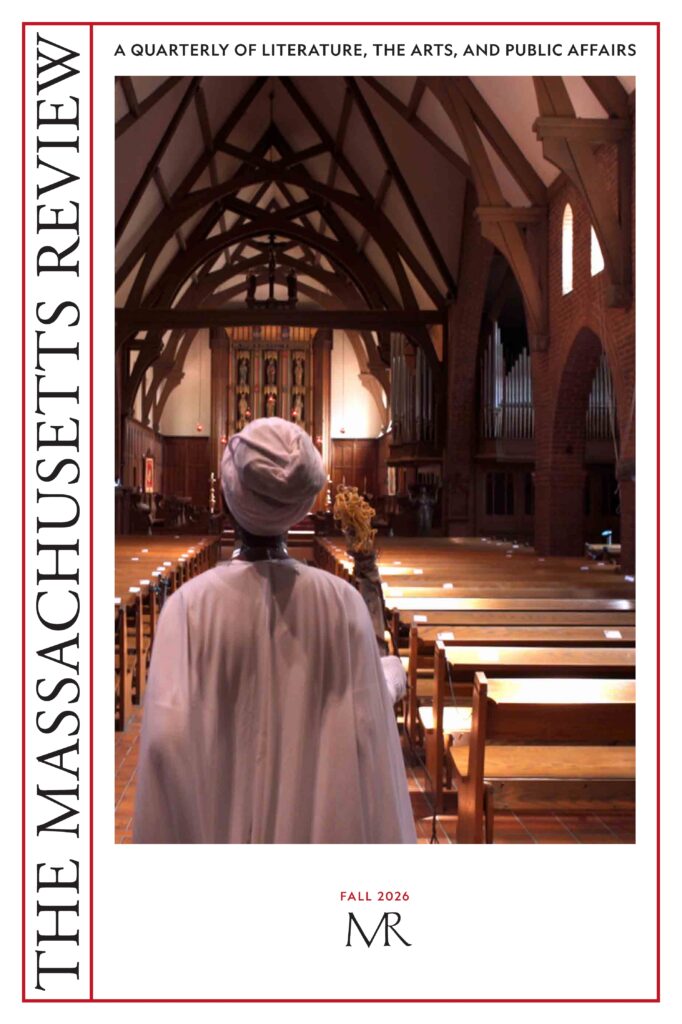

Volume 67, Issue 3
Introduction
FALL 2026 OFFERS READERS a veritable banquet of genres: poetry, fiction, creative nonfiction, and writing on public affairs, not to mention a lecture, an art portfolio featuring film stills, performance, and installations, and an ekphrastic photo essay. A piece of invasive species eco-horror by Kevin D. Jordan, “The Forest as Witness,” approaches questions about the environment and humanity’s entwined relationship with it in a way that is both unsettling and tender. We are also pleased to share not one but two works of drama in this issue. One of those pieces, scenes from a devised choreopoem titled “Many Patterns, One Cloth,” was co-authored by Iya Awotunde Judyie Al-Bilali, Priscilla Page, and Tatiana Rodriguez and appears here in the wake of Iya’s passing this past January. This choreopoem draws on Yoruba myth to imagine how a reclaiming of the divine feminine might lead to global healing and rebirth. We hope that this publication will stand as a testament to Iya’s memory and to the beauty and brilliance of her life’s work. Recent work by the interdisciplinary artist and scholar Camille Turner continues themes in “Many Patterns, One Cloth,” traversing memory, storytelling, and future-making across the diaspora.
Throughout, you’ll also find a strong thread of writing and thinking about contemporary social movements. M. E. O’Brien’s piece theorizes what she calls “insurgent utopianism,” a revolutionary method that emerges on the ground through the ever evolving, always shifting terrain of struggle. Miles Meth’s “Defend” is a work of fiction that registers the promises and perils of organizing actions right now, along with the tricky gender politics found in many movement spaces. Fan Gao offers a frontline report on anti-ICE activism in Minneapolis and the horrific murder of Renee Good and Alex Pretti by ICE officers there, while Robert Pastore, a contributor to our Incarceration & Family special issue, draws on personal experience to reflect on the “inescapable light” of solitary confinement and how the withholding of darkness is wielded as a tool of surveillance and control in U.S. prisons. Meanwhile, Shams Mazen Rajab writes on the necessarily political function of photography in Gaza today, where “the ban on photography is not merely a security restriction but an attempt to erase truth, to bury testimony before it is born.” Rajab notes, “Even the small camera I carry from a distance becomes a weapon against forgetting, a tool that tells the world: Here was a home, here was a life, here are people who still dream despite the rubble.” Questions of light, surveillance, and the documentation of existence also find their way into a short photo essay without photos, by Supratik Baralay, centered on the experiences of two Pakistani laborers living and working on the island of Santorini in Greece. A short story by Morteza Barzegar and translated from Farsi by AJ Javaheri further explores themes of incarceration, repression, and political violence.
With this focus on social movements, bearing witness, and visual culture we began to realize that many pieces in this general issue share guiding questions and concerns with our upcoming winter special issue on Documentation. Co-edited by the critic, essayist, poet, and performer Raquel Gutiérrez and two members of our editorial collective, poetry editor Abigail Chabitnoy and translation editor Corine Tachtiris, that issue seeks to meet our moment in the United States—marked by escalating deportations, ICE kidnappings, xenophobia, racism, and queer- and transphobia—with creative work interested in exploring the aesthetics and politics of “documentation.”
This cohering around a particular theme in a general issue is part of the alchemical serendipity that defines the process of putting general issues together for a literary magazine such as ours. But it also, I think, indicates something deeper about what’s in the air, a brief, Benjaminian flash of collective desire or even will. Indeed, one thing that art does well is cataloging the multitude of daydreams and utopian impulses that, according to Ernst Bloch, suffuse everyday life. MR is an archive of both those utopian impulses and attempts to translate that visioning work into our social and political realities. We look forward to sharing what surely will be a spectacular special issue come this December. In the meantime, we know you’ll find so much in this one.
Britt Rusert
for the editors
Table of Contents
INTRODUCTION
REALM OF FOX and I NEED TO SEE A BEAR,
poems by Sara London
POEM ABOUT PEONIES, a poem by David Blair
BLACK BOX, a poem by Yen Ai-Lin, translated by Anna Yin
THE FOREST AS WITNESS, a story by Kevin D. Jordan
FROM THE EDGE OF THE FORBIDDEN PLACE,
an essay by Shams Mazen Rajab
INESCAPABLE LIGHT, an essay by Robert Pastore
MISTAKE, a story by Morteza Barzegar, translated by AJ Javaheri
GLOSSOLALIA, a hybrid drama by Elizabeth Johnston Ambrose
THE ZOO HAS NONE and ODE TO DEHUMIDIFIERS,
poems by Li Jhen-hao, translated by Nicholas Wong
INSURGENT UTOPIANISM AS REVOLUTIONARY METHOD,
an essay by M. E. O’Brien
DEFEND, a story by Miles Meth DEAR MOSAB, a poem by Bruce Smith
MINNESOTA, LAND OF 10,000 WHISTLES,
an essay by Fan Gao
HERENESS, a poem by Jaye Kranz
NAUSEA, a poem by Bhaskar Chakraborty,
translated by Anindita Mukherjee
PORTO, BLED, PORTO II, and PORTO III,
poems by Tamara Štajner, translated by Rebecca Weingart
SEVENTY KILOMETERS FROM THE SEA,
a poem by Bruna Mitrano, translated by Hannah McKenzie
MANY PATTERNS, ONE CLOTH, a performance piece by
Iya Awotunde Judyie Al-Bilali, Priscilla Maria Page,
and Tatiana M. Rodriguez
BREATH CONTROL, an essay by Jahanara Ahmad
WEEKDAY MORNING and STATUES, poems by Teemu Helle,
translated by Niina Pollari
FROM FACIAL CALCULATION, poems by Anna Glazova,
translated by Alex Niemi
THE PROBLEM OF SURVIVAL, a poem by Patrick Kindig
SELECTED WORK, art by Camille Turner
CALDERA, an essay by Supratik Baralay
IN MIDDLE AGE I WANT TO MEDITATE ON BLUE and
THIS IS THE COLOR OF MY DREAMS,
poems by Shara McCallum
BECAUSE IT IS ELUL, a poem by Shelby Handler
CAGE, a poem by Georg Amsel, translated by Lake Angela
WHO ARE YOU, REALLY?, a story by Robert James Hicks
GOING TO GRACELAND, a story by Sean Murphy
AMPUTEE LIT, an essay by Emily Spencer
BANDISH: STHAYI, a poem by Sati Mookherjee
NOTES ON CONTRIBUTORS
Contributors
JAHANARA AHMAD is a writer living in Dhaka, Bangladesh, where she was born and raised. She is at work on her first book, about class, gender, and life in modern Dhaka. She has spent nearly a decade in the development sector, and her writing on education and early childhood development has appeared in the Journal on Education in Emergencies, Early Childhood Matters, and edited volumes from Routledge.
YEN AI-LIN, a poet from Tainan, Taiwan, was born in 1968 and graduated from the History Department of Fu Jen Catholic University. She won the Outstanding Youth Award from Taiwan Publishing, the fortieth anniversary of Epoch Poetry Quarterly Award, the National Outstanding Poet Award, etc. She was the First Cross-Strait Poet Laureate. She has authored twenty books, and her poems have been translated into many languages and selected for various Chinese textbooks in Taiwan and Hong Kong.
ELIZABETH JOHNSTON AMBROSE (she/her) is the author of two poetry chapbooks, Wild Things (Main Street Rag) and Imago, Dei (Rattle Chapbook Prize). Her work appears in The Atlantic, The Sun, McSweeneys, Cleaver, and Women Studies Quarterly, among others. Awarded Descant’s 2025 Betsy Colquitt Poetry Prize, Elizabeth serves on the board of Just Poets of Rochester, teaches trauma writing to breast cancer survivors, and coordinates the Creative Writing Program at Monroe Community College in Rochester, NY.
IYA AWOTUNDE JUDYIE ELLA AL-BILALI held a BA and an MFA from the University of Massachusetts Amherst, where she was a full professor of theater. As an actor, director, playwright, and producer, she has worked off-Broadway and in regional theaters nationwide. She taught at NYU’s Educational Theatre Program, the MA in Applied Theatre Program at CUNY, Amherst College, Hampshire College, and traveled around the world with Semester at Sea. Judyie is the author of two books, For the Feeling: Love & Transformation from New York to Cape Town and Halcyon Days, and was the recipient of numerous awards. She was a Fulbright Scholar at the University of the Western Cape in South Africa, where she created Brown Paper Studio, an applied theater methodology. She was an initiated priest in the Ifa-Orisa tradition.
GEORG AMSEL comes from Salzburg and conceives poetic ideas in an Austrian German from the late 1800s. His poems and collaborations with Lake Angela appear in Cagibi, Exchanges, Portland Review, Passages North, and ANMLY, among others, and his work “Komfort,” translated by Lake as “Comfort,” is listed in The Best Literary Translations of 2025. His poetry seeks to disrupt contemporary uses of language as much as its translations do.
LAKE ANGELA holds a PhD in intersemiotic translation from the University of Texas at Dallas and an MFA in poetry. Her latest book is Scivias Choreomaniae (Spuyten Duyvil), or “Know the Ways of the Dancing Madness,” a poetry collection based on her work as a Mad dance therapist at a state psychiatric institution. With Amsel, she seeks to invoke the transformative languages of color and movement across spacetime.
SUPRATIK BARALAY was born in Bombay and raised in London. He currently lives in Princeton, NJ, where he teaches ancient history.
MORTEZA BARZEGAR is a fiction writer and writing instructor based in Tehran, Iran. His published works include the short story collection The Orange Heart of the Angel (now in its fourteenth edition) and the novel Horrific Confessions of a Dead Turtle (now in its tenth edition), both of which have been nominated for and have won major literary awards in Iran.
DAVID BLAIR is the author of five books of poetry. He teaches poetry in the MFA Writing Program at the University of New
Hampshire and lives with his family in Somerville, Massachusetts.
BHASKAR CHAKRABORTY (1945–2005) was a prominent Indian Bengali poet and writer known for his lyrically prosaic style and recurring engagement with death, decay, and everydayness of urban life. His major poetry collections include Shitkal Kabe Asbe Suparna and Eso Susangbad Eso. His prose works include Priya Subrata and Shyanjaan. Chakraborty’s work is noted for conjuring a new poetic language interspersed with emotional restraint and lyric verve.
FAN GAO is a writer from Minnesota. His writing has appeared in Guernica and The New England Review. His manuscript The Asian Parents’ Guide to World Travel was a finalist for the prestigious AWP Sue William Silverman Prize (2025) judged by Cheryl Strayed.
ANNA GLAZOVA is a poet, translator, and independent scholar. A laureate of the Andrei Bely Prize, she has published seven
books of poetry in Russian and received her PhD in German and comparative literature at Northwestern University (USA). She translates from German and English; among the authors she has translated are Franz Kafka, Unica Zürn, Walter Benjamin and Emily Dickinson.
SHELBY HANDLER is a writer and organizer with Jewish Voice for Peace. Recent work has appeared in and or is forthcoming in Prairie Schooner, POETRY, The Iowa Review, Beloit Poetry Journal, Redivider, Poetry Northwest, and Southern Indiana Review, among others. Shelby received their MFA in poetry at the University of Washington-Seattle and has been nominated for a Pushcart Prize, Best New Poets, and Best of the Net.
TEEMU HELLE is the author of seven collections of poetry in Finland; work in translation has appeared in or is forthcoming from Plume, Cordite Poetry Review, The Los Angeles Review, Modern Poetry in Translation, Solstice Literary Magazine, Voice & Verse Poetry Magazine, and elsewhere.
ROBERT JAMES HICKS is a graduate of the Iowa Writers’ Workshop. His fiction has appeared in American journals, including The Southwest Review, and Canadian ones, such as PRISM international.
AJ JAVAHERI is an Iranian-born and -raised literary translator based in St. Louis, working between Farsi and English. She
holds an MFA in literary translation from the University of Iowa and is currently a PhD student in comparative literature, International Writers Track at Washington University in St. Louis.
Born in 1981, LI JHEN-HAO is the winner of the 19th Lin Rongsan Literature Award in Poetry in 2024. He is the author of two essay collections and three poetry books, including Drowning Ghost Incidents (2025), The Star Falling for a Black Hole (2019), and Moving Together (2015). He currently lives in Taipei.
KEVIN D. JORDAN is a landscape photographer and environmental consultant based in southern New Hampshire. He uses photography and writing to explore the natural world and the connections that tie us to place and to each other. “The Forest as Witness” is his first published story.
PATRICK KINDIG is the author of the poetry collections Agape (Saturnalia) and fascinations (Finishing Line), the academic
monograph Fascination: Trance, Enchantment, and American Modernity (LSU 2022), and two chapbooks. His poems have appeared in the American Poetry Review, The Southern Review, Prairie Schooner, Colorado Review, Copper Nickel, and other journals. He lives and teaches in Annapolis, MD.
JAYE KRANZ is a poet, writer, and documentary audio maker living on the unceded lands of the Wurundjeri Woi-Wurrung people in Naarm (Melbourne), Australia. She won the 2025 Plaza Prize for Poetry, judged by Natalie Diaz, and was a finalist for Poetry International’s 2024 C.P. Cavafy Prize. She received an Emerging Writers Grant from the Australia Council for the Arts (now Creative Australia). Her poems have appeared or are forthcoming in Oxford Poetry, Best of Australian Poems, New Ohio Review, Poetry Northwest, The Cincinnati Review, Verse Daily, West Branch, The Florida Review, and Foglifter, among others. Her award-winning sound-rich audio features have been commissioned for BBC Radio 4, BBC Radio 3, and ABC RN. She is writing her first collection of poems.
SARA LONDON is the author of Upkeep, winner of the New England Poetry Club’s Motton Book Prize, and The Tyranny of Milk, both published by Four Way Books. Her poems have appeared in Plume, The Hudson Review, Poetry East, The Common, the Poetry Daily anthology, and elsewhere. She teaches creative writing at Smith College and is the poetry editor at The Woven Tale Press.
SHARA MCCALLUM is the author of seven books, published in the US & UK, including Behold (2026); No Ruined Stone, winner of the 2022 Hurston/Wright Legacy Award for Poetry; and Madwoman, winner of the 2018 OCM Bocas Prize for Caribbean Poetry. From Jamaica and of Jamaican and Venezuelan parentage, she is an Edwin Erle Sparks Professor of English at Penn State University and a 2026–27 Cheney Creative Fellow at the University of Leeds, UK.
HANNAH MCKENZIE was a 2025 Bread Loaf Translators’ Conference participant. She frequently translates news articles on
human-rights issues and community organizing in Rio de Janeiro favelas for Brazilian NGO RioOnWatch. Based in Chicago, she works as an immigration paralegal supporting asylum cases.
MILES METH (they/them) is a queer, Jewish union organizer and writer living in Boston. They hold an MFA from the University of Southern Maine and their work has appeared in Bellevue Literary Review, The Boston Globe, Cleaver Magazine, The Healing Muse, The Stonecoast Review, The Forward, The Bias, and more. They were a finalist for the Saints and Sinners LGBTQ Literary Award.
BRUNA MITRANO is a writer and teacher. In recent years, she has collaborated with several magazines, including Cult and Piauí. She has contributed to more than twenty anthologies, including As 29 poetas hoje (29 poets of today), organized by Heloisa Teixeira. Bruna’s poetry books include Não (Patuá) and Ninguém quis ver (Companhia das Letras)— the latter a semifinalist for the Prêmio Oceanos (Oceans Award). Her work has been praised by leading names in Brazilian literary criticism. In 2024, Bruna was an official guest of the Paraty International Literary Festival.
SATI MOOKHERJEE’s third book, Deś, a poetry collection based on conversations with Bangladeshi, Pakistani, and Indian family and friends in their shared corner of the Pacific Northwest, is forthcoming from Tupelo Press (May 2027). Previous books are Eye (Ravenna Press) and Ways of Being (Albiso Award, MoonPath Press). Recent work appears in Best Spiritual Literature (2025), Poetry Northwest, Gulf Coast Journal, SWWIM, Michigan Quarterly Review, Quarterly West, RHINO, and Tupelo Quarterly. Her collaborations with contemporary classical composers have been performed and recorded. She is former vice-president of the board of directors of the CASCADIA International Women’s Film Festival.
ANINDITA MUKHERJEE is a poet, editor, translator, and a PhD student at the Department of English and Film Studies in University of Alberta. Her latest book, How Silkworms Break Their Eggs: Selected Poems (2024), brings the Bengali poet Mridul Dasgupta’s works into English for the first time and was nominated for the 2025 Kala Literature Awards. In 2022, her first chapbook, Nothing and Variations, was selected as the top ten Young Indian Voices. Her poems and critical works have appeared in The Guernica Editions, The Antonym, Madras Courier, The Lake, Poetry Pause: The League of Canadian Poets, Pamenar Press, and The Paris Institute of Critical Thinking, among others. Currently, she is working on her full-length poetry collection, titled Nothing Happens in Edmonton.
SEAN MURPHY is an author, founder of the nonprofit 1455, and director of the Center for Story at Shenandoah University. His podcast Some Things Considered features writers, critics, musicians, and industry leaders.
ALEX NIEMI is a writer and literary translator. She is the recipient of an NEA translation grant, the Heldt Prize, and an AATSEEL Book Award for her translations from Russian. Her latest translation is The Endless Week by Laura Vazquez (Dorothy, a publishing project), and she is the author of the poetry chapbook Elephant (Dancing
Girl Press).
M.E. O’BRIEN is a psychoanalyst and writer in New York City. She has two books: Family Abolition: Capitalism and the Communizing of Care (2023) and the coauthored speculative fiction novel Everything for Everyone: An Oral History of the New York Commune, 2052–2072 (2022). She helps edit two projects: Pinko, a magazine of gay communism; and Project 2052, an online collection of revolutionary science fiction. She previously did a PhD at NYU and currently works in private practice as a clinical social worker.
PRISCILLA MARIA PAGE is a writer, performer, dramaturg, and an associate professor in the Department of Theater at the University of Massachusetts Amherst, where she also directs the Multicultural Theater Certificate. Her research includes Latinx theater and contemporary Native American performance. She is currently writing about Latinx theater history in Chicago. She is a member of the Latinx Theater Commons, Literary Managers and Dramaturgs of America, and the Association of Theater in Higher Education. Her publications include “Crafting Latinx Culture on Chicago’s Stages” in the Routledge Companion to Latine Theater and Performance (2024); Wings of Night Sky, Wings of Morning Light: A Play and a Circle of Responses with Joy Harjo (Wesleyan Press); and “Collidescope 2.0: Performing the alien gaze” in Casting a Movement: The Welcome Table Initiative, edited by Claire Syler and Daniel Banks (2019).
ROBERT PASTORE is an incarcerated writer and scholar interested in the politics of incarceration, philosophy, and biology. His writing has previously appeared in Massachusetts Review, Defector, Prism Reports, TruthOut, and others. He is from the Bronx.
NIINA POLLARI is the author of three poetry collections, including Path of Totality (Soft Skull) and the forthcoming Risk Tolerance (Autofocus). She’s also the translator from the Finnish of Tytti Heikkinen’s collection The Warmth of the Taxidermied Animal.
SHAMS MAZEN RAJAB is a twenty-three-year-old writer, translator, poet, and essayist from Gaza. She holds a bachelor’s degree in English language and teaching methods from Al-Aqsa University in Gaza, and has also completed a continuing education certificate in equality, diversity, and inclusion awareness through online study at University College Cork, Ireland. She teaches Arabic to nonnative speakers, and through her bilingual writing she seeks to preserve memory and build bridges across cultures.
TATIANA M. RODRIGUEZ is a PhD candidate in the W. E. B. Du Bois Afro-American Studies Department at the University of Massachusetts Amherst. Her research explores Black feminist and womanist aesthetics and praxes in twentieth- century Black women’s drama. She is also a co-founder of The Re/Emergence Collective, a devised theater ensemble invested in creating devised, process-oriented, and site-specific and performance art in western Massachusetts.
BRUCE SMITH is the author of eight books of poems: The Common Wages, Silver and Information, Mercy Seat, The Other Lover (which was a finalist for both the National Book Award and the Pulitzer Prize), Songs for Two Voices, Devotions (a finalist for the National Book Award, the National Book Critics Circle Award, and the LA Times Book Award), Spill, and most recently Hungry Ghost from Arrowsmith Press. He lives in Syracuse, NY.
EMILY SPENCER is the author of East Walnut Hills. She earned an MFA from the Iowa Writers’ Workshop. Her work has appeared in the Kenyon Review, Florida Review, Puerto del Sol, and elsewhere. She teaches at Miami University and is working on her first essay collection.
TAMARA ŠTAJNER was born in 1987 in Novo mesto, Slovenia. She earned her master’s degree at the University of Music and Performing Arts Vienna. She is a recipient of multiple grants from the Austrian Federal Ministry for Arts and Culture in the fields of music, performance, and literature. In 2020, she was admitted to the Young Academy of Sciences and Literature (Mainz), and in 2022 she became a member of the Gutenberg Academy. Her first poetry collection, Schlupflöcher, was published in 2022, followed by her debut novel Raupenfell in 2023. In 2024, she won the Meran Poetry Prize and was invited by Brigitte Schwens-Harrant to read at the Ingeborg Bachmann Prize, where she was awarded the Kelag Prize for her text Luft nach unten. She lives and works in Vienna.
REBECCA WEINGART is a poet and translator pursuing a PhD in comparative literature at Washington University in St. Louis. Her translations have appeared in Pakn Treger, Hopkins Review, Harvard Review, and Grotto Journal and have received support from the Yiddish Book Center, the American Literary Translators Association, and the Regional Arts Commission of St. Louis.
NICHOLAS WONG is a poet, translator, and visual artist from Hong Kong. He is the author of Crevasse, which won the Lambda Literary Award for Gay Poetry, and Besiege Me, also a finalist for the same prize. His recent poems and translations appear in Hunger Mountain, Beloit Poetry Journal, North American Review, and The Yale Review, among others. In 2024, he was an International Writing Program resident at the University of Iowa and currently teaches at the Education University of Hong Kong.
ANNA YIN was Mississauga’s Inaugural poet laureate (2015–2017) and is the author of seven poetry collections and four books of translations. She is the recipient of the 2005 Ted Plantos Memorial Award, three MARTY Awards, two US scholarships, and multiple grants from the Ontario Arts Council and the Canada Council for the Arts. Her poems and translations have appeared in Queen’s Quarterly, ARC Poetry, The New York Times, China Daily, CBC Radio, Literary Review of Canada, and Modern Poetry in Translation, among others.