Volume 67, Issue 3
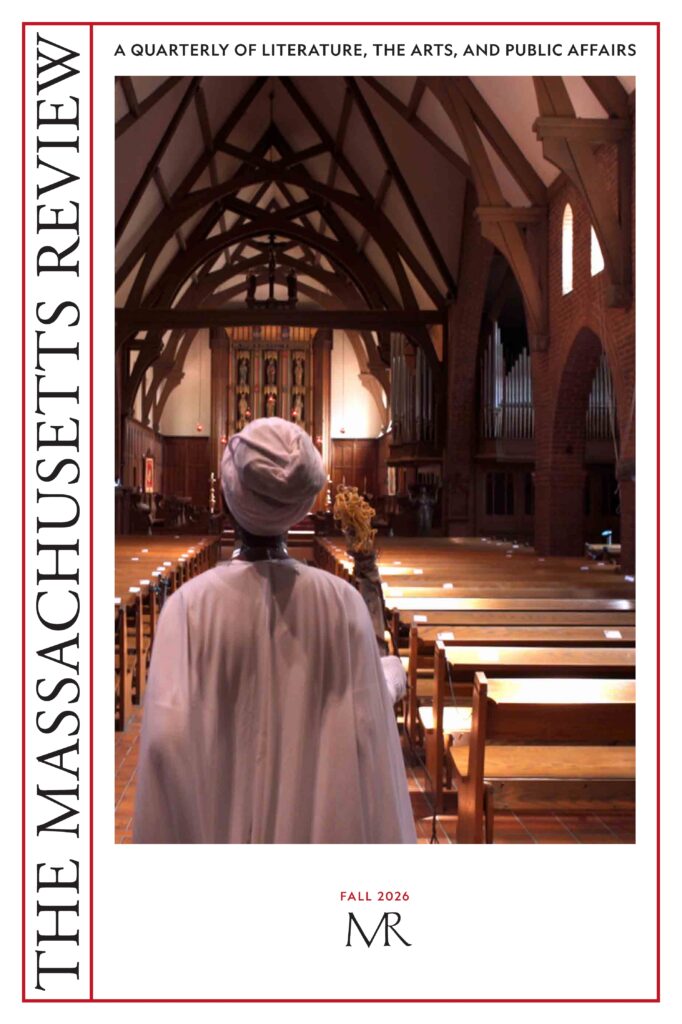
FALL 2026 OFFERS READERS a veritable banquet of genres: poetry, fiction, creative nonfiction, and writing on public affairs, not to mention a lecture, an art portfolio featuring film stills, performance, and installations, and an ekphrastic photo essay. A piece of invasive species eco-horror by Kevin D. Jordan, “The Forest as Witness,” approaches questions about the environment and humanity’s entwined relationship with it in a way that is both unsettling and tender. We are also pleased to share not one but two works of drama in this issue. One of those pieces, scenes from a devised choreopoem titled “Many Patterns, One Cloth,” was co-authored by Iya Awotunde Judyie Al-Bilali, Priscilla Page, and Tatiana Rodriguez and appears here in the wake of Iya’s passing this past January. This choreopoem draws on Yoruba myth to imagine how a reclaiming of the divine feminine might lead to global healing and rebirth. We hope that this publication will stand as a testament to Iya’s memory and to the beauty and brilliance of her life’s work. Recent work by the interdisciplinary artist and scholar Camille Turner continues themes in “Many Patterns, One Cloth,” traversing memory, storytelling, and future-making across the diaspora.
Throughout, you’ll also find a strong thread of writing and thinking about contemporary social movements. M. E. O’Brien’s piece theorizes what she calls “insurgent utopianism,” a revolutionary method that emerges on the ground through the ever evolving, always shifting terrain of struggle. Miles Meth’s “Defend” is a work of fiction that registers the promises and perils of organizing actions right now, along with the tricky gender politics found in many movement spaces. Fan Gao offers a frontline report on anti-ICE activism in Minneapolis and the horrific murder of Renee Good and Alex Pretti by ICE officers there, while Robert Pastore, a contributor to our Incarceration & Family special issue, draws on personal experience to reflect on the “inescapable light” of solitary confinement and how the withholding of darkness is wielded as a tool of surveillance and control in U.S. prisons. Meanwhile, Shams Mazen Rajab writes on the necessarily political function of photography in Gaza today, where “the ban on photography is not merely a security restriction but an attempt to erase truth, to bury testimony before it
is born.” Rajab notes, “Even the small camera I carry from a distance becomes a weapon against forgetting, a tool that tells the world: Here was a home, here was a life, here are people who still dream despite the rubble.” Questions of light, surveillance, and the documentation of existence also find their way into a short photo essay without photos, by Supratik Baralay, centered on the experiences of two Pakistani laborers living and working on the island of Santorini in Greece. A short story by Morteza Barzegar and translated from Farsi by AJ Javaheri further explores themes of incarceration, repression, and political violence.
With this focus on social movements, bearing witness, and visual culture we began to realize that many pieces in this general issue share guiding questions and concerns with our upcoming winter special issue on Documentation. Co-edited by the critic, essayist, poet, and performer Raquel Gutiérrez and two members of our editorial collective, poetry editor Abigail Chabitnoy and translation editor Corine Tachtiris, that issue seeks to meet our moment in the United States—marked by escalating deportations, ICE kidnappings, xenophobia, racism, and queer- and transphobia—with creative work interested in exploring the aesthetics and politics of “documentation.”
This cohering around a particular theme in a general issue is part of the alchemical serendipity that defines the process of putting general issues together for a literary magazine such as ours. But it also, I think, indicates something deeper about what’s in the air, a brief, Benjaminian flash of collective desire or even will. Indeed, one thing that art does well is cataloging the multitude of daydreams and utopian impulses that, according to Ernst Bloch, suffuse everyday life. MR is an archive of both those utopian impulses and attempts to translate that visioning work into our social and political realities. We look forward to sharing what surely will be a spectacular special issue come this December. In the meantime, we know you’ll find so much in this one.
Britt Rusert
for the editors