


Volume 66, Issue 4
ONE FATHER in a khaki jumpsuit branded with “Correctional Facility” smiles as he supports his fourteen-year-old’s interest in saving the bees through the telephone. In a prison waiting room, another father liesgently to his six-year-old son that the boy’s mother is not incarcerated at all, but at a “police training academy,” where they visit weekly. While on escorted furlough from the prison, a mother tells her toddler that the handcuffs binding her wrists are bracelets. She cannot open her arms to hug anyone at her grandfather’s funeral.
I have been in the strange position of having access to beautiful, difficult, and sometimes core-shaking stories about family and incarceration through my work in prisons. Many things shared are too terrible and tender to include here, but I will say, when I sat with each woman at a prison recently, touching nearly 150 hands for a brief moment, I said, tell me something good. It was a hard charge, but they rose to the occasion, slipping heartbreak into their momentarily sparked up eyes. I would estimate 98 percent of the women said something about their children.
It is my educated guess that close to none of them see their child more than once a week, if exceptionally lucky, if at all. Even the mothers of the babies in this prison’s nursery (of which there are very few nationally), who are able to see their children for a few hours a day, hand them off at night for someone else to mother. When the children, after being soothed by volunteers, mostly older white women, turn two years old, they go home to aunties or grandmothers or friends or the state. And that’s if they are there at all. Women with violent crimes are not allowed this privilege, and therefore neither are their children. Having a mother is a privilege.
I have also witnessed the bonding human force that cannot be fully extinguished. The desire for profound community reassembles and persists. The three men who tell me, three decades into their life-plus sentences, that they never leave each other without saying I love you. The youngest prisoner incarcerated at the facility, once a skinny teenager in big glasses, finds fellowship in learning about his Indigenous heritage, gathering a small group to perform ritual, petitioning the prison for the sanctioned use of peace pipes, and winning.
I have also witnessed the isolation. The trans woman in the men’s prison who asked me to sign her book to a fellow sister. She sat in the audience of a few empty chairs, a radius of humming alone. The poet who lost one half of her expected twins after giving birth in prison. She shared the photo of her tiny pink stillborn daughter, passing through the hands of women too kind not to look away. The woman who fantasized about seducing a prison guard just to have a baby but knew the fate of the child would be too cruel. She has a life sentence without the possibility of parole.
Most of the pieces on these pages hurt to read, masterfully capturing the shocking energy of fleeting, piercing, person-to-person confessions. It is said that prison incarcerates the whole family. I look forward to a day when it is an accepted fact that prison makes the individual, the collective, and society profoundly ill. These writers capture so wholly the scramble to keep family intact and the many ways one can find deep kinship outside of the predestined, in what has become just another brutal but typical American storyline.
I admire the writers here for sharing their stories. They remind us that we should not accept what is normalized, what is brutal, what is the warping norm. And I am thankful to the writers, to Nicole Shawan Junior, and to the MR team for this meaningful experience that reminds me not to either.
Caits Meissner
THE FIRST TIME my cousin Duval disappeared, I was about six or seven years old. Alton was taken shortly after that. There was also Sekayi and Theresa. Tamika, too. Randy’s disappearance gutted me. I was working as a felony prosecutor when I watched his sentencing from a courtroom pew, similar to the ones we sat in as kids at our grandmother’s Catholic church. But Amin! Amin, whom I bathed, shared a twin-sized bed, and played Asteroids on Atari with—his disappearance was by far the most devastating.
Andrea Ritchie has told us that “criminalization produces disposable people . . . So, if they’re punished or disappeared from society, justice was supposedly done.” The stories, essays, interviews, poems, and visual art in this special issue of The Massachusetts Review illuminate how incarceration severs by disappearance the foundation of all human relationships: the family. You will read about high phone call costs, geographic distances between home and prison, the fissures between incarcerated parents and their children, the fractionation of prison communities when incarcerated humans are snatched from their cells in the middle of the night, and more. It is true that prisons rob both the incarcerated and their loved ones of a sense of belonging, rootedness, and connection. But as geographer and abolitionist Ruth Wilson Gilmore often reminds us, “Where life is precious, life is precious.” In these pages you will encounter formidable families that persist despite the walls as well as communities of created kinship formed to help the disappeared maintain their mental health and humanity.
When asked to serve as guest editor for this issue, my second with MR, I immediately agreed. As an abolitionist, I know that no living person is unworthy of connection and remembrance, regardless of the crimes they may have committed. But that wasn’t my only reason for taking on this work. I rejoined MR as a guest editor this time around because it was a spiritual calling, an opportunity to wrestle. When my cousin Amin was finally returned after serving a nickel in various prisons across New York State, I didn’t have my own felony conviction yet. That would happen a few years later. Albeit, he hit me up: “Yo dat, Nik Nik!” I expected the call; we’d talked at least once a month in the year leading up to his release. “Yo dat!” I shouted into the phone. “You home?” Amin told me he needed “a coat and some clothes.” I didn’t care about my already overdrawn bank account or the nearly maxed-out credit cards I had. What mattered to me was Amin’s success. “I gotchu,” I said, because we were and would always be family. I hope I accomplished what we set out to achieve with this work. May the portrayals of family within this issue remind us all of the price and preciousness of connection, community, and humanity, especially for those surviving behind prison walls. One love.
Nicole Shawan Junior
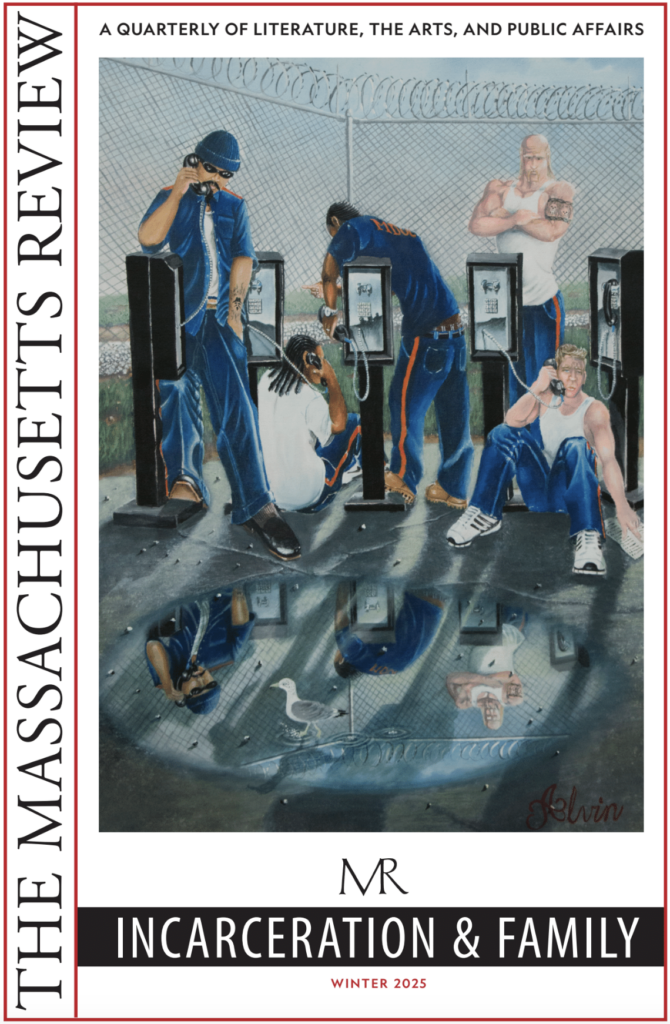
FRONT COVER:
Alvin Smith
Undesirable Water, c. 2015
ACRYLIC ON UNSTRETCHED CANVAS
Table of Contents
Introduction, by Caits Meissner and Nicole Shawan Junior
The Storms, a poem by Zeke Caligiuri
Killing Me, a story by Patty Prewitt
“GUGU,” Lost in the New Jersey Parole System: A Hidden Tragedy of American Injustice, an essay by TariQ MaQbool
Letters for The Apocalypse, a hybrid piece by Susan Li
Thank You, Whoever You Are, a poem by Carl Moore
Annotations of a Love Letter, an essay by LiXin
Still, an essay by Sheree L. Greer
Momma Tried, an essay by J. D. Mathes
Selected Work, art by Alvin Smith
one night outlaw, a poem by Mae Ellen-Marie Wissert
Gotchu, an essay by Zobella Vinik
The Family We Make, an essay by Kwaneta Harris
Shipped, a story by Jackson Herring
Stillness Behind Me Freestyle, a poem by Justin Rovillos Monson
Daylight Radio, a poem by Janice Lobo Sapigao
Traveling Mercies, an essay by Jodi M. Savage
Some Mother’s Darling, an essay by Robbie and Benjamin Frandsen
First Offence, a story by Rachel Allen
Dear Brother, a poem by Jakyra Green
Solitary, an essay by Jianna Heuer
A Conversation in Kites, with Rickey Cummings and Teddrick Batiste
Ikiryō, a hybrid piece by Eric Boyd
Take this Poem As a Gift You May Never Get to Open and Stay Away From the Light, poems by Demetrius Buckley
Lingering Effects, an essay by Dwayne “BIM” Staats
Blood Mother, an essay by Starr Davis
the two who broke my heart, a hybrid piece by Radhiyah Ayobami
“Thanksgiving Isn’t Over Yet,” an essay by Robert Pastore
Maybe to Pin Us to Heaven, a poem by Sylvia Chan
Photo Negative, an essay by Michael Fischer
Notes on Contributors
VOLUME index, VOL. LXVI
Contributors
RACHEL ALLEN lives in the beautiful North Wales countryside with her husband and two young sons. Her work has been published by Grind & Bearing Press, Every Day Fiction, and The Preservation Foundation. She’s rarely without a hot cup of tea, and when she’s not writing you can often find her building train tracks and Lego houses with her children.
RADHIYAH AYOBAMI is Brooklyn-born with Southern roots. Her journey to writing began at the kitchen table listening to her grandmother’s stories. She holds a BA in Africana studies from Brooklyn College, and a MFA in prose from Mills College. She has received awards from the New York Foundation of the Arts and the Sustainable Arts Foundation. She has also received residencies from the Atlantic Center for the Arts and International Literary Seminars (Kenya). She was the 2024 Talk of the Town Resident Artist with El Museo and the NYC Mayor’s Office of Immigrant Affairs. Some of her most enjoyable work has been facilitating creative arts sessions in schools and community centers across NYC. Her free time is spent unrolling her yoga mat in random locations and cheering at her son’s basketball games. She is a writer in residence at the Children’s Art Carnival in Harlem and author of The Long Amen.
TEDDRICK BATISTE says: “I lost my freedom young, a victim of circumstance and the streets that raised me. Gifted but neglected, taught pain more than peace, my path was shaped by what my uncles knew and what love couldn’t save. Though the street life claimed years of me, over fifteen years later I rose—a conscious man, a street poet, an urban activist. From pain, I found purpose. Today I’m the published author of Ocean Deep, using my peace to reach the broken raised by the broken. All I simply want to do is help somebody not make the same mistakes that I made and show them how easily an unconscious bias can create the path of those mistakes. A strong man once a hurt boy, I now give my son what I never had: hope.”
ERIC BOYD’s work has appeared in The Rose Books Reader, HAD, and Guernica, as well as the anthologies Prison Noir (Akashic Books) and Words Without Walls (Trinity University). He is a winner of the Foundry Prize in Fiction and a PEN Prison Writing Award. Boyd edited The Pittsburgh Anthology (Belt Publishing) and is currently working on a novel about train hoppers. His website is Eric-Boyd.com
DEMETRIUS “MEECH” BUCKLEY has earned multiple writing honors, including a 2024 Editor’s Choice Award in CRAFT literary magazine’s Memoir Excerpt & Essay Contest and the 2021 Toi Derricotte & Cornelius Eady Chapbook prize. He was finalist for the 2024 Rattle Poetry Prize. Buckley’s work has appeared in or is forthcoming from The Yale Review, The Boulevard, The Rumpus, PRISM, The Progressive, and ResentencingNow, among other outlets. He has performed his work at the Brooklyn Museum. Buckley is also an editor for Apogee literary magazine’s “Freedom Meridian,” and he works with Look2Justice and Empowerment Avenue. He is currently hopeful.
ZEKE CALIGIURI is a writer and organizer from South Minneapolis. He is the author of This Is Where I Am (University of Minnesota Press), a finalist for the Minnesota Book Award. He has won multiple awards through the PEN Prison Writing Contest and is the co-founder of the Stillwater Writer’s Collective, the first all-prisoner-created-and-facilitated collective in the country. He is a contributor to The Sentences That Create Us: Crafting a Writer’s Life in Prison, School, Not Jail: How Educators Can Disrupt School Pushout and Mass Incarceration, and American Precariat: Parables of Exclusion (Coffee House Press, 2023), the last of which he also edited. His fiction was anthologized in Prison Noir, edited by Joyce Carol Oates. He is directly impacted by over two decades of incarceration. Currently, he is helping build the Re-Enfranchised Coalition, empowering system-impacted people and reinvesting in the humanization of those still stuck within the captivity business. He was recently named as a 2024 Writing Freedom Fellow through Haymarket Books.
SYLVIA CHAN is an amputee-cyborg writer, educator, activist, and author of We Remain Traditional (Center for Literary Publishing). Her poetry and essays appear in Poetry, Zócalo Public Square, The Cincinnati Review, and The Best American Nonrequired Reading, among others, and have been named National Poetry Series finalist and Best American Essays Notable. Chan has received fellowships and support from the Poetry Foundation, Zoeglossia, Roots.Wounds.Words., Bolt Cutters, and The Center for Art and Advocacy’s Right of Return. She lives in Tucson, where she works with crossover and foster youth, and writers who have been impacted by the criminal justice system.
RICKEY CUMMINGS is a father, son, brother, and friend whose life is a testament to the power of transformation. After being wrongfully convicted and sentenced to death, he embarked on a transformative journey that enabled him to break free from the internal bondage of his past and to find a higher purpose in helping others. Now a published author, artist, and dedicated advocate for personal growth, Rickey uses his own story to empower at-risk youth and to help eradicate the preconceived notions about who is on death row. As a mentor and guide, he works tirelessly to help others to overcome their circumstances and discover their own paths to healing and freedom while, simultaneously, vigorously doing all he can to save his life. His book, Holding Vigil, can be found at www.ThickPress.com. To learn more about his plight, and to see some of his art, please visit: www.iamrickeycummings.com.
STARR DAVIS is the author of the debut poetry collection Affidavit (Hanging Loose Press, 2025) and winner of the Autumn House Nonfiction Prize for her forthcoming memoir, I Am Mostly Bad Blood (2026). She teaches poetry with Brooklyn Poets, edits nonfiction at TriQuarterly, is a Visions After Violence Fellow with the After Violence Project, and lives in Houston, Texas.
MICHAEL FISCHER is a nonfiction writer, storyteller, and senior manager at Jobs for the Future’s Center for Justice & Economic Advancement. He also conducts writing and storytelling workshops for various organizations, including AIDS Foundation Chicago. Michael is a fellow of Haymarket Books Writing Freedom, Right of Return USA, Illinois Humanities Envisioning Justice, Luminarts Cultural Foundation, the Patricia Valian Reser Center for the Creative Arts, and the Education Trust Justice Fellows Policy Program. His writing—which has been cited as notable in Best American Essays and won the National Systems Impacted Writers’ Contest, among other honors—appears in The New York Times, Salon, The Sun, Lit Hub, Guernica, Orion, The Rumpus, Brevity, River Teeth, and elsewhere. Michael is also a Moth StorySLAM winner. He holds an MFA in creative writing from the University of Nevada, Reno and an MA in humanities from the University of Chicago, where he was awarded a Grauman Fellowship.
BENJAMIN FRANDSEN is a writer, educator, public speaker, and the founder and executive director of the Ben Free Project. After spending eighteen years in prison for a murder he did not commit, Benjamin turned to writing and education as acts of survival and transformation. While inside, he earned nine associate’s degrees and served as a literacy tutor for students in college, GED, and ESL classes. Upon release, Ben began hosting his show, the Ben Free Podcast, and was accepted into UCLA, where he graduated with honors in English. His poetry has appeared in Iconoclast, PEN’s World Voices Festival, and on the TEDx stage. He is now pursuing his MFA in creative writing at San Diego State University, where he also serves as a teaching associate and mentor in the Rhetoric and Writing Studies program. His publications include work in Columbia University’s exCHANGE magazine, PEN America, Open Campus, UCLA Magazine, the Prison Journalism Project, and the Vera Institute of Justice.
ROBBIE FRANDSEN (1952–2013) was a writer, scholar, and advocate whose life embodied resilience and transformation. After graduating with high honors from USC in Urban Sociology & the Study of the City and earning a Master of Public Administration with high honors from Harvard’s Kennedy School, she became recognized as a leading voice on recidivism, publishing work in the Los Angeles Times and the Boston Globe. In 2005, she was awarded the PEN USA Emerging Voices Fellowship for her memoir in progress, Some Mother’s Darling. That manuscript told the story of her journey standing by her only son as he battled the criminal justice system. Robbie worked on the book until her death from cancer in 2013. Before she died, she made Benjamin promise to finish her book and bring it to the world.
JAKYRA GREEN (she/her) grew up in Elkhart, IN, and graduated from Goshen College with majors in English and education. Her poetry is shaped by her lived experiences in all its joys and challenges. She was named Poet of the Month in June 2022 by PAN-O-PLY Magazine, and her poem “The Sistine Chapel Took Four Years to Complete” appeared in Broadside Publishing.
SHEREE L. GREER is a writer living in Tampa, Florida. The founding director of Kitchen Table Literary Arts, she is the author of two novels, Let the Lover Be and A Return to Arms, and the short story collection Once and Future Lovers. Her nonfiction work has been nominated for Pushcart Prizes and notably named in Best American Essays 2019. As a member of southern arts collective The Rubber Bands, Sheree also curates an annual arts exhibition at the intersection of visual, performing, and literary art.
KWANETA HARRIS is a former nurse, business owner, and expat, now an incarcerated journalist and Haymarket Writing Freedom Fellow. In her writing, she illuminates how the experience of being incarcerated in the largest state prison in Texas is vastly different for women in ways that directly map onto a culture rooted in misogyny. Her stories expose how the intersection of gender, race, and place contribute to state-sanctioned, gender-based violence. Harris’s writings have appeared in a wide range of publications, including Solitary Watch, Cosmopolitan, Rolling Stone, The Marshall Project, Scalawag, Prism, the Appeal, and Teen Vogue, among others. She writes on Substack at “Write or Die.”
JACKSON HERRING is a thirty-three-year-old currently serving time in a state prison in the United States. His struggles with depression at a very young age and a traumatic life-altering injury as a young man led to him becoming a victim of the national opioid epidemic, which he, along with thousands of others, suffered through unnecessarily and ultimately led to his incarceration. In no way does this reflect or define who he is today. Jackson appreciates the exposure, growth, and adventure he has experienced through access to literature. His stories have been published in The Main Street Rag, Down in the Dirt, and Café Irreal. He has poetry forthcoming by Vine Leaves Press. Jackson is grateful for the introduction to computer programming through The Last Mile program, where he discovered his own aptitude and enthusiasm for a profession he now wants to pursue after his release from incarceration. Jackson has hope for his future.
JIANNA HEUER is a psychotherapist in New York City. She writes nonfiction and fiction. Her work has appeared in The Hooghly Review, Months to Years, The Inquisitive Eater, and other literary journals. Her flash non-fiction has appeared in two books, Fast Funny Women and Fast Fierce Women. Check out more of her work here: www.jiannaheuerwrites.com.
SUSAN LI is a writer based in Brooklyn, New York. She loves radical history, community-run libraries, poetry, local organizing, and walking in the woods. She believes in a world in which life is precious.
LIXIN is a Chinese-American memoirist whose work explores love, ambiguous loss, and socially engaged Buddhist practices to transmute suffering. Her interest in these themes stemmed from her early work in human rights, where she led oral history interviews with Holocaust survivors, their descendants, and displaced communities in Jordan, France, Nepal, and Chile. She is at work on a memoir—a lyrical record of the letters she exchanged with her immigrant mother, who was an incarcerated firefighter in Los Angeles County. A Tin House 2023 alumna, she is also a 2024 Periplus Fellow and 2024 Aspen Words Emerging Writer Fellow through the Aspen Institute. She can be found on Instagram @lixin.writes.
TARIQ MAQBOOL is a consultant and a correspondent for the Prison Journalism Project. His work has been published in Al-Jazeera English, Rolling Stone, The Marshall Project, The Star-Ledger, Slant’d, The Progressive Magazine, and many other platforms. He maintains the website Captivevoices.com to share his and other incarcerated writers’ writings. MaQbool is currently incarcerated at New Jersey State Prison. He maintains his innocence. TariQ’s life story has been extensively covered by journalist Jack Laurence in his podcast One Minute Remaining.
J. D. MATHES grew up a feral child in the deserts of the American Southwest who loved to read library books. He is a PEN America Writing for Justice Fellow, the result of which is Of Time and Punishment: A Memoir, forthcoming October 28, 2025. Other books of his include Ahead of the Flaming Front: A Life on Fire, an essay collection Fever and Guts: A Symphony, The Journal West: Poems, and Shipwrecks and Other Stories. Among things he’s done to support his writing and two daughters have been a wildland firefighter on a helicopter-rappel crew, oilfield chemist, and logistics at Amundsen-Scott South Pole Station, Antarctica, where he led the Southernmost Writers Workshop in the World. www.jdmathes.com
JUSTIN ROVILLOS MONSON is a Filipino-American writer and author of the book AMERICAN INMATE (Haymarket Books), which won the 2025 Midwest Book Award for a debut poetry collection. He was an inaugural PEN America Writing for Justice fellow and a recipient of the Kundiman/Asian American Literary Review/Smithsonian Asian Pacific American Center A Lettre Mentorship in poetry. His work has appeared in POETRY, The Rumpus, The Nation, and elsewhere. He is currently serving a sentence in the Michigan Department of Corrections, from which he hopes to be released in 2027.
CARL MOORE was stolen from a lab and raised in the forests of Tennessee by gnome ninjas . . . He was captured in 2003 and has spent the last twenty-two years in prison, tryna get his mind right. His goal is to be the best son, father, brother, husband, and neighbor he can be. He would like to thank Allah, Cliff Krcha, Durlands library, Carl, Yvette, Storm, Lisa, Sylvia, Helen, Lynn, and Kim: “I am who I am, because y’all loved me.”
ROBERT PASTORE is an incarcerated writer interested in illuminating issues within the carceral space. His writing has previously appeared in Defector, TruthOut, Prism Reports, and the Prison Journalism Project. You can find more of his work on Substack. He is from the Bronx, NY.
PATTY PREWITT served nearly forty years in prison wrongfully. Her sentence was commuted on December 20, 2024, and she was freed to return to her family. In May her first memoir, Trying to Catch Lightning in a Jar, was published by Some People Press and is available on Amazon and as an ebook. Currently she’s a student at Washington University Saint Louis and will earn her BS in December.
JANICE LOBO SAPIGAO (she/her) is a Filipina American poet, writer, and community college educator from the San Francisco Bay Area (unceded Ohlone land). She co-created the Teach Palestine Speaker Series at Skyline College, which highlights the history and experiences of SWANA (South West Asia North Africa) communities within the United States and in a global context, and advocates for a Free Palestine. She authored the poetry collections like a solid to a shadow (Nightboat Books) and microchips for millions (PAWA, Inc.), along with two other chapbooks. She is working on a novel and a nonfiction manuscript on Philippine American archives.
JODI M. SAVAGE is the author of The Death of a Jaybird: Essays on Mothers and Daughters and the Things They Leave Behind. Her essays have appeared in The Offing, Oprah Daily, HuffPost, Kweli Journal, Catapult, and other publications. Jodi is a three-time Pushcart Prize nominee, and her essays have also been nominated for Best of the Net and listed as a notable essay in The Best American Essays 2019. She also obtained her MFA in creative nonfiction from New York University, where she was a Goldwater Fellow and facilitated poetry workshops for patients at Roosevelt Island’s Coler-Goldwater Hospital.
DWAYNE “BIM” STAATS is the founder of Believing in Myself, LLC, and the co-founder of Rebellious Hearts, which is a movement for liberation built upon revolutionary, matriarchal, abolitionist, and Black power principles. He is the self-published author of Vaughn 17 Speaks and Rebellious Hearts: When Forced Into a Corner, They Attack. You can write to him at Dwayne Staats 467005, James T. Vaughn Correctional Center–1101, P.O. Box 777, Las Vegas NV 89193 or follow him on Instagram @bim_21_. View active petition at https://www.change.org/p/free-bim
ZOBELLA VINIK (they/she) is an emerging writer from the Sonoran Desert. A survivor of solitary confinement, they organized for access to sunlight while incarcerated, advocating alongside women denied it for over a year. Recently released, she looks forward to engaging in work that centers the queer, trans, and nonbinary people impacted by the sex offense legal regime—honoring the complexity of those who have lived through harm, caused harm, or both—and the trauma carried by their loved ones. She is committed to restorative and transformative justice practices. This is their second publication, following a letter to the editor in The New Yorker. They are sustained by therapy, community, and their dog, Charlie.
Originally from Idaho, MAE ELLEN-MARIE WISSERT is currently an MFA student of poetry at the University of Mississippi. Her poetry is published in West Trade Review and is forthcoming in North American Review. She can be contacted through her email, mewisser@go.olemiss.edu.