


Volume 67, Issue 1
SPRING 2026 ISN’T AN EASY READ, but given the times in which we are living, it shouldn’t be. Regarding “The First Spring,” Emma De Lisle’s speaker opens, “It hurt,” while Jacques J. Rancourt’s “Five Wounds” concludes, “I let that hurt suspend me.” The Marxist philosopher, literary critic, and beloved teacher Fredric Jameson, who departed this world a little over a year ago, said that “history is what hurts.” Here, Charlie Clark’s speaker adds: “Hurt is hard and does not translate well / But let me try.”
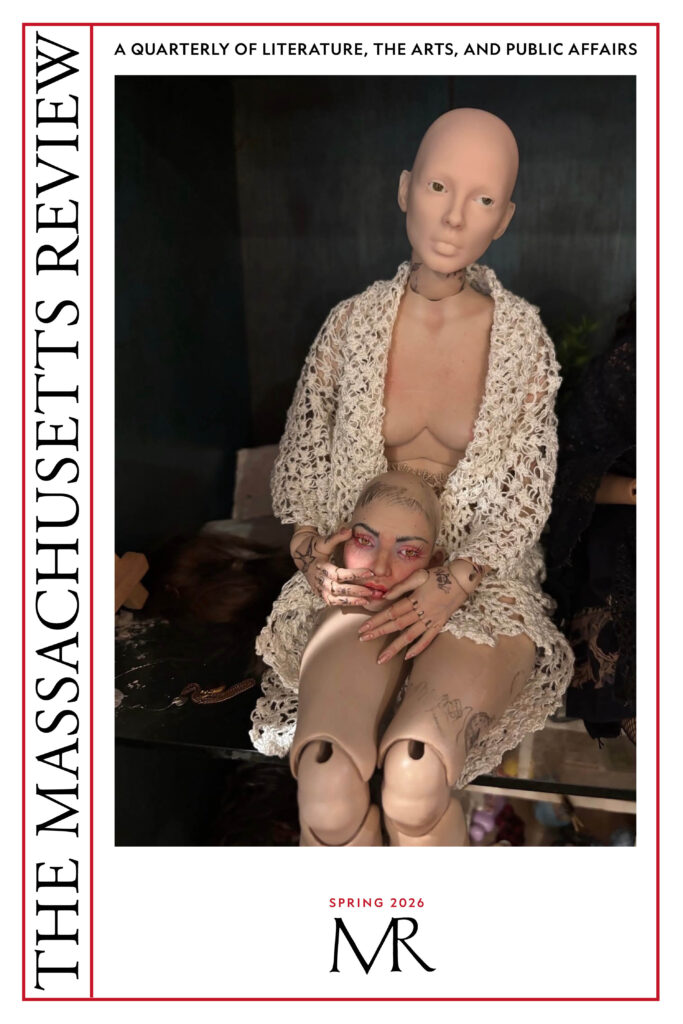
If this is an issue that heralds spring, it understands that beginnings can only be midwifed—painfully, haltingly, sometimes glacially slow—from deep and honest reckonings with loss. It also reckons with how—from beloved authors to loved ones taken too soon—the dead never truly leave us. Hassan Herzallah’s on-the-ground report from Palestine shares how people insist on sanctifying bonds of love amid an ongoing genocide and a fictional ceasefire while a short story by L. F. Khouri registers the interpersonal violence of settler colonial ideologies and Zionist masculinities in places that may seem far from Palestine but are central to imperialism’s global death cult. A moving personal narrative by Valeria Belardelli reflects on the loss of one of her twin daughters during birth, a reminder that gestation and birth can also beget devastating losses. Artist Jennifer Strings’s gorgeously morbid interiors and haunting embodi-ments are a fitting frame for this issue’s collective grieving for both the dead and the living.
While war, genocide, and crony capitalism rage outside, the contributions to this issue refuse the divide between the public and private, showing how man-made catastrophes shape our most intimate realities. But the good news is that if it’s true that structural violence goes all the way down, affecting us even at a cellular level, then this is also a profound opportunity. Even a poem can be an opening. Take Lucille Clifton’s “The Lost Baby Poem,” published in MR in 1971, a humble, three-stanza elegy for a baby who could not be because of the way the world was, and is: “you would have been born into winter / in the year of the disconnected gas /and no car.” The poem closes with this lamentation and promise: “if I am ever less than a mountain / for your definite brothers and sisters / let the rivers pour over my head / let the sea take me for a spiller / of seas let black men call me stranger / always for your never named sake.” Clifton’s “The Lost Baby Poem” is one of many abortion poems written by Black women poets in pre-Roe America, including Gwendolyn Brooks’s “the mother” (“you remember the children you got that you did not get”) and, decades earlier, Georgia Douglas Johnson’s “Black Woman” (“Do not knock at my door, little child / I cannot let you in”). Looking back at these works from the vantage of a now post-Roe America is nothing short of surreal. Our only way forward may be to look back, tenderly and bravely, and to join hands with the ghosts, the ancestors, the stillborn, and the “never named sake[d]” that Clifton memorializes in her poem.
Britt Rusert
for the editors
Table of Contents
INTRODUCTION
FIVE WOUNDS, a poem by Jacques J. Rancourt
THREE TRYERS, a story by Siamak Vossoughi
2. and 3., poems by Souri Ahmadlou,
translated by Morteza Dehghani
IS THERE LOVE IN GAZA?, an essay by Hassan Herzallah
GO AHEAD, PINCH ME, a story by L. F. Khouri
BULBUL, a story by Suhbat Aflatuni,
translated by Sabrina Jaszi
PERAMBULATION, a poem by Stella Wong
NUDE IV, a poem by Shira Erlichman
THE SCIENCE COLLEGE, a story by S. M. Sukardi
WHAT’S GOING TO HAPPEN, a poem by Lisa Bellamy
DAUGHTERS, PLURAL, a story by Valeria Belardelli
YOUR DAD IS JUST SOME GUY, a poem by Mimi Yang
WINDOW and OLD TEMPLE 2, poems by Cho Ji Hoon,
translated by Sekyo Nam Haines
THE FIRST SPRING, a poem by Emma De Lisle
THE SEVEN HABITS OF HIGHLY EFFECTIVE PEOPLE, a story by Jess Row
FILLERS, a poem by Carlos Andrés Gómez
REDACTOR’S LOVE SONG and DICTIONARY WRITER
ON TRIAL FOR “WRECKING THE LANGUAGE,” MOSCOW, 1933, poems by Charlie Clark
SELECTED WORK, art by Jennifer Strings
GO BACK HOME, a poem by Hendri Yulius Wijaya,
translated by Edward Gunawan
LET’S SING GHAZALS AT NIGHT, a story by Abhishek Sengupta
GERTRUDE SAID IT TAKES A LOT OF TIME, a poem by Joseph J. Capista
SCENE and SELF SOMETHING, poems by Carolyn Guinzio
POEM PENETRATED BY DEREK JARMAN, a poem by Tyler Patton
OBSOLETE CURRENCY, a poem by Dan Pinkerton
PREPARATION, a story by Ge Fang
SETTING THE FEATURES, a story by Dan Shields
NOTES ON CONTRIBUTORS
Contributors
SUHBAT AFLATUNI (Evgeny Abdullaev) is a writer, translator, and scholar born in Tashkent, Uzbekistan, in 1971. He is the author of three books of poetry, seven novels, and a short story collection, and a winner of the Yasnaya Polyana Literary Prize, the Oktiabr Magazine Award, the Russian “Premiia” prize, and the Triumph Prize. He serves on the editorial boards of the literary magazines Zvezda Vostoka and Druzhba Narodov. In the first decade of Uzbek independence he helped to found the “Tashkent School,” a movement of writers asserting poetic difference from Russia within the Russian language. His poems and stories have been translated into English, French, Korean, and Polish. He lives in Tashkent.
SOURI AHMADLOU is an Iranian poet whose work has been published widely in Iran. She is currently a staff writer for Jahan-e Ketab—a national magazine that publishes book reviews—and continues to contribute to literary magazines. Ahmadlou’s first collection of poems, The Cherry Ladder Does Not Turn the Moon Red, was published in 2007 by Ahang-e Digar Press. Her second collection, A Stone for a Game of Seven- Stones, was published by the Morvārid Press in 2020. Ahmadlou’s poems, in English translation, have appeared in Poetry Northwest, The Kenyon Review, and Michigan Quarterly Review.
VALERIA BELARDELLI is a writer and playwright from Rome. In 2022 one of her plays, written with playwright and director Francesca Caprioli, was selected for Playground, in collaboration with the Royal Court Theatre. Her works appeared in some Italian newspapers and magazines, such as Pastrengo and Il Foglio. She now lives in Siena, Tuscany.
LISA BELLAMY studied with Philip Schultz at The Writers Studio, where she teaches. Bellamy is the author of The Northway and Nectar, a chapbook, and has received two Pushcart Prizes and a Fugue Poetry Prize. A new chapbook and new collection are forthcoming in 2026 and 2027. She graduated from Princeton, lives in New Jersey and the Adirondack Park, and works as a researcher for an international nonprofit.
JOSEPH J. CAPISTA is the author of Intrusive Beauty (Ohio University Press). His poems have appeared in Agni, Copper Nickel, The Georgia Review, Ploughshares, and Poetry Daily. He teaches at Towson University and lives with his family in Baltimore.
CHARLIE CLARK studied poetry at the University of Maryland. He is the author of The Newest Employee of the Museum of Ruin (Four Way Books). He lives in Austin, TX.
MORTEZA DEHGHANI is a poet and literary translator. His translations have appeared in Michigan Quarterly Review, Poetry Northwest, and The Kenyon Review, and his poetry has been shortlisted for the Malahat Review Open Season Awards and Long Poem Prize. Morteza is currently an MFA student in creative writing with a focus on poetry.
EMMA DE LISLE lives in Western Massachusetts. Her most recent poems are out or forthcoming in, among others, 32 Poems, Image, Lana Turner, The Missouri Review, and West Branch. Currently, she serves as co-editor-in-chief of Mark.
Writer, visual artist, and musician SHIRA ERLICHMAN is the author of Odes to Lithium, which won the Publishing Triangle’s Audre Lorde Award for Lesbian Poetry, and is the writer-illustrator of the picture book Be/Hold: A Friendship Book. Her work has been featured in The New York Times, The Seattle Times, The Huffington Post, The Nation, and PBS, among others. A finalist for the Lambda award and a recipient of a MacDowell Fellowship, she runs In Surreal Life: an Online Global Creativity School and is a visiting professor in the Randolph College Low-Residency MFA. She lives in Brooklyn with her wife.
GE FANG is a writer from Xi’an, China. Her work appears or is forthcoming in Epoch and Waxwing, and she has been a finalist for the Disquiet Literary Prize. She lives in Southern California.
CARLOS ANDRÉS GÓMEZ is a Colombian American poet from New York City. His poetry collection Fractures (University of Wisconsin Press) was selected by Pulitzer Prize winner and 19th U.S. Poet Laureate Natasha Trethewey as the winner of the Felix Pollak Prize. Winner of the Foreword INDIES Gold Medal and the International Book Award for Poetry, Gómez has been published in The Nation, New England Review, Academy of American Poets’ Poem-a- Day series, The Yale Review, BuzzFeed Reader, Poetry Unbound: 50 Poems to Open Your World (W. W. Norton & Co.), and elsewhere. Carlos is a graduate of the University of Pennsylvania and the MFA Program for Writers at Warren Wilson College.
CAROLYN GUINZIO’s eighth book is Cameo Blue (Carnegie Mellon). Earlier books include A Vertigo Book (The Word Works) and Meanwhile in Arkansas (2025), winner of the Quarterly West Chapbook Prize. She is the 2025 recipient of The Porter Prize, given to an Arkansas writer.
EDWARD GUNAWAN is a queer Indonesian-born Chinese writer and literary translator based in the San Francisco Bay Area. Recipient of the Lunch Ticket’s Gabo Prize in Literary Translation and Multilingual Texts, Edward has authored two chapbooks—including the Start a Riot! Prize–winning The Way Back (Foglifter Press). They earned their creative writing MFA from San Francisco State University, where they received a Distinguished Graduate Achievement Award. Their work has appeared in Asymptote, Words Without Borders, and MAYDAY, among others. They will make their full-length translation debut with Wijaya’s Stonewall Tak Mampir di Atlantis (There’s No Stonewall in Atlantis), forthcoming from Circumference Books.
SEKYO NAM HAINES is a poet and translator from Cambridge, MA. Her translation Bitter Seasons’ Whip: The Complete Poems of Lee Yuk Sa was published in 2022 (Tolsun Books). Her poems appeared in Constellations, Off the Coast, Lily Poetry Review, and elsewhere. Her translations of Kim Sowohl’s poetry appeared in The Harvard Review, The Brooklyn Rail: In Translation, Ezra, and Circumference. Her translations of Cho Ji Hoon appeared in many literary journals including Asymptote’s Translation Tuesday blog, The Tampa Review, Guernica Magazine, Hayden’s Ferry Review, Common, Rhino, LIT Magazine, Los Angeles Review, Chicago Quarterly Review, and Gulf Coast Journal.
HASSAN HERZALLAH is a Gaza-based translator, writer, and storyteller currently in his fourth year studying English translation. His work covering life under siege, displacement, and daily struggles in Gaza has been published by the London Review of Books, New Lines, The Massachusetts Review, Prism, Mondoweiss, and many other international outlets, and translated into more than seven languages.
Born in 1920, CHO JI HOON is a canonical poet of modern Korea and a renowned scholar of Korean aesthetics, culture, and history. In 1939, Cho Ji Hoon’s first poem appeared in the literary magazine Moon-Jang. In 1946, his poetry appeared in the collection Cheongnok Jip (청록집) along with the works of Park Mokwohl and Pak Doo Zin. The three were known as “Cheongnokpa,” or the “Green Deer Poets.” A professor of Korean language and literature at Korea University for twenty years, Cho Ji Hoon served as the president of the Korean cultural society affiliated with the university and president of the Korean poet’s association. He died in 1968.
SABRINA JASZI is a translator, editor, and writer in California. Her translation with Roman Ivashkiv of Andriy Sodomora’s The Tears and Smiles of Things (Academic Studies Press) won the American Association for Ukrainian Studies’ Translation Prize. Her work has been published by the New York Review of Books, The Paris Review, The Dial, AGNI, and others. Translating from Uzbek, Ukrainian, and Russian, she is a founding member of the Turkoslavia translation collective and journal.
L. F. KHOURI is a Palestinian writer whose work explores war, memory, and the inheritance of silence. His creative work has appeared or is forthcoming in such literary journals as Alaska Quarterly Review, The Adroit Journal, The Offing, SmokeLong Quarterly, Vestal Review, Chestnut Review, Another Chicago Magazine, and elsewhere.
TYLER PATTON is a fiction writer and poet from Portland, Oregon. He has received support from the Voices of Our Nation Arts Foundation fellowship and the Fine Arts Work Center. He was the 2024 recipient of the queer writer fellowship from the Martha’s Vineyard Institute of Creative Writing. He is the former fiction editor of Indiana Review and received his MFA at Indiana University. His work can be found in The Baltimore Review and &Change.
DAN PINKERTON lives in Urbandale, Iowa. Poems and stories of his have recently appeared or are forthcoming in The Pinch, The Broadkill Review, Denver Quarterly, River Styx, Moon City Review, Nine Mile, and descant. Dan’s first book of poetry is Democracy of Noise.
JACQUES J. RANCOURT is the author of two books, Brocken Spectre (Alice James Books) and Novena (Pleiades Press), as well as a chapbook, In the Time of PrEP (Beloit Poetry Journal). A recipient of fellowships from the National Endowment for the Arts, the Wisconsin Institute for Creative Writing, and a Wallace Stegner Fellowship from Stanford University, he lives and teaches in San Francisco.
JESS ROW’s new collection of short stories, Storyknife, will be published by Ecco in summer 2026. His previous books include the novels Your Face in Mine and The New Earth and the essay collection White Flights: Race, Fiction, and the American Imagination.
ABHISHEK SENGUPTA is imaginary. Or he is stuck inside a window in Kolkata, India, writing magical realism novels. Same difference. His stories have appeared in The Adroit Journal, The Forge Literary, and elsewhere around the globe, featured in Best Small Fictions, won the Bristol Short Story Prize, and can travel seamlessly through walls.
DAN SHIELDS’s work has appeared in The Normal School, Cleaver, ANMLY, New Delta Review, and others. He is an alumnus of the Kenyon Review Writers Workshop.
JENNIFER STRINGS is multimedia artist Jennifer O’Connell. She works under the artist names Known As Myself and Jennifer Strings. She lives and works in NYC.
S. M. SUKARDI is a writer, essayist, and occasional critic from Southern California. They are at work on a novel.
SIAMAK VOSSOUGHi is a writer living in Seattle. He has had stories published in Kenyon Review, Missouri Review, Idaho Review, Bennington Review, Gulf Coast, and Copper Nickel. His first collection, Better Than War, received a 2014 Flannery O’Connor Award for Short Fiction and his second collection, A Sense of the Whole, received the 2019 Orison Fiction Prize. His third collection, The Friend Seekers, will be published in 2026.
HENDRI YULIUS WIJAYA is an Indonesian writer and poet. The author of Intimate Assemblages: The Politics of Queer Identities and Sexualities in Indonesia (Palgrave Macmillan) and the co-editor of Queer Southeast Asia (Routledge), he has published his essays and poems in international journals and media outlets, including The Jakarta Post, Art & Market, Social Text, The Margins, and Esquire. In recognition of his long-term engagement with gender, sexuality, and sustainability issues, he delivered the 2023 Tomlinson Memorial Lecture at the University of Nottingham in the UK. An English translation of Wijaya’s debut full-length poetry collection, Stonewall Tak Mampir di Atlantis (There’s No Stonewall in Atlantis), translated by Edward Gunawan, is forthcoming by Circumference Books.
STELLA WONG is the author of STEM (Princeton University Press) and SPOOKS (winner of the Saturnalia Books Editors Prize). A graduate of Harvard, the Iowa Writers’ Workshop, and Columbia, Wong’s poems have appeared in POETRY, American Poetry Review, and The New Republic. She is an electrical and computer engineering PhD student.
MIMI YANG / 杨月潇 is a poet, graphic designer, and organizer from Shanghai, though they are currently studying in Rhode Island. They are a Best of the Net and Forward Poetry Prize Nominee, and their poems appear or are forthcoming in Palette Poetry, ANMLY, Booth Journal, Cream City Review, and more.