
What Must Be Forgotten…

The introductory chapter to Priscilla Hayner’s comparative study of truth commissions begins simply and dramatically. The author quotes an exchange with a Rwandan government officer, the sole survivor from his immediate family. One out of seventeen. The occasion for their conversation was a visit to the church at Nyarubuye, a scene of slaughter where the bodies of victims had been left as memorial to the carnage. Little more than one year after the genocide, which killed some 800,000 Rwandans, her interviewee comments, “With each day, we are able to forget more.”
Somewhat confused, it seems, by his palpable relief, Hayner responds with a short question, cutting directly to the heart of the matter – and this is true whether we speak of the people of Rwanda, or of those in the U.S., a decade after 9/11, or of the citizens of Sarajevo, Bosnia-Herzegovina, where today I write these lines. “Do you want to remember, or to forget?” A simple question, though one which requires a nuanced answer.
The immediate occasion for my own visit, to Sarajevo, was celebratory – the wedding three days ago of a friend and former student. As it happened, at the U.S. Embassy that day, our flag was lowered to half-mast in preparation for the 9/11 anniversary. A decade earlier, in early September, the new bride had just arrived in the U.S., to attend a one-year program of studies at Smith College. And now, after years working for the international agency responsible for supervising her country’s peace accords, she has married another citizen of her country, and will soon move to Chicago, joining her husband and thousands of other compatriots already resident in that city, a major site of the Bosnian postwar diaspora.
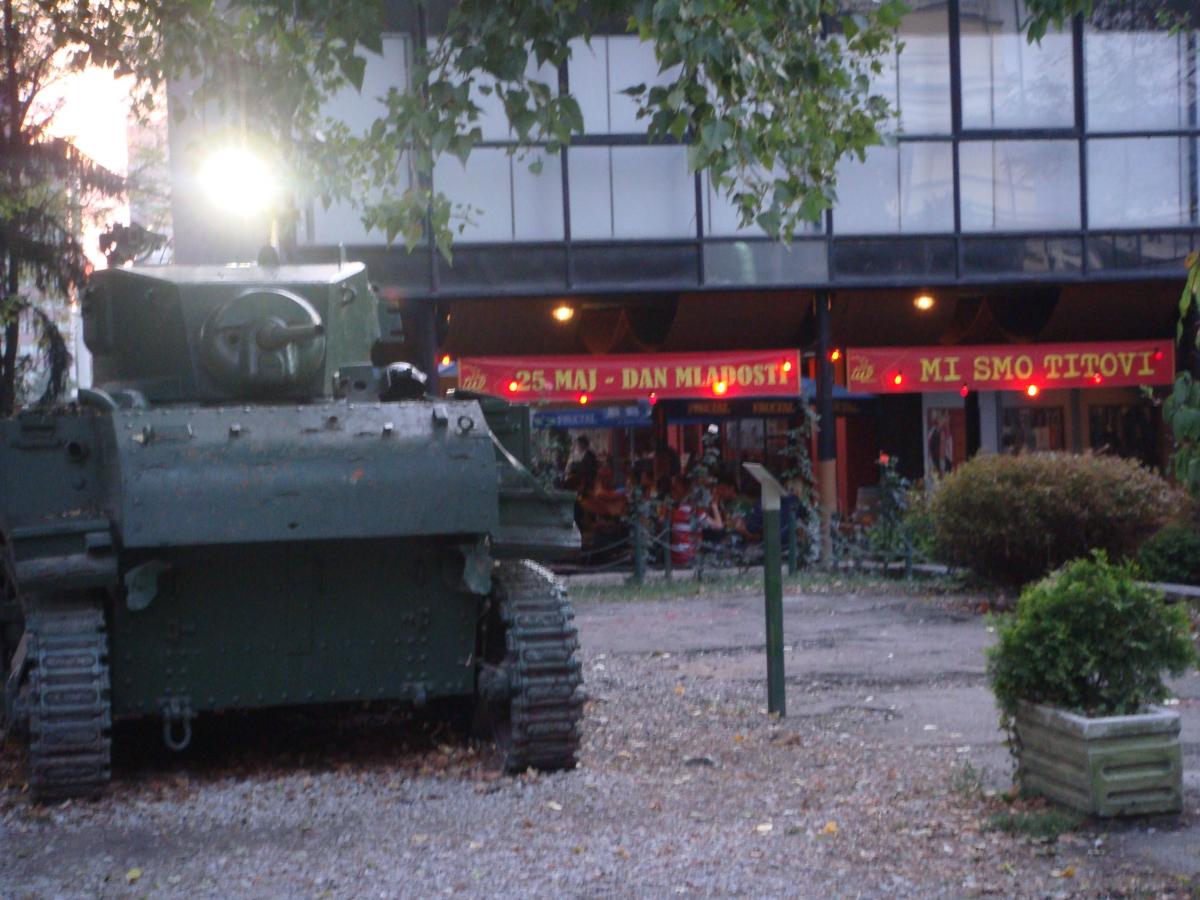
Things change, the world moves on … that seems clear enough. Yet, since I’m sitting here at Sarajevo’s Tito Café, I can’t resist mentioning the internet password: “Neretva1943” – an allusion to the failed German offensive against Tito’s partisans. The capacity for self-deflating irony seems to me a fair measure of national health.
In short, we surely must both remember and forget. This, in point of fact, is precisely what Hayner’s government official understands – in a way more intimate than the rest of us can possibly imagine. “We must remember what happened in order to keep it from happening again,” he tells us, “But we must forget the feelings, the emotions, that go with it. It is only by forgetting that we are able to go on.”
Trauma, neuroscience tells us, is where just the opposite happens. Rather than fade with time, emotion recurs, eternally, in a nightmarish present. “In all my dreams, before my helpless sight / He plunges at me, guttering, choking, drowning.” Thus Wilfred Owen, in one of the classic war poems ever written.
A response where reason is buried and horror remains fresh leaves us, individually and as a nation, susceptible, even subjugated, to whomever promises to deliver us from fear. In the U.S., there has lately been much talk of moving on, and of memory, but much less parsing of what truly needs to be remembered, and what must be forgotten.
To that end, here’s a joke from the 1992-95 war in Bosnia – a lesson for today from Sarajevo. A spaceship, piloted by a Serb, carries a three-man landing party from the former Yugoslavia to the moon. The first to set foot on the lunar landscape is a Croat, who immediately plants a flag and claims the moon as Croatian territory. Following him a Bosnian Muslim climbs down the ladder. He also plants a flag, though it isn’t clear whether he claims the moon for his people or for his country. The last out of the spaceship is the Serbian member of the landing party. Just as he touches the lunar soil, the Serbian pilot takes out a gun and kills him. The other two astronauts are baffled, and ask why he suddenly decided to kill one of his own. The reply? “Wherever a Serb is buried, is Serbia.”
Today, Monday, September 12th, I walked by the U.S. Embassy again. The flag had been returned to its full height, and the diplomacy of our nation was proceeding normally. As it should.