
“Tatreez, Taught” التطريز , مُدرَّس
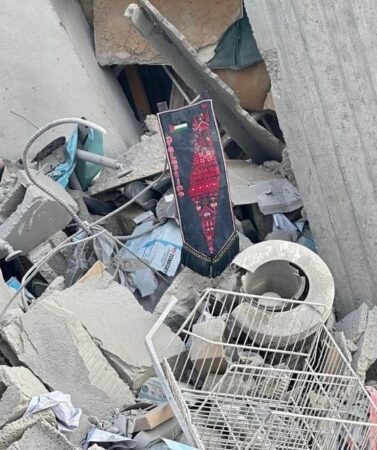
Reproduced with permission of Kenar Embroidery.
During the genocide of Gaza beginning in 2023, the destruction extended beyond lives, land, and buildings into art, culture, heritage and memory. One day, I saw a picture of a Tatreez piece lying above the rubble, it was a stitched map of Palestine. The red threads were still intact, while everything else around it was destroyed. My first thought went to the woman who made this piece: how many hours did she spend stitching? Why did she make it? Was it a gift, or did she make it for herself? I wanted to know the story behind this piece, but it had been lost.[1]
Tatreez is the Palestinian art of embroidery. For centuries, Palestinian women stitched on their clothes, reflecting their personal narratives and connection to the land. Each pattern on a woman’s thob, the traditional Palestinian dress, carried meanings tied to a specific region and social experience. The coffee bean from Gaza represents one of the central customs of Palestinian hospitality; Ramallah’s kohl pot memorializes an ancient beauty ritual. Colors were chosen to reflect age or status: young women would wear brightly-colored dresses, adorned with red, pink and orange threads, while older women preferred to use darker shades of brown, navy or gray. In the aftermath of the Nakba in 1948, what was once a decorative art-form produced on women’s clothing and house items became a powerful resistance tool in the face of Israel’s ongoing attempts to erase Palestinians and their culture. It was during the First Intifada (1987–93) that Palestinian women began to stitch their dresses with the Palestinian flag, which Israel had banned, protest chants, and maps with the borders of historic Palestine.
Three decades later, that image of the embroidered map haunted me, poking holes at the legal frameworks I was trained to rely on. I have a background in International Law & Human Rights; a field which is founded on Raphael Lemkin’s 1942 definition of genocide as inclusive of the disintegration of culture. Yet, despite being added to the UNESCO list of the Intangible Cultural Heritage of Humanity in 2021, Tatreez was not mentioned in any of the statements issued by the agency since October 2023—none of which have put a stop to Israel’s genocide, of course. The photo of the map among the ruins proved that despite being documented and shared on social media, neither Palestine’s heritage nor Palestinians themselves are being protected from annihilation. Overwhelmed with frustration and anger, I reasoned that, if I could not stop the genocide, I could always practice Tatreez.
I founded Samarkand as a cultural initiative to preserve Palestinian embroidery and offer a space to learn the history and significance of Tatreez as well as the basics of cross-stitching. Each gathering feels like moving back in time: a group of Palestinian women seated in a circle, fabrics on their laps, and threads moving in a quiet rhythm to create this beautiful cultural legacy, and resist Israeli attempts to erase it, and us.
I gave my first workshop at the Wonder Cabinet, a space for art production and cultural development in Bethlehem, in August 2024. The participants were a diverse group, including Palestinians and international visitors, people of different ages and genders. Many told me they were thankful to learn Tatreez because it offered them a rare moment of calm in the midst of an active genocide. This motivated me to continue, and in October 2025, I founded a Tatreez community called “Tatreez Mornings” at Singer, a local cafe in Beit Jala, where we meet every week to have coffee and stitch together. These meetings are free and open to everyone; people are welcome to make a donation to cover the cost of materials and the space, but they don’t have to. My goal is to make Tatreez accessible and affordable, especially in times of emotional and financial hardship.
Kinda, a 19-year-old girl from the Dhiesha refugee camp, the youngest member of our community, told me Tatreez helped her feel calmer and more present, and gave her something to look forward to everyday. Before joining her first circle, she had been looking for a place where she could regain a sense of belonging: Kinda’s grandmother, who is physically unable to teach her Tatreez, was deeply proud when she saw her stitching.
But Samarkand has helped Tatreez cross the borders beyond Palestine, and me along with it. In 2025, I began a year-long collaboration with Made in Palestine, an Australian non-profit dedicated to supporting Palestinian refugees. It started from an informal meeting in Bethlehem with Georgia Mulholland, an artist, curator and humanitarian aid worker. I taught her Tatreez for only about 10 minutes, but she continued stitching on her own back in Australia. A few months later, Georgia reached out to ask if I could lead an online workshop. With the support of Stitch Intifada, a Tatreez collective based in Naarm[2], I was able to bring Tatreez to Palestinians in the diaspora, as well as Australians. The workshops meet every month now, and we are working on our first traveling group exhibition, featuring artwork by community members both in Australia and Bethlehem.
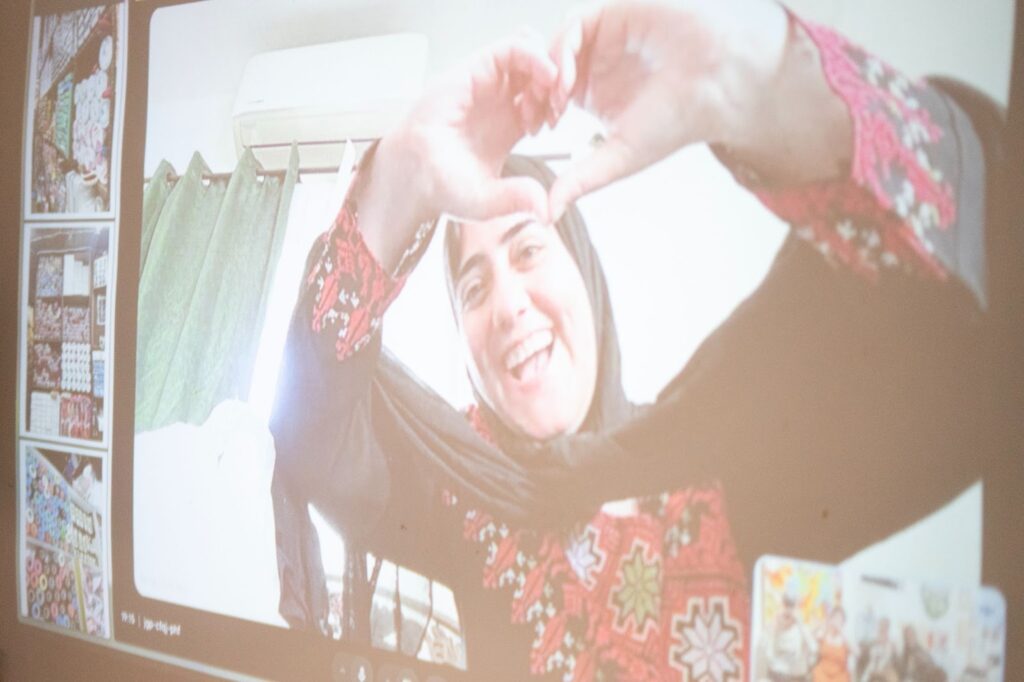
The author during an online workshop. Image credit: Georgia Mulholland.
In the fall of 2025, I was invited to give a series of workshops and talks in Italy, and I felt honored to have the opportunity to travel to teach Tatreez for the first time. I always found it painful to think that Palestine is only known through images of war and destruction, but the people I met in Naples and Rome were eager to learn about Palestinian culture beyond what they see in the news. Tatreez has allowed me to tell a different story, one about Palestine’s beauty and the rich history of its people. The workshops became a place of human connection and community, where people showed their support and solidarity by engaging with an ancient form of Palestinian art.

Tatreez workshop in Rome at Atelier d’Isagio. Image credit: Reveal.fotografia.
Everyone engages with Tatreez differently: young women from villages in the West Bank have more familiarity with patterns and techniques than participants from historic Palestine or the 1948 territories, even if they do not stitch themselves, because Tatreez is already part of their everyday lives. To Palestinians in the diaspora, whether they have a basic knowledge or acquire it for the first time during the workshops, stitching gives a sense of community and connection to the land they thought they had lost forever. International participants, who have less knowledge of Palestinian art and culture more generally, come to show their solidarity through learning and through practice. Teaching Tatreez has allowed me to form friendships and witness the emergence of global networks of support, because this art-form encourages a kind of vulnerability which is needed now more than ever, for those of us who cannot stop worrying yet refuse to look away.
Tatreez is expanding a traditional Palestinian women’s space to fill up the world with something beautiful, preserving a cultural heritage that has endured through the centuries and still lives on today, strong as Palestinian people are.
Notes:
1. As I later found out, the map was made by Maha Abu Seedo, a Tatreez artist, fashion designer, and founder of Kenar Embroidery. The photograph depicts the ruins of her workshop in Gaza, and was taken in her absence, as Maha was forced to flee in order to survive and continue her Tatreez practice elsewhere. [back to text]
2. The Kulin Nation’s Traditional Place Name for Melbourne. [back to text]
Samar Abdrabbou is a Palestinian cultural practitioner and human rights advocate, and the founder of Samarkand, an initiative dedicated to preserving and sharing the Palestinian art of tatreez. She holds a BA in International Law and Human Rights from Bard College and is the Program Manager at Made in Palestine, a non-profit supporting Palestinian communities through humanitarian and economic initiatives. Through Samarkand, Samar works with Palestinian women artisans, research, and storytelling to position tatreez as a living practice of cultural memory, identity, and resistance. You can support her work by following Samarkand’s Instagram page, purchasing embroidered pieces or kits when available, and inviting Samar for talks, workshops, exhibitions, or cultural programming.