
The Magicians: A Review
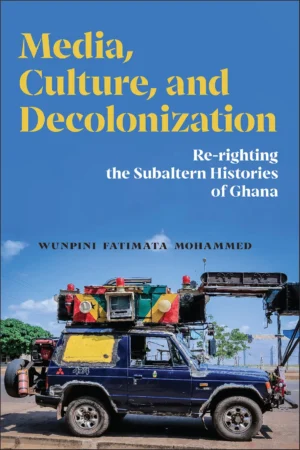
Review of Wunpini Fatimata Mohammed’s Media, Culture, and Decolonization: Re-righting the Subaltern Histories of Ghana (Rutgers University Press, 2025)
Wunpini Fatimata Mohammed’s Media, Culture, and Decolonization: Re-righting the Subaltern Histories of Ghana is an exploration of the media landscape of Northern Ghana, specifically among the Dagbamba people. Mohammed presents to us a world where filmmakers and their actors co-create using oral scripts and journalists act as griots. She argues that traditional and modern media cannot be divorced from each other, media is more than radio, television, and film, it is also drum histories, folklore, etc.
Mohammed grounds the book with a strong case for decolonizing our approach to media. We can do this by centering African systems of knowledge. She introduces us to the philosophy of Bilchiinsi, a way of thinking that values all of humanity and holds human dignity sacred, not that different from southern and eastern Africa’s ubuntu. Mohammed builds on Ngūgī wa Thiong’o’s work on linguicide—the death that can occur to indigenous languages because of colonization and neo-colonization, and pushes for creating media in indigenous languages. She advocates for community-based research, as well as an African feminist approach to our decolonization of media. She exhorts us to study South-South media flows—cultural exchanges across the global South—such as how India’s Bollywood inspired the Northern Ghana and Northern Nigerian film industries. All this will create a rhizomatic effect and will, as she writes, “open pathways toward rethinking what epistemological disruptions to foreground the margins can look like.”
This richly researched book’s raison d’être is encapsulated in this sentence: “In this book, therefore, I draw attention to subaltern media by re-re-righting the silenced histories of media in Ghana focusing specifically on Northern Ghana.” Ghana’s colonial government effected policies, some of which the country’s elites still continue to employ today, which set back the north when it came to literacy, education, and electrification, among others. She writes, “When I speak of the subaltern here, I am referring to ethnic groups that have been systematically written out of not just the Ghanaian public sphere but culture making in the country.” Mohammed shares her own experiences as a child of this region, and a chord was struck in me, because not only does my paternal family come from the north, but my grandmother lived in Zogbeli, the same neighborhood in Tamale where Mohammed grew up. I was also raised in a media family. Even as a child I had a deep sense of how marginalized it was. The images I saw of the north in the media were hardly flattering and whenever I visited, news seemed to filter up slowly. This is precisely Mohammed’s point: media is a powerful storytelling tool.
The book’s methodology involves many techniques, including interviews, scouring the archives, and employing what she calls communal conversation circles. What stands out is the care with which she talks to and about her subjects, whom she considers co-creators. There are people such as BBC, who directed and acted in the first Dagbanli movie, which took only a few months from inception to finish; Radio 10,000, who self-finances and procures films he sells on DVD and distributes in his inimitable van; and Sherifatu Issah, who directs her films by co-creating with her actors and using no written scripts. As one director says, “God has given us something here. Our actors here, God has given them brains, sharp brains.” For a world that has been left to its own devices for a long time, the lives and occupations of the book’s subjects and this book itself are acts of resistance.
Mohammed’s writing shines when she delves into the film industry, from its history to its modern distribution. There’s so much to learn here. For instance, I had no idea that the Dagbanli film industry was the first to emerge in Ghana in the late 1980s, even before Kumawood, the film center of the largest ethnic group in the country. Also interesting is the fact that, in the north, filmmakers and other cultural producers are not dying for the outside gaze. They create in their languages, for their communities, with little support from the Ghanaian government. When it comes to television, Mohammed shows how Indigenous language television has more of a community and development focus. However, the move towards religious programming often operates to the detriment of women. Mohammed leaves no stone unturned, writing about everything from how journalism in Ghana is strange bedfellows with American imperialism to recommendations on how the government should support the arts.
Even though Mohammed references griots—or specifically, lunsi in Dagbanli culture—I would have liked to see more of how the precolonial media wove through to the present. A big part of decolonizing should also involve Sankofa, stretching our timelines to include lives before the European colonial project. Sankofa is an Akan philosophy, symbolized with a bird craning its neck to pick up an egg on its back, that says if one forgets something, one can go back to find it. In addition, to fully develop an African Feminist Media Praxis, we should have heard directly from women lunsi.
We need more archives of African lives, especially of places like the north of Ghana, and Mohammed’s book is the right start. She and her co-creators offer keys for anyone who wants to create or to produce art, media, films, literature independently. These media creators in Northern Ghana are magicians, teaching us how with little, one can create meaningful and “liberatory futures,” as Mohammed puts it. This book encourages us to continue to infuse care into our work, to put human dignity first, and to always root the work in place.
Senegal-based Ghanaian author Ayesha Harruna Attah has published several books including The Hundred Wells of Salaga, a finalist for the William Saroyan Prize, and the forthcoming Bitter Sweet, her non-fiction debut. Her writing has appeared in Chimurenga, The New York Times, The Guardian, among others. Her work lives in spaces that history has chosen to keep hidden.