
The Most Dangerous Man in America*
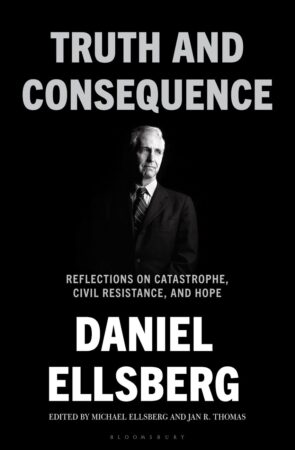
A review of Truth and Consequence: Reflections on Catastrophe, Civil Resistance, and Hope (Bloomsbury 2026) by Daniel Ellsberg
From the time Daniel Ellsberg was barely more than a toddler, his mother—a domineering woman whose love was conditional on obedience to her wishes—was determined that Ellsberg would become a world-class concert pianist. Thus, instead of a “normal” childhood going to school and playing with friends and being just a kid, he spent hours and hours every single day for years sitting at a piano. As he got older, he only went to school for half a day so that he could devote the rest of the day to practice.
But when he was fifteen, while his father was driving the family from Detroit to Denver to visit his mother’s brother, his father fell asleep at the wheel, resulting in a terrible accident that killed his mother and sister, and left Ellsberg severely injured. Though it was clear by then that Ellsberg was not going to be a professional pianist, his mother’s death removed what would surely have been the shadow of her disappointment with her son.
Ellsberg’s relationship with his mother, and the accident itself, have everything to do with his decision over two decades later to copy and make public what have come to be known as The Pentagon Papers. We learn about the piano, his mother, and the accident in the opening chapters of Ellsberg’s posthumously published Truth and Consequence: Reflections on Catastrophe, Civil Resistance, and Hope, edited by his younger son Michael Ellsberg and his longtime assistant Jan R. Thomas, forthcoming from Bloomsbury Publishing in March 2026.
During his long life, Ellsberg published only a few books: Papers on the War (1971); Secrets: A Memoir of Vietnam and the Pentagon Papers (2002); The Doomsday Machine: Confessions of a Nuclear War Planner (2017); and very belatedly his doctoral dissertation, Risk, Ambiguity, and Decision (2001). But Ellsberg wrote constantly, filling notebooks, notepads, and whatever scraps of paper happened to be handy with his thoughts, speculations, observations, and insights.
In 2019, a few years prior to Ellsberg’s death in 2023 the University of Massachusetts acquired his voluminous papers—some 600 boxes worth of material—which are now housed in the Ellsberg Archive as part of The Ellsberg Initiative for Peace and Democracy. And while Michael Ellsberg and Thomas were preparing this material for delivery to the university, they realized that at least some of this unpublished material ought to be put into the public domain. Thus, this book.
The many brilliant little aphorisms and pearls of wisdom scattered throughout Ellsberg’s writing are, by themselves, worth the cost of the book. Here is a sampling:
“The costs of war rest lightly on elites.”
“Far too many secrets are kept.”
“Learn to be angry about the right things.”
“Power addicts; then it corrupts.”
“If you want peace, prepare for peace.”
“There is a time when silence is a lie, when silence is complicity.”
“Cultivate joy.”
“I would like to be able to love my country and love justice too.”
“We need to change what it means to be human.”
“Reject violence and cruelty.”
“It turns out that ‘inhumanity’ is characteristically human.”
“I have no confidence that good will prevail, . . . Yet, I fight.”
“It is in our power to change the world.”
“We can do better than this. We can be better than this.”
“The seeds of violent conflict are sown in despair and injustice.”
“We need to be skeptical of what we think God tells us to do, or permits.”
“We have to learn how to speak to people with whom we do not agree.”
“If a policy looks crazy, it may very well be.”
“Be skeptical if you’re asked to go to war for freedom, democracy or regime change.”
“Humans can’t stand too much reality.”
“If we can’t stop climate change, we can’t survive.”
“This is not a species to trust with thermonuclear weapons.”
And this is just a sampling. Ellsberg spent a lifetime, at least since 1971 when he chose to risk the rest of his life in prison, thinking about the human condition, the state of his country, the future of humanity, and indeed the fate of all life on Earth.
But why did he choose to abandon his privileged place among the powerful, the influential, the insiders inhabiting the halls of power? He was, after all, a wunderkind, still in his 30s when he was working variously for the Defense and State Departments, and the powerful Rand Corporation, a protégé of and advisor to powerful insiders like John McNaughton and Robert McNamara, someone who knew Henry Kissinger—both before and after Nixon became president. A young man with a stellar future ahead of him.
The chapters of Truth and Consequence, excepting the three more formal essays by Ellsberg that open the book and a few more at the end, are laid out year by year from 1971 through 2021. He returns to certain themes and subjects repeatedly over the years. One of them is the addictive nature of power, the compelling attraction of being an “insider” with access to knowledge that others do not have, the privileges and status that come with it, and the difficulty of walking away from all that.
And Ellsberg knew that if he were to make public the classified government documents he had access to, he would not only be risking a life sentence in prison, but also the complete ostracism and condemnation of his former colleagues. He would be—intellectually and socially—left out in the cold, isolated and alone.
But as this book makes clear, he had become convinced by his own experiences during nearly two years in Vietnam itself in the mid-1960s that the war was not only unwinnable, but that “there is no legitimate basis for the U.S. to be killing any Vietnamese, or to pay Vietnamese to kill other Vietnamese. Nor are the interests of Americans served in doing so, except those of the ruling classes.” At another point, he writes, “We were wrong in Vietnam. It was murder. It was evil.”
Ellsberg had hoped that Richard Nixon would, as he had promised, end the war in Vietnam. But when Ellsberg’s friend Morton Halperin, who worked under Kissinger on the National Security Council, made it clear that Nixon had no intention of ending the war, Ellsberg made up his mind to obey his conscience, turn his back on power, and hope that the knowledge he was making public would prod the American people to demand an end to the war.
None of this is all that new. Ellsberg talks about this in his memoir, Secrets. What’s new is how “the Accident” and the death of his mother figure into Ellsberg’s decision. That fateful day of the car crash in 1946, Ellsberg’s mother was insistent that the family get to Denver in time for her brother’s birthday party. Ellsberg’s father had been driving all night and well into the next day. He had repeatedly told his wife that he needed to rest, that they needed to stop at a motel or at least pull over so he could sleep.
But she had been adamant: he could not stop or they would not arrive in time, and she herself would not drive, so he simply had to keep going. He subsequently fell asleep at the wheel, the car drifted off the road, hit a bridge abutment, and mother and daughter, both on the right side of the car, were killed instantly.
Ellsberg came to believe that if his father had stood up to “authority” and done what the situation required, the accident would not have happened, and his sister would still be alive. (Not surprisingly, he seems far less remorseful about his mother’s death, though he says more than once that for all her flaws, he loved her.)
Thus, those many years later, he saw himself in a position that required him to stand up to authority and do what the situation required. Had his father done that, two lives would have been saved. Now Ellsberg was in a position to save perhaps thousands of lives and more by facilitating an end to the Vietnam War. (It didn’t work out quite as neatly as Ellsberg had hoped, but in a backhanded sort of way, Ellsberg’s decision to release the papers led to Nixon’s downfall, which did lead to the eventual end of the war.)
But as Truth and Consequence makes clear, the Vietnam War was really only subsidiary to his primary life’s concern, which was to his dying day the terrible threat to humanity—and indeed, all life on earth—posed by the existence of thermonuclear weapons. Even as Ellsberg was dying, and had made that fact public, his final interviews—all of which he agreed to, and did, for as long as he was able—continued to emphasize the dire situation posed by the existence of these weapons of mass destruction.
“Can the human species and civilization—as well as other species—survive humans’ dangerous proclivities?” he speculated. “My current understanding of politics does not indicate a feasible ‘way out’ of future ecological catastrophe and nuclear attacks. . . . I fear there’s not enough time, and it’s too late to achieve enough change in enough people. But I’m not going to give up. If we do go down, we’ll go down fighting, helping each other.”
As Ellsberg’s older son Robert says in the very first sentence of his foreword, “My father was a complicated man.” Indeed he was. At one point in his writing, he says, “I am ashamed of my species.” At another point later on, he says, “I am proud to be a human.” Though he deplores and condemns the killing of innocent civilians, noncombatants, what are often called these days “collateral damage,” he seems to accept Augustine’s Just War Theory, though one can hardly imagine how the killing of noncombatants is avoidable in modern warfare. He argues that “not all secrets are bad or wrongful. Not all whistleblowing is good.” But he offers no suggestions about how to be able to distinguish good secrets from bad secrets, or bad whistleblowing from good whistleblowing.
These are small quibbles, however, almost petty in the light of Daniel Ellsberg’s long and eventful life. Truly a man who singlehandedly changed history by a monumental act of moral courage, he went on to live his beliefs in ways that few people ever dare to do. And this posthumous collection of his writings offers a wonderful window into the mind and heart of a great American hero, a compassionate human being, and finally a wise and thoughtful teacher.
*The words of the title are attributed to Henry Kissinger, who supposedly said, after the Pentagon Papers became public, “Daniel Ellsberg is the most dangerous man in America. He must be stopped at all costs.”
W. D. Ehrhart is the author of Vietnam-Perkasie: A Combat Marine Memoir and Thank You for Your Service: Collected Poems. The entire trajectory of his life was permanently changed by his encounter with The Pentagon Papers.