
Agitate, Educate, Organise: Caring for each other’s stories in the wake of “Documenta 15”
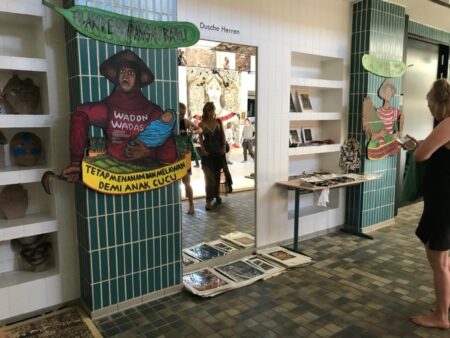
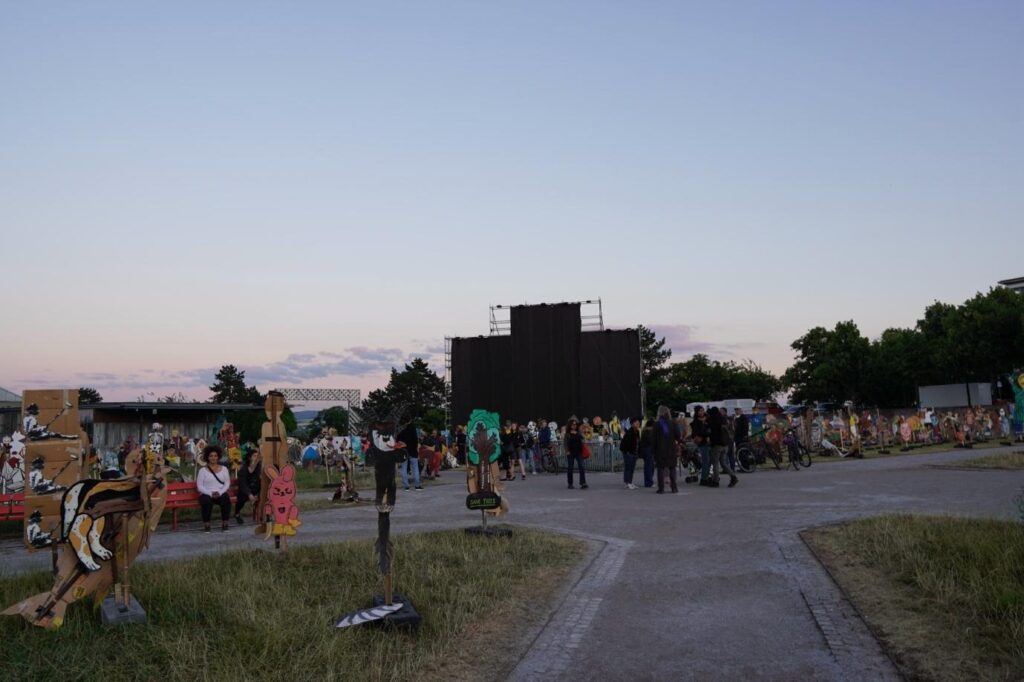
Taring Padi’s merchandise corner at Hallenbad Ost, Documenta 15, Kassel, Germany, Summer 2022.
On the last day of the preview week at Documenta 15 a woman approached our lapak. The stall where we sold emblems, t-shirts, pins, zines and woodcut prints was tucked away in a remote corner of Hallenbad Ost, an old Bauhaus swimming pool turned events venue in Kassel. Every five years, this small German city hosts one of the world’s biggest contemporary art exhibits. I was there alongside other members of Taring Padi, the art workers’ collective we founded in Yogyakarta, Indonesia, almost three decades ago. When the woman purchased multiple copies of our posters for thirty euros each, one of our members worked up the courage to ask her who she was, even though having to speak English made him feel shy. “I am Frances Morris, from Tate Modern London,” she said, to which he enthusiastically replied: “Ah… Manchester United!”
When we met at Tate Modern almost a year later, Frances, whom I had also failed to recognise, told the story from her point of view: “The whole week everybody tried to talk to me. And you didn’t even know or care about the Tate, didn’t even get the city correct! Manchester United, really?” It was precisely our “ignorance” that made Frances like us even more, because it was consistent with Taring Padi’s use of art as a political tool.
Taring Padi’s practice is connected to our naivety—and deliberate disregard—of the contemporary art ecosystem. One might be excused for not recognizing the director of Tate Modern in person; but when an artist has no awareness of Tate Modern at all, they are outside the circle—both literally and metaphorically.
When we started Taring Padi in 1998, we wanted to be outsiders. Our official name was Lembaga Budaya Kerakyatan Taring Padi (The Institute of People-Oriented Culture of Taring Padi). This designation purposefully echoed the Lembaga Kebudayaan Rakyat, a leftist cultural organization historically associated with the Indonesian Communist Party, to signal a shared ideological lineage. We explicitly condemned the art establishment, identified ourselves as art workers rather than artists, and adopted collective modes of living and working. We privileged accessible media such as woodcut prints, cardboard puppets from Indonesia’s popular tradition, and large-scale banners that invited collective modes of production.
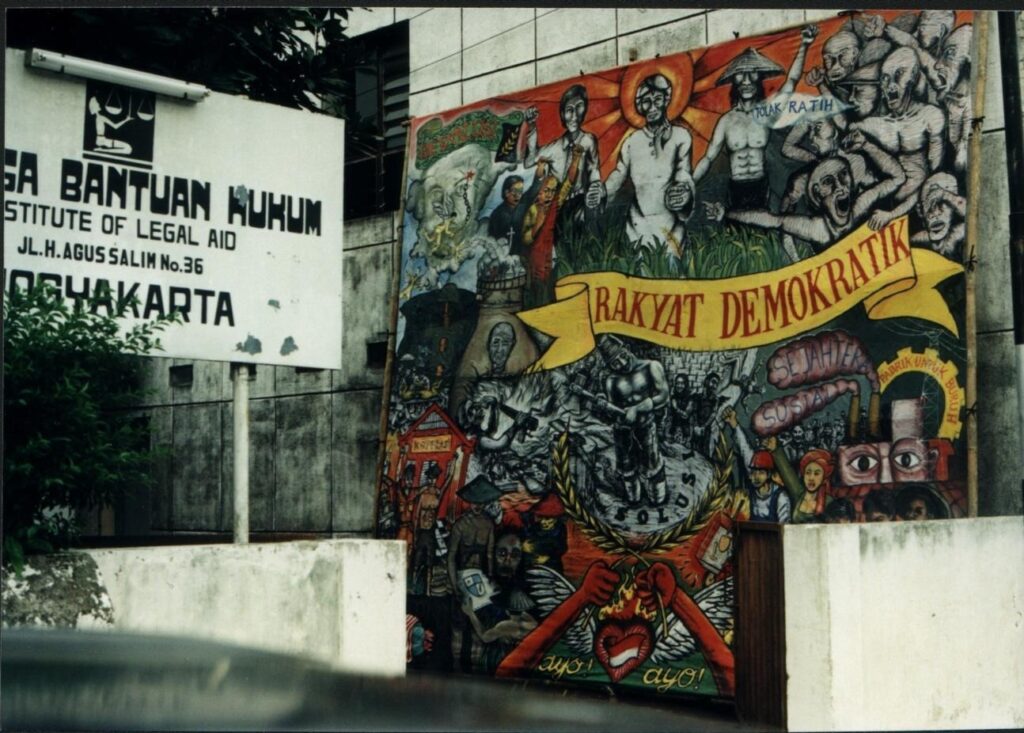
The Display of People’s Democracy banner during Taring Padi’s declaration at the Institute of Legal Aid, Yogyakarta, Indonesia, 21 December 1998.
After Documenta 15, for better or worse, Taring Padi is no longer an outsider. We accepted the invitation to participate not only to give our solidarity work a bigger platform, but also because, under the artistic directorship of the Jakarta-based collective ruangrupa, we felt we could speak for ourselves. And yet, even within a framework that explicitly prioritized voices from the Global South, one of our works ended up at the center of a power struggle over the very meaning of racism, and who gets to define it.
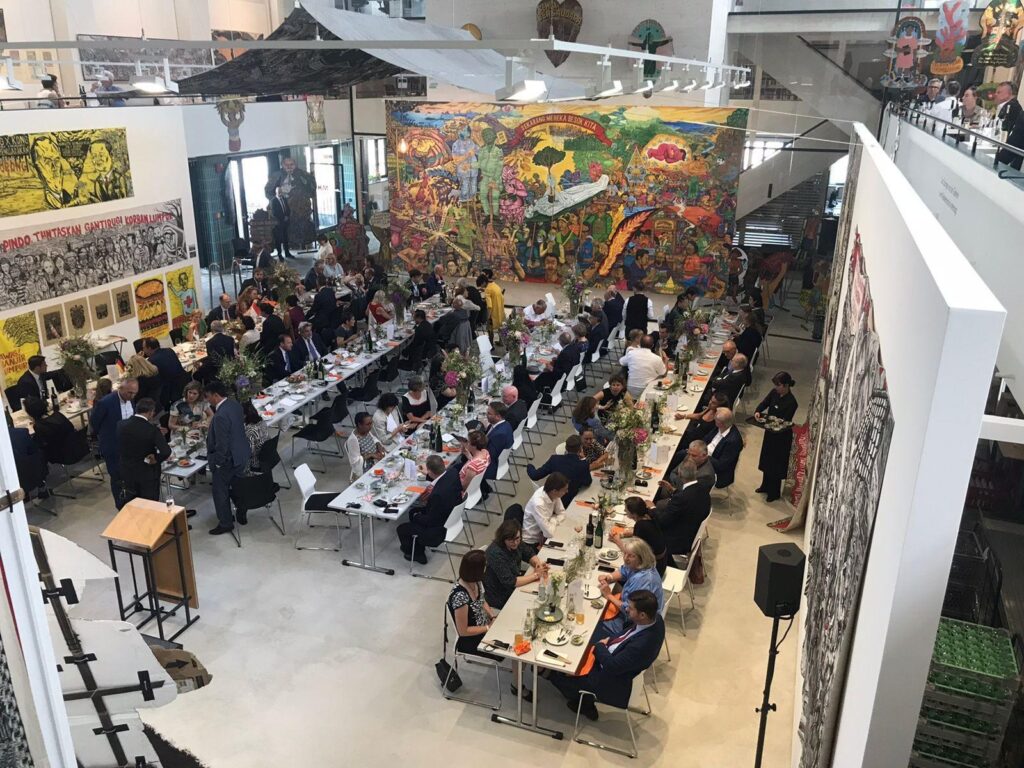
German President Frank-Walter Steinmeier attends a lunch with dignitaries for the opening of Documenta 15 at Taring Padi’s space.
Measuring twelve by eight meters, our 2002 banner, People’s Justice, was displayed in Friedrichsplatz, Kassel’s central square, with around 1,000 accompanying life-sized cardboard puppets, one day before the opening on June 18th. Only a few hours later, the journalist Nathan Giwerzew published a tweet accusing both Taring Padi and the Palestinian collective The Question of Funding of antisemitism. He singled out a dollar sign and a star of David which appeared in People’s Justice to represent the Mossad’s complicity with the Suharto military regime (1967-1998), responsible for the genocide of hundreds of thousands of Indonesians accused of being Communists. Three days after the opening, the banner was taken down without consulting us.
The covering of People’s Justice banner before dismantlement the following day at Documenta 15, Friedrichsplatz, Kassel, Germany, 20 June 2022.
This is not the place to re-hash the controversy surrounding People’s Justice, which Michael Rothberg, Chair of Holocaust Studies at UCLA, analyzed in great detail in his Berliner Zeitung article. We stand by our apology and the repair work we have done since to learn from and co-create with Jewish communities and art collectives. We also believe, as we have written elsewhere, that the decontextualisation of our work and the virality of its scapegoating led to the recolonisation of art, reinforcing existing power hierarchies and denying space for dialogue.
As we rode out the storm of allegations, accusations, and condemnations of Documenta 15, the opportunities to make art rooted in internationalist solidarity grew, as did the establishment’s appetite for political art. We hoped for the former, but had not anticipated the latter.
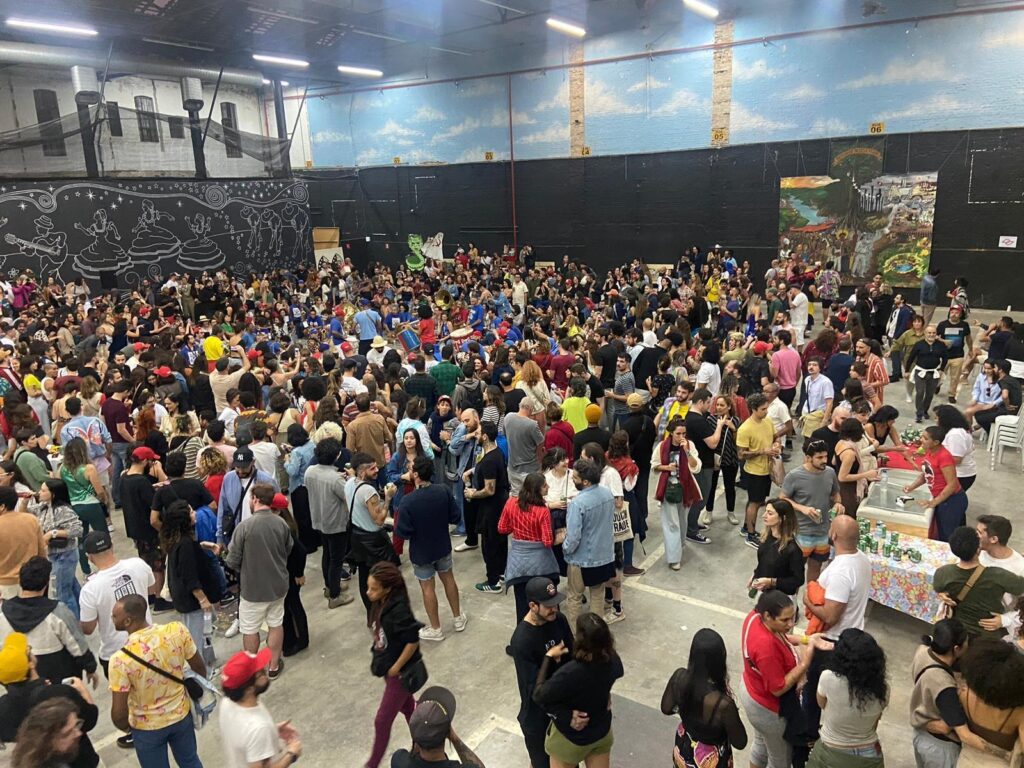
First Presentation of Retomar Nossa Terra banner from People’s Justice series No. 2 at MST space, Sao Paolo, Brazil, April 2023. The banner is co-produced by Taring Padi, MST, Casa do Povo and Framer Framed.
Right after Documenta 15, Taring Padi staged major solo shows at Framer Framed in Amsterdam and the Griffith University Art Gallery in Brisbane, and participated in a number of biennales, festivals, and exhibitions. We collaborated with Casa do Povo, a progressive Jewish collective in Sao Paolo, the Landless Workers Movements/MST, and Tricontinental to make another large banner entitled Retomar Nossa Terra (Reclaim Our Land). This was followed by Ngaliya Budjo Djarra (Our Motherland), co-created in 2024 with proppaNOW, an aboriginal art collective in Brisbane, marking the creation of a new People’s Justice series. In the meantime, we have not abandoned our Palestinian comrades, with whom we co-produced a Palestinian version of People’s Justice.
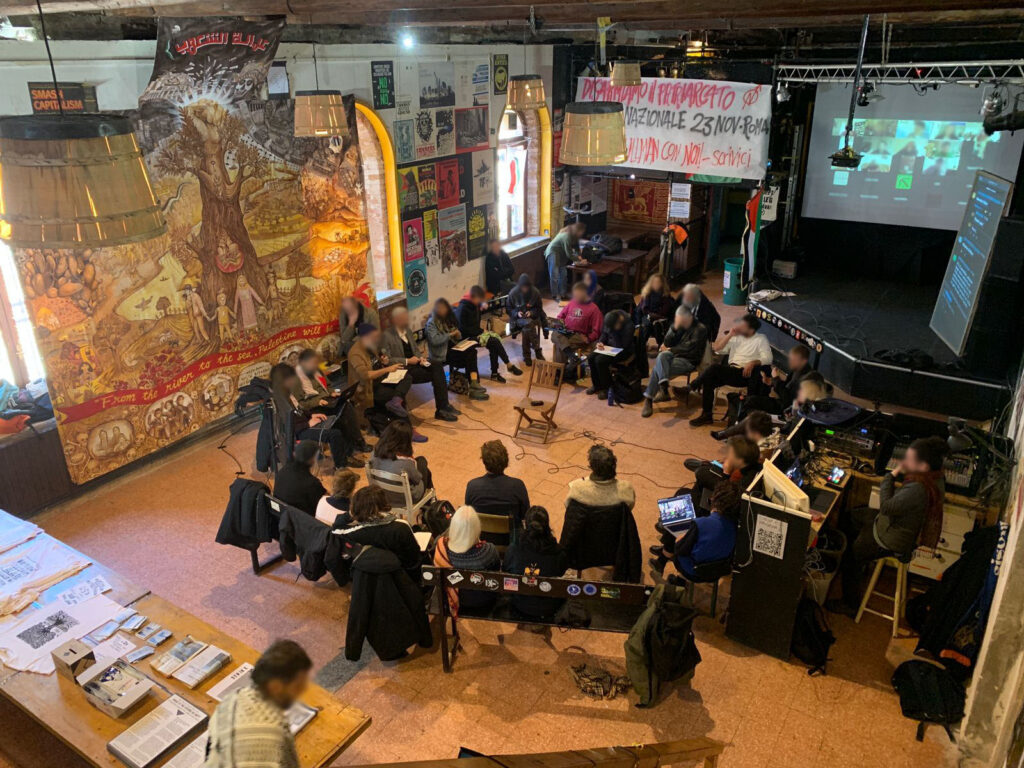
Banner دالة الشعب from People’s Justice series No. 7 as backdrop for the first congress of Art Not Genocide Alliance (ANGA), Venice, November 2024. The banner is co-produced by Taring Padi, The Kitchen, Globe Aroma, Subversive Film, Question of Funding, and Learning Palestine.
Working and learning together, as we have always done, is how we take ownership of the condemned People’s Justice banner and reclaim it as a framework to agitate, educate and organise.
This was the core principle of our Agitate, Educate, Organise exhibition for the opening of Cantadora Gallery in Rome in October 2025. The gallery was established by Enrico Palmieri and Flavia Prestininzi, whom we met in Venice a year prior, at the first Art Not Genocide Alliance congress. Despite having been brought together by the Palestinian struggle, we were reluctant to accept their offer at first, because theirs was a commercial gallery. Our solution was to showcase Taring Padi’s works alongside a collective banner on the working conditions of Sikh agroindustry migrant workers around Rome, co-produced with the Italian General Confederation of Labour (CGIL).
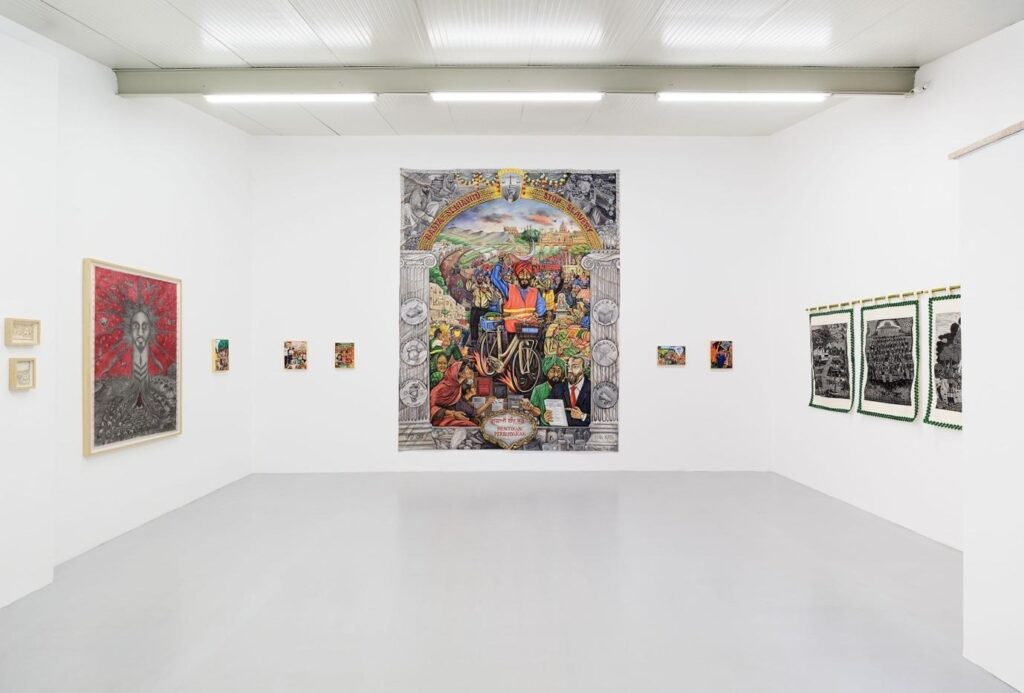
Installation of Agitate, Educate, Organise exhibition, with Basta Schiavitù banner, Rome, October 2025.
Meanwhile, art museums in Europe, Australia, and Asia, including Tate London, have been acquiring our large banners, woodcut posters, and cardboard puppets. In less than four years since Documenta, our tools for direct political action have become objects of display and art commodities.
Market demand for our work allows us to continue producing more, but the commodification of political art can also prevent action truly rooted in solidarity. As we navigate the unfamiliar overlapping of these territories, we are also learning to stay close to the ground while nurturing an internationalist network.
When Tate workers picketed outside Tate Galleries in November 2025, we sent our solidarity woodcut posters to curators, art handlers, registrars and account assistants who oversaw the acquisition of our works. Whilst Taring Padi’s works are part of Tate’s illustrious collections, our actions are in allegiance with the workers. With them, we march on.
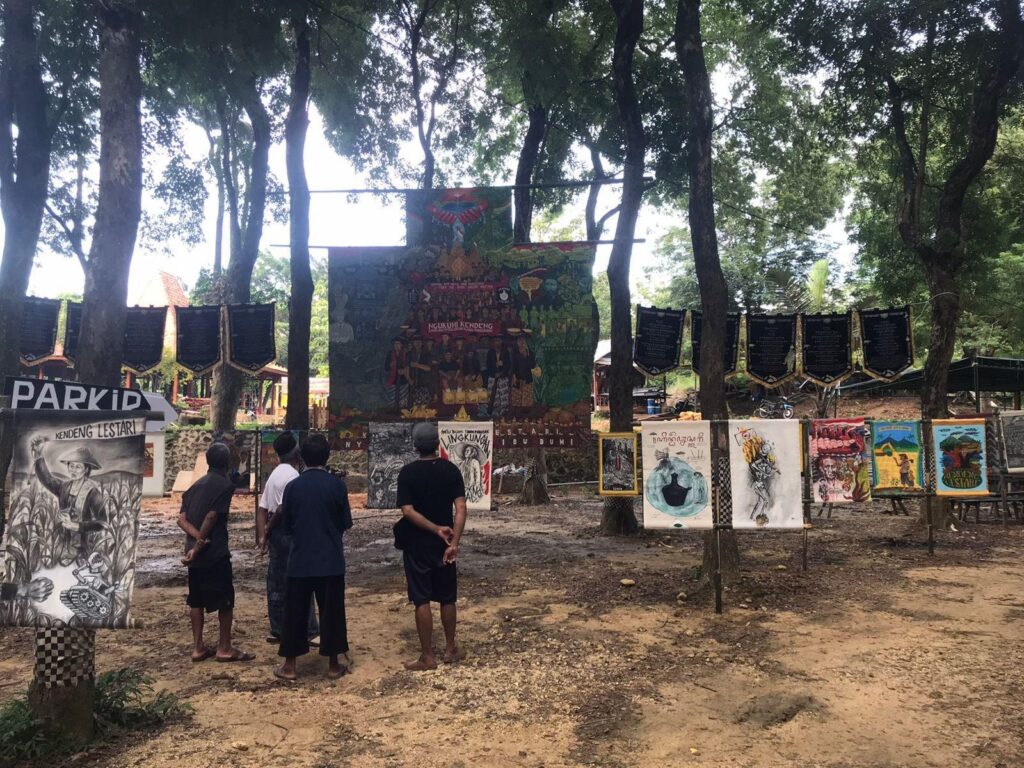
Installation of Kendeng Lestari, Nyawiji Kanggo Ibu Bumi banner, ronteks and pennants, from People’s Justice series No. 5, 2023, in Sonokeling, Misik village, Sukolilo, Pati, Central Java, December 2025.
Back home, towards the end of 2025, we continued to fight alongside the Kendeng peasant community in Central Java against the development of a factory in their area. The installation of our artworks in their village came out of a long history of solidarity with their struggle. The same was true when we displayed the People’s Democracy banner at the Yogyakarta Legal Aid Institute, which hosted our founding declaration twenty-eight years ago.
What we as Taring Padi feel and believe is that we can only maintain our radicalism when we deeply care for each other, and each other’s histories.
Alexander Supartono is an art historian and curator specialising in modern and contemporary art in Southeast Asia and associate professor at Edinburgh Napier University. He obtained a PhD in History of Photography from the University of St. Andrews, Scotland. He is one of the first-generation members of Taring Padi. Presently he is one of principal investigators at Photography Unbound, a Getty Research Institute’s project that explores computational methods to analyze large collections of 19th century photographs and the application of computer vision to art historical questions.