
Gaza in the New Year: Countdown to Death, Not Celebration
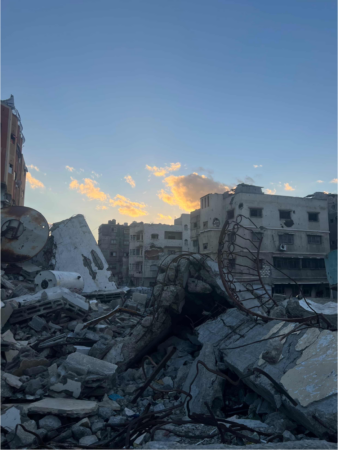
Rubble in Gaza, taken by Farah Rebhy.
Our next two public affairs posts, for today and on February 27th, are written by twin sisters in Gaza, Amna and Alaa Dmeida. As Israel’s ongoing genocide continues to sever Palestinian kinship with unfathomable cruelty, Palestinian writers continue to share their stories with heartbreaking courage.
—Shailja Patel, Public Affairs Editor
Across the world on New Year’s Eve, people counted the seconds to midnight, hoping for new beginnings. But in the Al-Tuffah neighborhood in the east of Gaza, the countdown had a completely different meaning. Hundreds of families counted down the time left before homes turned into rubble, and before they were forced to flee.
Street after street, the same bitter scene played out: women carrying wet blankets, children dragging school bags filled with clothes instead of books. They did not say goodbye to the passing year; they said goodbye to walls and houses full of memories, and streets they may never return to.
Israel has carved up Gaza into three zones: red, yellow and green. The colors are not traffic rules; they determine our survival. The danger of this classification lies not only in the immediate moment, but in the possibility that it will become permanent. We have witnessed this in parts of the West Bank, and inside Palestinian communities within Israel, where arrangements presented as temporary measures by Israel have turned into long-term realities. This is what concerns us most.
The Red Zone in Gaza is the Forbidden Zone. These are areas of complete danger and a total ban on existence.
The Yellow Zone in Gaza is the Gamble Zone. This is where my city, Jabalia, is located. Jabalia is still inaccessible; returning is fraught with danger. The fate of residents who attempt to go home to the Yellow Zone hangs on the mood of the Israeli Occupation Forces. Survival demands daily calculations of risk.
The Green Zone in Gaza is the Permitted Zone. The Israeli Occupation Forces claim that this is a “safe” area, but the reality on the ground tells a far grimmer story. The Green Zone has frequently been targeted, turning what were promised as sanctuaries into scenes of devastation. This systematic targeting renders the term “safe” entirely meaningless.
The IOF repeatedly and incessantly violates the ceasefire agreement since it was signed on October 10th 2025.
For instance, on Christmas Day of 2025, the IOF expanded these zones in East Al-Tuffah by an additional 100 meters in length and 300 meters in width.
In Gaza—one of the world’s most densely populated regions, with 6,000 people per square kilometer—such “minor” adjustments on a map result in the immediate displacement of thousands and the systematic demolition of entire residential blocks.
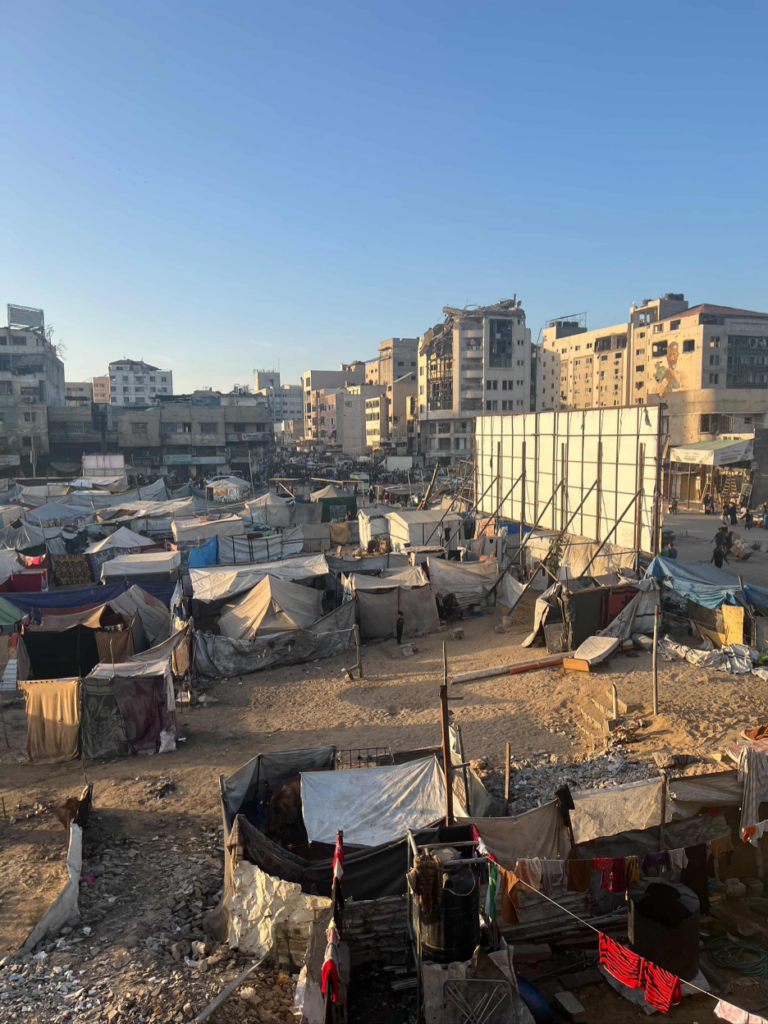
A camp overcrowded with tents that are unfit for living in Gaza, taken by Farah Rebhy.
Israel’s color-zoning of Gaza is an aggressive policy of grabbing land and redrawing borders, making the return of Gazans to their homes almost impossible.
This expansion destroys any talk of a ceasefire or truce. How can there be calm when bulldozers are consuming our neighborhoods, and international agreements are being crushed under tanks?
The evacuation in Al-Tuffah neighborhood was not organized; it came as a shock during a harsh winter for the displaced. Families were driven out in freezing cold and rain that had already turned their tents into puddles of mud.
I met a displaced family walking without a clear destination, carrying what remained of their lives in their hands. The mother was wrapping her child in a wet blanket, and the father was dragging a small bag that could hold only a few clothes. They stopped to ask, “Where should we go?” The question was not directed at me, but at the emptiness around us. They had fled after the IOF warning, taking neither documents nor photographs. It was a complete uprooting. “Every time we say this is the last time… how long will this go on?”
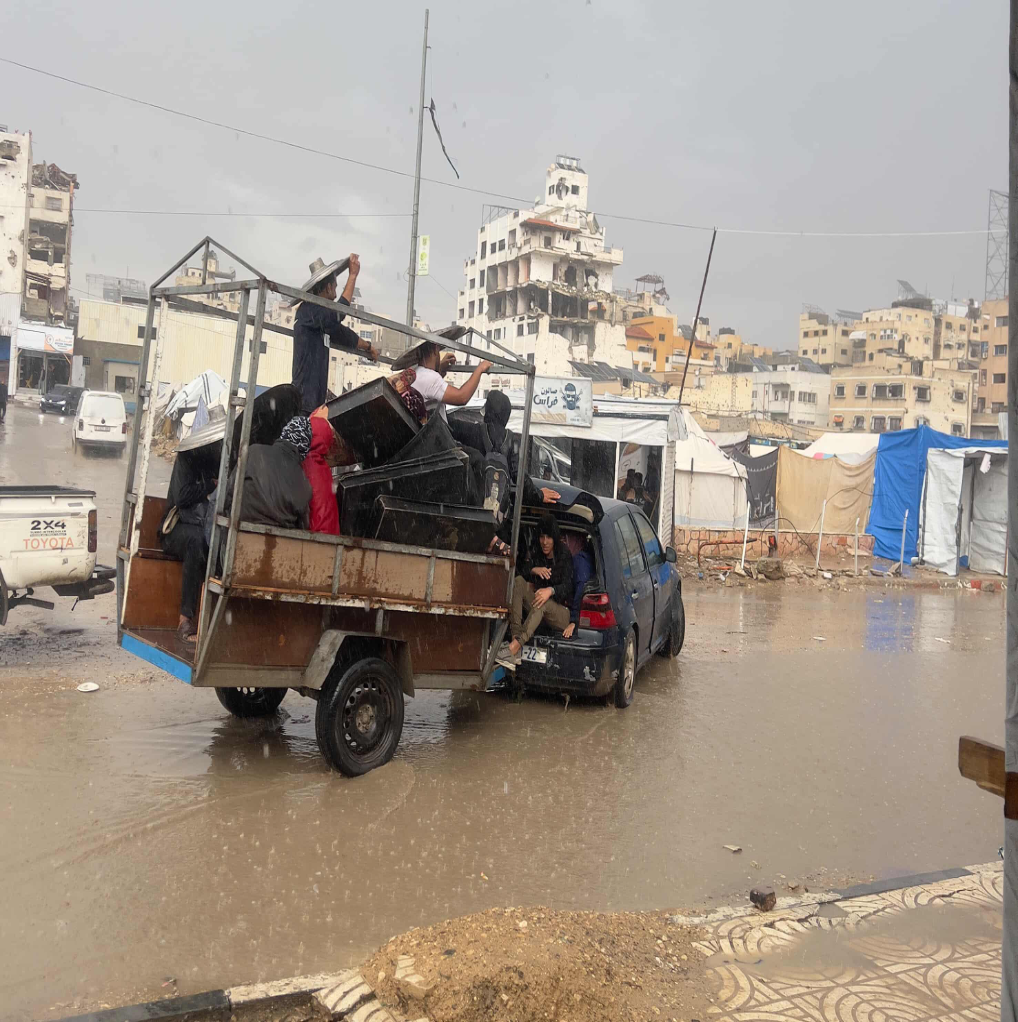
A family in Gaza is displaced in stormy weather in Gaza, taken by Farah Rebhy.
According to UNRWA, the IOF has damaged multiple UNRWA installations since the ceasefire agreement, and tens of thousands of tents, shelters, and buildings. The IOF detonated a robotic tank next to a school in Al-Tuffah, extensively damaging the building.
As the world celebrated the new year, flares lit up Gaza’s skies, revealing new lines of displaced families. Gazans entered 2026 facing ongoing displacement and devastation. When will we stop counting down to our next displacement? When can we begin counting down to return, rebuilding and stability? When will this end?
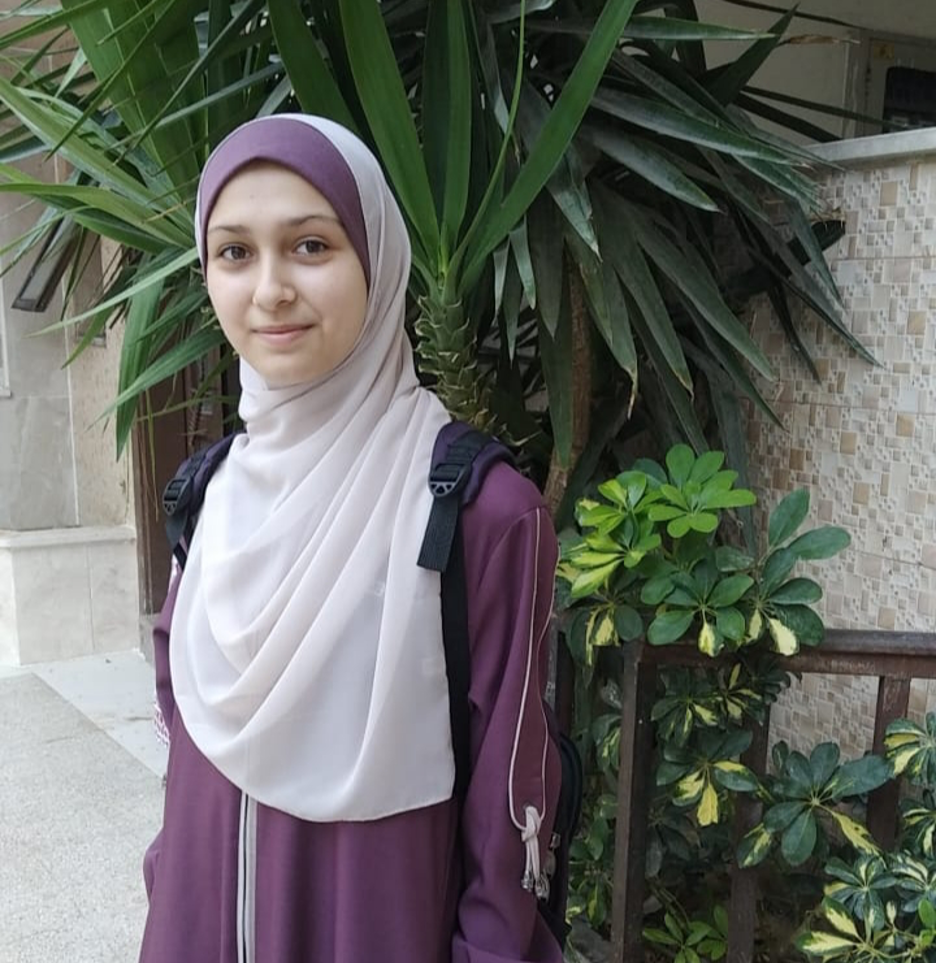
Amna Dmeida is a 20-year-old English Literature student at the Islamic University of Gaza, and a writer who found herself between the lines, discovering her passion and strength through writing—telling the lived stories of Gaza and showing the world that Gazans are individuals with dreams and details, not just numbers.