
Review of Brahim El Guabli’s Desert Imaginations: A History of Saharanism and Its Radical Consequences
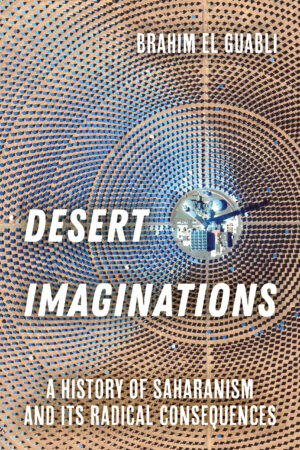
“The Sahara,” articulates Maysa Abou-Youssef Hayward in her study of the desert in Arabic verse, “represents a location marked by fear, loss, exile, and emptiness, the result of destruction.” In Desert Imaginations: A History of Saharanism and Its Radical Consequences (University of California Press, 2025) Brahim El Guabli argues that this idea is not a neutral description of landscape but part of a long-standing ideology that has shaped how deserts (most centrally the Sahara) across the world have been imagined, governed, exploited, and sacrificed. El Guabli names this enduring formation “Saharanism,” a transhistorical and trans-desert ideology that legitimizes what he describes as “exploitive, inhumane, and ecocidal endeavors” in arid lands. Once deserts are imagined as empty or disposable, almost anything becomes possible in them—from nuclear testing and mass displacement to resource extraction, border militarization, and environmental destruction.
Methodologically, El Guabli combines archival research, literary analysis, environmental history, political theory, and media studies. His interdisciplinary approach enables him to trace Saharanism across diverse sites without collapsing historical specificity. From the outset, El Guabli positions Saharanism in critical but careful conversation with Edward Said’s Orientalism. While Orientalism exposed how the “Orient” was produced as an object of Western knowledge and domination, Saharanism, as El Guabli conceptualizes it, functions differently. It is not bound to a simple East/West or colonizer/colonized binary, nor is it limited to European imperial formations. However, Saharanism operates as a discursive logic, mobilized by empires, nation-states, corporations, media industries, and even postcolonial regimes, wherever deserts are framed as exceptional spaces where ethical, legal, and ecological norms can be suspended. From ancient Greek racialization to French colonial cartography, from Hollywood movies to renewable-energy megaprojects, deserts recur as what Steve Lerner famously called “sacrifice zones,” landscapes whose people, ecologies, and histories are systematically erased in the name of progress, security, and/or salvation.
Across five analytically distinct yet tightly woven chapters, El Guabli traces different modalities of Saharanism. The opening chapter explores what El Guabli terms “spiritual Saharanism,” the religious and missionary discourses that portrayed desert societies as morally deficient and in need of salvation. From there, El Guabli turns to “extractive Saharanism,” tracing how deserts have been imagined as storehouses of non-renewable resources. The desert is declared empty not because it is, but because emptiness makes extraction easier to justify. In the chapter on “experimental Saharanism,” deserts emerge as laboratories. From French nuclear tests in Algeria to Cold War weapons programs and large-scale infrastructure experiments, deserts are treated as ideal testing grounds precisely because they are presumed uninhabited. El Guabli makes clear how such an abstraction—seeing land only as space, data, or surface—translates directly into violence.
Perhaps the most unsettling chapter is the one devoted to “sexual Saharanism.” El Guabli shows how deserts have long been imagined as zones of sexual freedom and impunity, from colonial-era abuse to contemporary countercultural fantasies. Even as the book exposes these destructive tropes across its chapters, it threads a counter-narrative. Throughout, El Guabli points to Indigenous desert knowledge and traditions, culminating in the concept of “ecocare” in the final chapter. By gesturing early toward “ecocare” as an alternative vision rooted in local understandings, Desert Imaginations encourages readers to track how desert cultures have long understood land as a living system of relationships. Drawing on Arabic literature, El Guabli demonstrates that these restorative perspectives are not simply responses to Saharanism but enduring epistemologies suppressed by dominant narratives.
This literary dimension, for me, is one of the book’s great strengths. El Guabli does not treat the literary texts as mere illustrations of theory. Yet he shows that Arab writers—such as Abdelrahman Munif from Saudi Arabia and Ibrahim al-Koni from Libya—have long articulated, in narrative form, the ethical insights of the concept of “ecocare.” The desert that appears empty to the outsider is often overdetermined with meaning to those who belong to it. El Guabli insists that Saharanism is an ideological deafness (rather than blindness), a learned incapacity to hear or register the voices, stories, and intricate relationships that make up desert life, so that only fantasies of absence, danger, or utility are recognized. This, in turn, suggests not merely an inability to see what is there, but a refusal or failure to attune oneself to forms of meaning and presence that demand attention beyond the visual. In his quintet Cities of Salt, Munif situates the desert at the core of his narrative vision. Rather than portraying it as barren emptiness, he imbues it with longing and elegiac nostalgia, casting it as a lost homeland to which the post-oil protagonist yearns to return. In doing so, Munif challenges the Saharanist assumption that deserts are vacant or unused spaces. Instead, the desert emerges as a site of memory, a living archive of social bonds and ways of life effaced by the advent of petro-modernity. An analogous ethics of desert relationality animates Ibrahim al-Koni’s oeuvre, where the desert’s precarious ecological equilibrium and the complex interdependencies among human, animal, and elemental life forms constitute the moral and cosmological core of his fiction. This logic of reciprocity anticipates El Guabli’s notion of “ecocare,” in which desert life is bound by ethical obligation rather than domination.
On a final note, Desert Imaginations is a landmark contribution to the environmental humanities. At a moment defined by the climate crisis, intensified border violence, and renewed extractivism, El Guabli’s work offers not only a diagnosis of how deserts have historically been sacrificed but also a framework for imagining ethical, ecological, and political alternatives. The relevance of Saharanism as a critical framework is starkly apparent in today’s policy debates. For instance, large-scale projects such as Morocco’s Noor-Ouaazazate solar mega-complex have been hailed as symbols of green progress, but their construction raises urgent questions about land rights, displacement of local communities, and the sustainability of treating the desert as a seemingly inexhaustible resource. Similarly, the ongoing expansion of border infrastructure along the U.S.-Mexico border turns vast stretches of the Sonoran and Chihuahuan deserts into militarized “sacrifice zones,” disrupting both fragile ecologies and indigenous ways of life for the sake of security. These contemporary cases vividly illustrate how Saharanist imaginaries continue to shape high-stakes decisions, with real consequences for people and planet alike. El Guabli’s articulation of desert “ecocare” resonates strongly with a long-standing countertradition in Arabic literature that refuses to conceive of the desert as empty, inert, or disposable. Arab writers resist Orientalist and colonial tropes by foregrounding dwelling rather than discovery. The Sahara is rarely a frontier to be conquered; it is a lived space structured by memory, survival, and intimate knowledge. This clarifies why El Guabli’s framework is so productive. Saharanism does not merely misrepresent deserts; it actively suppresses alternative epistemologies already present within desert cultures.
Works Cited
Hayward, Maysa Abou-Youssef. “Communities at the Margins: Arab Poetry of the Desert.” Arid Lands Newsletter, no. 50, 2001. https://azmemory.azlibrary.gov/nodes/view/92943
Ibrahim Fawzy is an Egyptian writer and literary translator working between Arabic and English. He holds an MFA in Literary Translation from Boston University and both a BA and MA in Comparative Literature from Fayoum University, Egypt. Fawzy’s translations have been featured in various literary outlets. His accolades include a 2024-25 Global Africa Translation Fellowship, a 2024 PEN Presents Award, and the 2024 Peter K. Jansen Memorial Travel Fellowship from ALTA.