

Interview with Eric Boyd
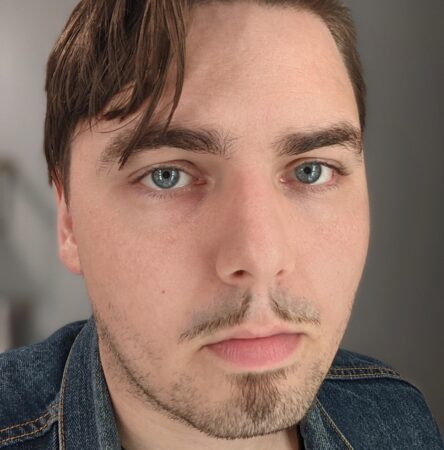
| I was done up in pale powder and period costume, neatly combed and asked to shave. I look totally different, which was exactly the point. | He looks weird, like a ghost. Which is funny. It’s been so long and, especially with this goofy getup, I almost don’t recognize him. |
—from Eric Boyd’s “Ikiryō” (Volume 66, issue 4)
Your piece has two stories happening side-by-side. How would you recommend we read it?
I’d definitely prefer if people went back and forth throughout. Left sentence, right sentence or vice versa. It should feel slightly disorienting, maybe a little hypnotic. If it were a song it might be like Philip Glass’s “Einstein on the Beach,” where there’s multiple vocal tracks playing different things but their repetition allows you to follow along well enough in the same way this piece is often “I opened the door / he opens a door;” this is a piece that’s more about intonation than forward momentum.
What was the first thing you wrote that you were proud of?
Forever ago I wrote two different pieces to submit to Joyce Carol Oates for Prison Noir: one that I thought was exactly what they were looking for—hard, gritty crime shit with a twist ending—then one that I submitted literally as a ringer, like a wingman, that was so insular and metaphorical and sensitive that I figured the first one would look so good in comparison. Guess which one got published? The one that, in the end, was more from the soul.
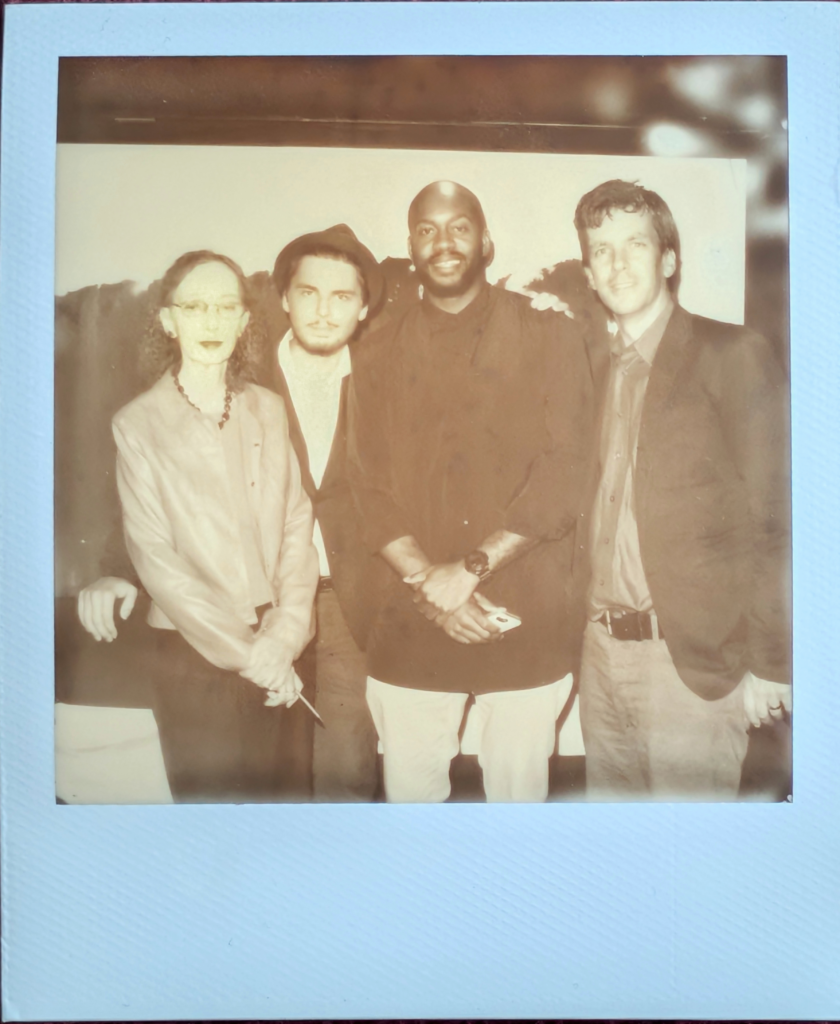
As far as just pure enjoyment, pure satisfaction with a piece of writing goes, I’d probably have to say my piece published in The Rose Books Reader last year. That was maybe the first time I wasn’t trying to do something, you know what I mean? I wasn’t trying to be the tough jail writer or the blue-collar Pittsburgh guy. It was freer, a little more experimental, much closer to my piece in MR. I get so tired of living up to some imagined expectation of what makes sense for me to write. I just want to write. I’m getting there.
Share some of the best things you’ve been reading or watching recently.
Really loved Female Loneliness Epidemic by Danielle Chelosky. I feel heartened by the return of autofiction. It’d be easy to label the genre as self-obsessed but I think self-exploratory is more apt. People are so bombarded it’s easy to lose yourself, so being steadfast in holding on to that is important. We’re living in a world where people speak and live in their truth as opposed to some idea of the truth. We’re in a universal solipsism where the world is made up of eight billion islands. When someone writes about their individual experience they’re offering their half of a drawbridge; the reader can offer theirs back and create that connection, that relationship— keyword relate. Also loved Matthew Gasda’s Writer’s Diary almost as a living example of that drawbridge concept.
I watch a lot of films. Sometimes three or four a day if I’ve fallen behind a bit. I couldn’t believe how well Kristen Stewart adapted Yuknavitch’s Chronology of Water. Amanda Kramer is one of my absolute favorites right now and her latest one, By Design, is incredible. Then I’ve fallen down a rabbit hole of watching films featuring Joshua Burge. That guy is probably one the best American actors working today. Makes me want to return to screenwriting.
After all this, I feel obligated to ask: Do you have a Letterboxd?
Yes, but most of my reviews are on Instagram reels.
Do you have any unpopular opinions or advice about writing/reading/literature?
I think speculative fiction helped give rise to Donald Trump, which is why I welcome the return of autofiction/realism. People had their head in the clouds for so long during the Obama years they lost sight of the growing horrors on the ground. Obviously there are amazing spec authors out there; what I’m saying comes with the caveat that only bad work is bad etc etc.
Where are you drawing the line between speculative fiction as political escapism and as translation (ie using it to more easily understand one’s surroundings)?
So I think the question hinges on the word escapism, which is largely irrelevant in this information-soaked age. To that end I feel the best spec fiction right now strays far away from escapism and leans heavily into catharsis. It acknowledges the world and offers an outlet to show your disgust with it, possibly even defeat it. To me it’s the difference between Thomas raging against the dying of the light instead of covering his eyes as it goes out.
Do you have any special interests?
Ever since Covid I began collecting perfume, mostly for fear that I might lose my sense of smell; I wanted to catalog as many beautiful scents as I could in my mind. Thanks to late-stage capitalism I’m able to be really irresponsible with my money and use PayPal or Klarna to buy perfumes I probably shouldn’t be buying.
I recently modded an Atari VCS console into a PC running Linux and I’m using it to work on a project. It’s almost an attempt at method writing, I feel using such a niche, esoteric device suits the character.
Then I design puzzles and bartend a little (for the same day job!) I want every interest of mine to dovetail into every other interest. In my writing room I installed a brass bar rail to rest my feet. When I’m coming up with a cocktail it’s usually inspired by a film or book I love, then I build the recipe based on perfume notes I like. It’s a lot of small, goofy things that keep my mind focused on stuff I love. In the past I’ve allowed myself to operate from a place of spite and a need for vindication; now I just want to surround myself with things I love.

Is there a cocktail or scent that you recommend pairing with “Ikiryō”?
For Valentine’s day at the bar this year, I did have an idea for two cocktails which could be combined into one, and that would be some sort of metaphor for love and relationships. This story could kind of do the same thing, couldn’t it? Probably the absolute easiest existing cocktail would be a New York Sour, which is just a whiskey sour with a floater of red wine on top. Where you’d normally use egg white in a sour to cut down the tannins from the lemon, you play into it with the red wine. The idea of this bitterness floating at the top of something sour, somehow both separate and inextricable from the main drink, seems fitting.
While we were planning for this interview, you had mentioned that there was a piece you wanted to recommend. Will you share that piece with us now, and maybe comment on it?
I just can’t get over Caligiuri’s piece. It feels so epic, so all-encompassing. But it shifts from big to small, broad to intimate. It has these beautiful, poetic lines, but then it has some that cut right to the bone like, “It all went to you! The money and the love and the time.” It’s just heartbreaking stuff.
Then just from a personal level I can’t get over how many times he and I have been like ships in the night. This isn’t the first thing we’ve appeared in together but I’ve never gotten to actually meet the guy, congratulate him not only on his writing but the tremendous effort he continues to make for the incarcerated community, all that. Folks like him, like Caits and Nicole, they just make the world a better place—and not through escapism.
ERIC BOYD‘s work has appeared in The Rose Books Reader, HAD, and Guernica, as well as the anthologies Prison Noir (Akashic Books) and Words Without Walls (Trinity University). He is a winner of the Foundry Prize in Fiction and a PEN Prison Writing Award. Boyd edited The Pittsburgh Anthology (Belt Publishing) and is currently working on a novel about train hoppers. His website is Eric-Boyd.com