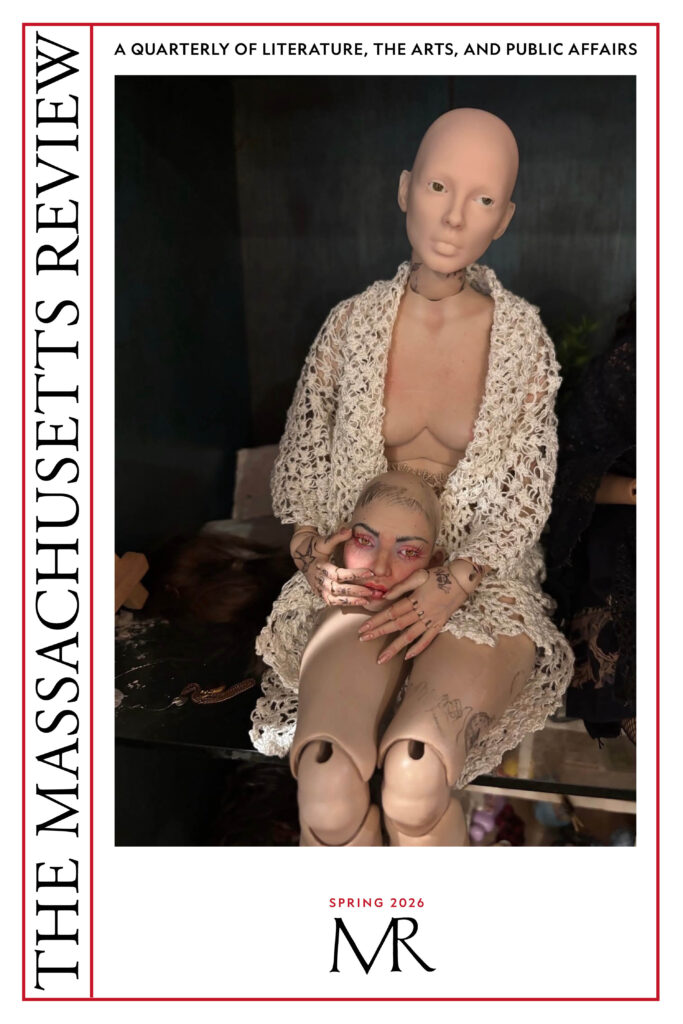

Night Night, and Fuck You

A Review of Night Night Fawn (One World 2026) by Jordy Rosenberg.
Among many human beings it is customary—has been, for a long time, in all kinds of places—for the act of giving birth to convey upon the birther a combined legal standing, quasi-proprietary status, cultural role, and economic function known as “motherhood.” If the baby lives, one is generally considered a mother—socially speaking—regardless of how or even whether one mothers (albeit, as with everything “universal” under cishet racial capitalism, many exceptions apply). Yet, at the same time, paradoxically, mothering is very often a project that bears no relation to motherhood; and furthermore, even when one is a mother, doing mothering doesn’t necessarily stabilize maternal title at all. A too-comradely mothering effort might, in fact, accidentally call into question one’s embodiment of the patriarchal institution altogether. On the flip side, one doesn’t have to be a woman or even an adult to participate. Anyone at all who engages in peoplemaking, I submit, is best understood as a “mother-er,” that is, someone who mothers.[1] This is a labor that must and shall, I hope, one day be diffused across our communities and decoupled completely from its present definitional overlap with femininity.
In recent decades, various queer communists and communards have wagered that it is possible to pit mothering against motherhood, collectively and politically.[2] Contrary to what one might assume, in other words, the verb can unmake the noun—or so America’s gay and lesbian radicals posited in the 1980s, as have black feminists and other feminists of color more recently. In the vital 2016 anthology Revolutionary Mothering, Alexis Pauline Gumbs enjoins all to “take the word ‘mother’ less as a gendered identity and more as a possible action, a technology of transformation that those people who do the most mothering labor are teaching us” (23). In her phenomenal book This Watery Place (2025), Emma Heaney similarly theorizes conception, gestation, birth, and postpartum “as processes against the static image of the mother” (10). Far from auto-generating “motherhood,” she shows, the materiality of gestating makes a mockery of cisness, individuality, and maternal identity. Another way of stating this is that the relation between the institution and the many embodied labors is dialectical. Probably the third thing yet-to-come—the as-yet-nameless thing that is neither of the two but born of their conflict—has yet to emerge fully into the web of history. In the meantime, the dynamic between mother qua private property and mother qua incipient struggle to communize care for all people will remain one of “irresolvable conflict-and-yet-entanglement,” as Jordy Rosenberg’s narrator Barbara puts it in his new novel, Night Night Fawn.
A fawn is, of course, a baby vis-à-vis the deer. But here the mommy-baby dyad is turned on its head, since “Fawn” is the name of the dying Barbara mothered into oblivion by her child—or rather, of an unflattering double of Barbara whom Barbara discovers, much to her horror, in a notebook. The one tucking Fawn in and turning off the lights, in a manner of speaking, is the baby stag who managed, against all odds, to flee and survive her. For many years, Fawn’s spawn has been absent, incommunicado, elsewhere; in other words, successfully repelled and alienated. Now, however, he is intermittently back: at his mom’s bedside in her hour of need, proffering practical ministrations that the hateful old lady would rather receive from literally anyone else in the world. Could we not view this perverse scenario, too, as a mothering against motherhood? What if, asks Night Night Fawn, a trans survivor of a sadistically anti-trans childhood deploys the force of their own queer cosmonautical birthright—a need for or utopian entitlement to the giving and receiving of abundant, comradely mothering—in all willful persistence against the violent harms of their mother? What if, furthermore, they embark on this project from inside their mom’s brain?
Barbara Rosenberg (née Horowitz), of the Upper East Side (formerly Flatbush), is a fabulously witty, brutal, and cruel mother, high off her skull on Oxycontin, and dying of cancer. She cares about cis-sexuality, straightness, men, conventional beauty discipline, two-ply toilet paper (or the financial success it signifies), and assimilation. “I am pretty sure,” she brags of a date that took place in her early twenties, “that if a blindfolded person had been sitting at the next table, on hearing my teeth click lightly against the silverware (as I closed my teeth, but not my lips, and swallowed), they would have sworn they were hearing a WASP eating soup.” During a stint living in a military outpost called Ramat Gan in occupied Palestine, she also comes to care about Zionism, a fascism which handily synthesizes several of her other passions. “I suppose I ought to have protected my daughter from this brutal hazing,” she muses, misgendering her child as usual in the context of Israeli pre-teens queer bashing the young “bulldagger” Jordana. “But to be honest it was a relief” to outsource the job to others. “I found myself rooting for this throng of bullies.”
As Davey Davis notes in their insightful review of Night Night Fawn, the rationale of Barbara’s relatively delayed latching-on to the cause of Jewish-supremacist ethnonationalism affords us “a very effective demonstration of how the logics of one violence inform the other”—specifically, settler-colonial annihilation of the native, and cisness—without conflating their scale:
As a self-proclaimed yenta failed by her identity, Barbara trades it in for the death cultist’s access to self-importance and belonging; for something that is, for once, as she puts it, ‘entirely about me.’
Since, for Barbara, motherhood is the manufacture of cisness, marriage, bourgeois security, and immortality for one’s own ego, the mere existence of her child in the world makes a failure of her identity. So, re-enter Zionism—the doctrine alluringly “emulsified in silver halide and projected onto a screen in three-act structure” in her youth for every Brooklynite’s absorption in the form of the 1960 blockbuster Exodus (this being the same natural, indispensable three-act structure that gender-queerness fundamentally defies, according to Barbara). While Exodus hadn’t really won her at the time, years later, the cause of ethnically cleansing a fantastical “promised land” proffers itself as a ready alternative outlet for her narcissism.
In this way, Night Night Fawn consists overwhelmingly of Barbara’s unconscious self-condemnation-cum-charm-offensive. Coruscating, riveting, louche, she delivers a sharply observed autobiographical account of her long and, in her view, thwarted life (in Brooklyn, Israel, and Manhattan) that is simultaneously an unintentional record of a kind of ordinary evil—Zionist, cissexist, homophobic, and maternal. If I were her trans Marxist son, I, too, would take revenge on her by putting all kinds of Marxist concepts, including the definition of dialectics, in her mouth as I virtuosically ventriloquized her selfhood after her death, and slowly prepared to have her hang herself with her own rope. “I didn’t give birth to an ugly freak,” Barbara spits at one point: “You’re the biggest mistake of my life.”
There is nonetheless an electric degree of brokenhearted authorly respect, here, for the target of his own joke-studded vengeance. Barbara is quite simply as cunty as people come. (“Unlike certain people I’m not writing a novel,” she quips at one point, breaking the fourth wall). Yet there is no sentimentality attached to Rosenberg’s treatment; and no forgiveness, since none has been earned. Far from to forgive all, in this book, to understand all is precisely to entertain the loving and revolutionary imperative of non-forgiveness. After all, who do we doom, when we make peace with their murderers? Non-didactically, Night Night Fawn presents a non-reparative ethic of kinship to the reader on a little tray like an oncological pill.
It may well be, of course, that the tray in question is most readily visible to readers for those of us who are queer and trans refugees from the family-form, or—I imagine—direct victims of the state of Israel. Many may try to overlook it, because the story of Mrs. Rosenberg and her son, to quote Davis again, “goes up against one of liberal art’s most deeply ingrained fantasies: that an unlikeable character can be redeemed through empathy; that by coming to understand why they are the way they are, the reader initiates the transformation that reunites them with the people they’ve alienated.” To my eyes Night Night Fawn is not, or ought not to be, legible as the product of the familial doctrine of grieving that is teleologically geared toward quiescence and conciliation. This admittedly can be discomfiting, and—alas—liberalism’s ability to find familial-humanist redemption in the most unlikely places has once again shown itself undefeated. Already, Barbara’s self-portrait has inspired one reviewer to muse on the fact that family members can be “charming, misinformed, even brutal” all at once; that we all contain “many truths,” in short, and are “frequently wrong, but sometimes delightfully so.”
Make no mistake: it is at Barbara-the-narrator’s cancer deathbed that the author is saying “night night,” and perhaps, semi-audibly, fuck you. Even as hundreds of pages have brought this parent to posthumous life, the overarching “night night” carries the force, dare I say the satisfaction, of obliteration. In Rosenberg’s climactic image, it is as though the book itself has become a giant, ragged, mite-infested bird flying across New York City—swooping eventually up into outer space—with Fawn/Barbara’s body “waving in its beak like a flag.” Inside the text, up until this moment, the wet-eyed bird has been the present-day incarnation of Barbara’s son—the transmasculine carer we know (again) only as “Jordana.” On and off, this magic-realist avian incarnation of Barbara’s progeny flickers between meanings: at times, we seem to be dealing with her oxy-addled, hallucinatory, transphobic perception of her filial bedside attendant. At other moments, the bird appears as an angel of death, a projection-ridden monster, or an actual bird. Whether this “is” or “is not” the author himself, it is Fawn’s ex-estranged baby who is now a scary, feathered adult bringing green juice, administering pills, chauffeuring her to hospital visits, and engaging in despair-filled screaming matches with his incontinent gestator.
Metatextually, it strikes me that it is this “mannish,” reluctantly received form of mothering—a labor of love and hate reluctantly provided by the Rosenberg family’s species-ambiguous “gender disaster”—that turns Barbara into someone else, a fiction, namely: “Fawn.” And isn’t that what Barbara’s annihilatory style of mothering has sought to do for decades—i.e., turn her child into someone else, something fake? In the final moments of her consciousness, soaring through space just like the science-fiction lesbians her despised “daughter” loves to read about, the thing that makes Barbara realize she is dying is the fact that, “on top of everything,” she is dreaming the bird’s dreams, “science fiction dreams.” Her self is disintegrating such that, within moments, her “golem” offspring will be the only one left to represent her: “Soon Fawn will be only the part of her that is the bird.”
Part III of Night Night Fawn is entitled “Vogelfrei,” a word which one hopes, in German, will mean “free as a bird,” but which in fact used to refer in early-capitalist Germany to a legal category of banishable outlaws who could be denied both life and burial, as in, abandoned to the birds—a fate that Barbara believes awaits all queer people. Queerly, from an early age, Barbara’s child wants to “fly into orbits,” to take flight and “love the sky with women,” to elude three-act structure, and to “accoutre [him]self out of the misery of femaleness.” It is a desire, a utopianism, that horribly enrages Barbara, who is unable to see that her own straight life has devolved into something perilously close to kinless vogelfreiheit in her old age. Too bad for Barbara: “cockamamie” Marxist lesbianism turns out to be the imperative that wins. Somehow, out of the cursed “double freedom” of proletarian life (i.e., the infamous capitalist combination that Marx observed, of being “free” from having and “free” to work), a moment of real freedom has dialectically erupted. Here are two differently-gendered mother-ers orbiting the sky together, bound by an anti-liberatory institution, on the one hand, yes, but bound also by a leap of the bird’s imagination, turned praxis. It is at once an image of divine justice for queer youth, and a hint of a future in which, to borrow from the family abolitionist M.E. O’Brien, people aren’t “bound together violently any longer.”
SOPHIE LEWIS (@reproutopia) is a freelance writer and ex-academic who lives in Philadelphia (go Birds, fuck ICE, free Palestine). She only rarely goes back to the UK, France, and Germany, her places of origin. She is the author of innumerable essays, as well as four books so far: Full Surrogacy Now (2019), Abolish the Family (2022), Enemy Feminisms (2025), and Femmephilia (2026). You can find her work at http://lasophielle.org/, or on Patreon.
[1] Sophie Lewis, “Mothering against Motherhood: Doula Work, Xenohospitality and the Idea of the Momrade,” Feminist Theory 24(1), 2022.
[2] For more on this concept, see Alexis Pauline Gumbs, “Mothering,” Parapraxis 15 July, 2025; Sophie Lewis, Full Surrogacy Now, Verso, 2019; Andrea O’Reilly, “Mothering Against Motherhood: The Legacy of Adrienne Rich’s Of Woman Born,” Women’s Studies 46(7), 2017.