

The Management of Misery: A Scholar’s Prediction for Gaza’s Future
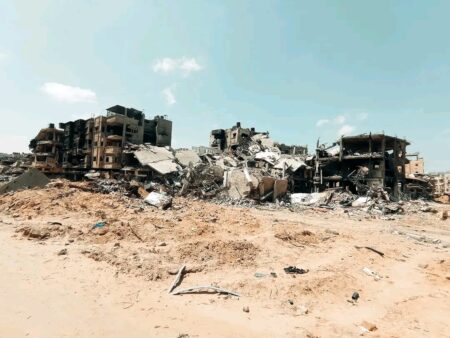
Destruction in Khan Younis, Gaza.
Gaza today appears like a place where crises are not managed but accumulated, where collapse is not accidental but deliberately engineered—in full view of the world. Between the warnings of yesterday and the realities of today, a more unsettling question emerges: are we witnessing the early stages of a trajectory that may not reach its peak until 2034?
In 2019, Professor Abdel Qader Jarada, a prominent judge with more than twenty-four years of experience in the field and over fifty books and specialized studies on Palestine’s sociopolitical transformations under his belt, published a bleak prediction for Palestine’s future: accelerating Judaization, i.e. the expansion of Israeli settlements and policies aimed at altering the demographic and geographic reality of the Palestinian territories, rising poverty, suffocating unemployment, and endless political division among Palestinians themselves. At the time, he clearly warned against continued political negligence, stressing that entering 2023 without fundamental solutions would inevitably cause a comprehensive collapse, unless corruption was curbed and the national course corrected.
These predictions did not emerge from speculation, but from a rigorous reading of Israeli political trajectories, the rise of religious far-right governments, regional shifts, and the hidden agendas operating behind the slogans of “security” and “deterrence.”
Former Israeli Defense Minister Benny Gantz had already warned about a potential security escalation in 2023. With extremist forces firmly embedded within Israel’s ruling coalition, these warnings were not casual remarks, but reflected a structural shift in the conflict’s nature: what had long been managed as a political and security confrontation was increasingly taking on a religious and ideological dimension, as shown by the attacks on Al-Aqsa Mosque, which framed Palestinian presence as an existential threat.
Ramadan 2023 was not the climax of escalation, but the beginning of a prolonged trajectory of systematic religious violence—one that, Jarada warned, may not reach its peak until 2034. In 2026, this trajectory is already affecting Palestinians’ daily lives. We see repeated attacks on holy sites, including the Al-Aqsa Mosque, often led by extremist settlers under police protection. At the same time, policies and restrictions on movement continue to make daily life unpredictable and dangerous for Palestinians, who are often prevented from reaching schools, workplaces, and hospitals.
What we are witnessing today is not a temporary aggravation. Many of those warnings appear either fulfilled or rapidly approaching fulfillment. Gaza is no longer merely a “humanitarian disaster zone” in the conventional sense; it has become a territory where life itself is being deliberately stripped away.
The human toll alone is only part of the story. More than a quarter of Gaza’s population is either dead, injured, or detained. But beyond the human cost, the physical and economic foundations of life have been almost entirely dismantled: over 90% of infrastructure—including agricultural and economic systems—has been destroyed. Multiple UN reports from late 2025 document extensive damage to housing, health, water, and sanitation systems after two years of war. The collapse extends deeply into the economy, with contraction exceeding 80%. All 2.3 million residents were pushed below the poverty line. Near-total food insecurity prevails. Essential systems that sustain daily life have also broken down. Schools no longer function, universities have effectively ceased to operate, and hospitals, where still standing, lack both the equipment and capacity to respond to overwhelming needs. At the same time, crossings remain closed, and the siege has been reimposed with unprecedented severity, cutting Gaza off not only from movement but from recovery itself.
This is especially significant for the so-called “buffer zone,” meaning the areas along Gaza’s borders where Palestinians face severe restrictions on everything from farming to construction and freedom of movement. Jarada argues that this reality is likely to persist for years. Even if the occupation withdraws a few kilometers, it often returns at the first pretext, permanently cutting off significant portions of Gaza, destroying homes and farmland, and creating unprecedented demographic and economic suffocation. Understanding these spatial and political constraints is essential when evaluating any reconstruction plans, as partial measures cannot address the root causes of Gaza’s isolation and systemic deprivation.
What is often presented as “reconstruction,” which is estimated to cost in excess of 100 billion dollars, increasingly appears as an illusion, shaped by political narratives that obscure more than they reveal. Trump’s proposals include transforming Gaza into a “freedom zone” or a major economic hub under international oversight, or large-scale redevelopment projects, including smart-city initiatives and investment-driven frameworks aimed at creating a “prosperous” Gaza economy.
Jarada argues that despite public optimism toward these initiatives in Gaza itself, what is being offered amounts to partial measures incapable of addressing the roots of the catastrophe or sustaining long-term recovery. As he told me in an interview I conducted last year, “reconstruction without sovereignty, without lifting the siege, and without a national political project is not the restoration of life—it is the management of misery.”
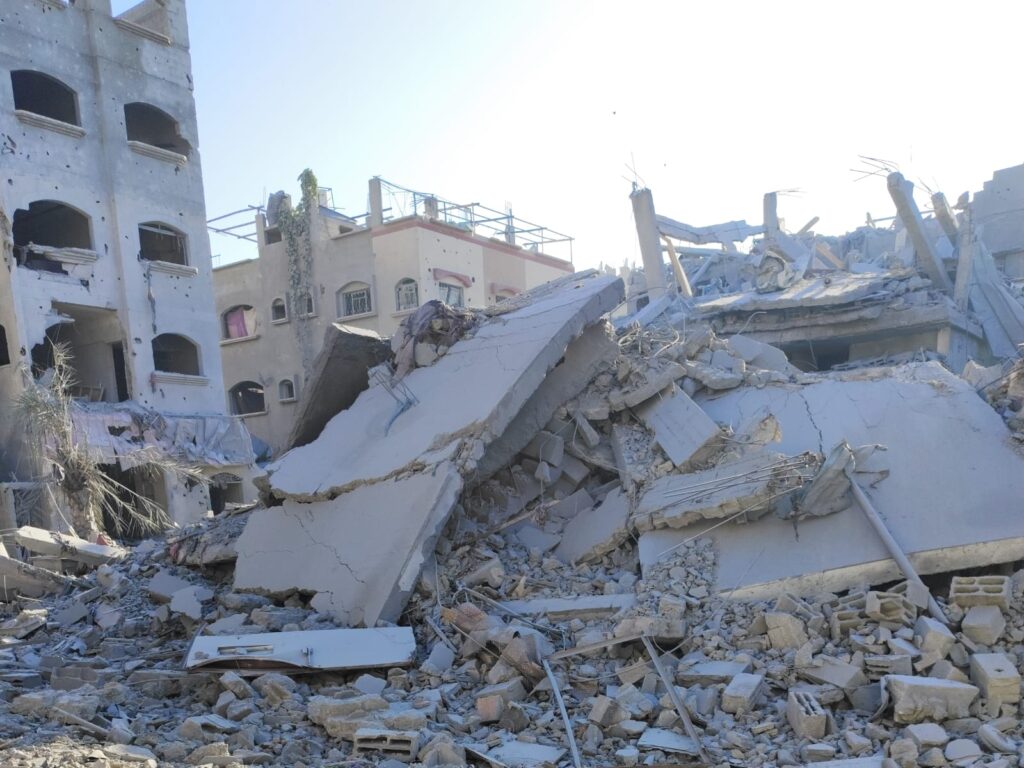
Destruction in Beit Lahia.
He also warned that the occupation was preparing for a major regional event that could erase Gaza entirely from global attention. This is no longer a distant possibility. Escalation in Lebanon and the growing confrontation with Iran are already reshaping regional priorities and media focus.
Thus, the war after the war is more vicious than war itself—a cold, prolonged dismantling of human existence and meaning, without intense bombardment, yet far more destructive.
Gaza is on track to transform from a (part of a) homeland into a field of aid dependency, fragments of temporary solutions, and so-called “model cities” that would accommodate not even 1% of those who have been displaced and are now living in tents.
As for dreams of returning to the pre-division era or reviving a conventional peace process with Israel, Jarada dismisses them as a historically hollow reading. Netanyahu’s writings and political discourse repeatedly affirm his reliance on “deterrence-based peace” and “politics of fear,” not coexistence.
To understand Gaza’s future, one must study both the past and the present. The equation today is unmistakable: Gaza is not being allowed to recover—it is being managed to remain on the edge of collapse.
Unless this trajectory is politically broken, the question will no longer be what will Gaza look like in 2030 or 2050? But rather: will Gaza be allowed to exist at all?
Jumana Maghari is a 25-year-old journalist with a BA in English from Al-Aqsa University in Gaza. Her writing is driven by a passion for amplifying voices of resilience amid adversity, and has appeared in the Washington Report and Electronic Intifada, among others. Additionally, Jumana works as a project coordinator at Dar Al-Sabeel Orphanage in Gaza City, directly supporting orphaned children, and offers English courses to those eager to enhance their language skills. In the darkest of times and under immense pressure, Jumana discovered the strength to return to her work and reclaim her existence through writing.