
Interview with Morteza Dehghani
Editor’s note: Upon being invited to participate in our interview series, Morteza Dehghani, translator of Souri Ahmadlou’s poems “2.” and “3.” from Volume 67.1, offered to write the following experimental piece “about the art of translation,” centralized around the questions of what attracts him to a piece, why he translates, and what translation of poetry means to him. The visuals are from his notebooks.
a. To delight in the draft.
b. Will I be able to help it grow,
will it help me grow?
c. Translation, a blueprint
of my mind’s transformation;
d. Being open to change.
Body and mind of poems change,
to keep their unity, to have a form.
e. I translate, therefore I am
not the person I was before I slept
with the original
and the translated poems
at the same time.
f. I create my own version of a work.
g. Pragmatics means
Do I love the work in Farsi?
Will I love the poem in English?
Do I really understand the work?
Has the poem ever been translated before?
h. To say building a new home
might sound like a cliché;
but, well, building a new home.
i. Put on that new garment, poem! It’s cold in here.
Get naked, poem! It’s hot in here.
j. Poetry is impossible to translate
and that’s exactly why I translate it.
k. An inversion?
What draws with light
is a photograph.
Between day and night;
in-between colours translate;
a flowering into,
a flowering from…
What is day?
What is night?
Is one translation of the other?
I’d love to bring poets
from my mother tongue
along with me to this new home;
a geography against loneliness.
l.
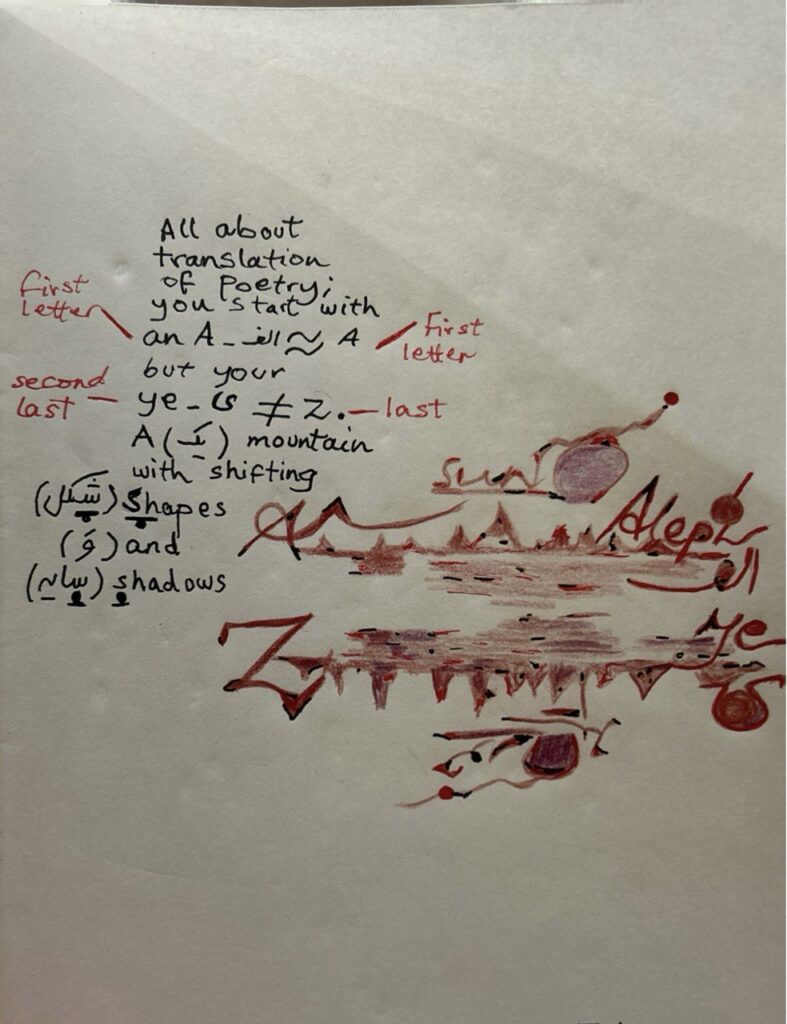
m. Accommodating
a sun in the night,
a moon in the day.
n. Building
a second self
is not necessary;
we are always becoming
something.
o. To animate
the inanimate:
can a silence,
can an intuition
cross over with me?
p. To say be,
and doubt if it ever will,
to say become
and, well…, doubt it.
q. A new beginning,
translation is a moment:
if I’m happy with a line I translate, that is tantamount to an epiphany.
r. Translation captures and reflects my inscape.
s. Translation is my limits brought in on a platter;
to be between a desire to work on a piece and the fear of challenges.
Between the love of the work and a realization
that I won’t be able to do justice to it.
Translation justice:
I wonder if the two plates ever even out or equate.
t. A road lost, another road found.
A book slowly rendered
into a book on the recto;
my draft, I, as a draft.
It’s almost impossible to have
the same number of words,
almost impossible to have
one word stand for another,
one moment here for another there,
the month of September for the Mahe Mehr,
one doesn’t exactly fall on another,
almost impossible to say
a rood-khaneh, a river, and not miss on its home
because it actually says river’s home,
because the word means music too, or perhaps song,
and even is an offspring; the kid of spring;
especially when mothers lament
for their kids, rood, rood, rood,
as they mourn their children, and beating their chests.
But can I be happy? We are lucky
to see the same stars everywhere.
The world is not small, as they say,
if you look in, if you look out.
And don’t laugh if I say true true, this is
infinitesimal, this world
of infinitudes; our languages.
My world can perhaps grow with a new tongue.
A word longs for another word;
and like lovers who were separated
always look for their hidden halves.
If you say home and see khaneh
if you see khaneh and read home;
this is like
our desire to reach,
because a word glows with longing,
this is how a word feels homesick,
how it seeks to rejoin.
Almost impossible is not impossible.
My joy is the joy of a hungry horse,
alone on a green pasture.
u. Reading
from left
to write
in English
I go.
Rendering
them from
right to left
in Persian
I come back.
Or
just the other
way around;
transliteration
directional
synesthesia.
v. I run into a poem I can’t translate;
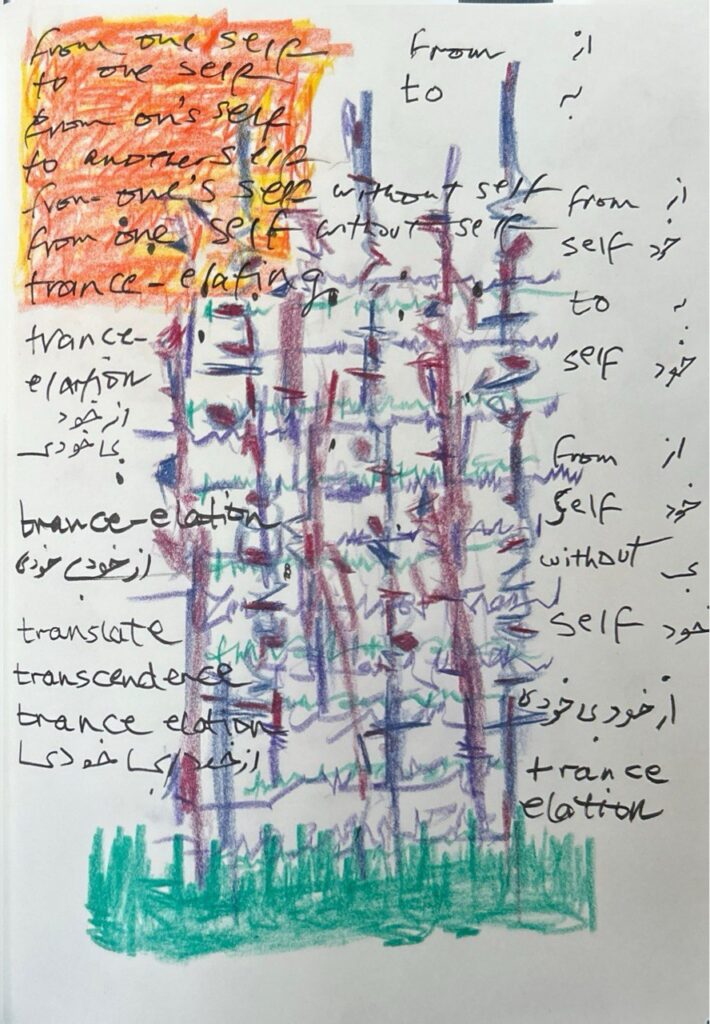
I find myself coloring, instead.
Here’s my translation of the work in colors;
not translation, but trance-elation; az khod bi khod shodan. از خود بی خود
I scribbled trace-elation in both languages.
I colored trans-elation and let the colors elate.
Any translation is coloring.
Life as trance-elation;
life, a work always in progress.
Creating something out of chaos.
w. Any translation is experimenting.
x. Looking at the inner and outer color palettes in transition,
I see a bringing together; the crack of dawn and dusk
when lines appear on the horizon:
y. Lips to lips, soul to soul, self to self, tongue to tongue, body to body, geography to geography, culture to culture:
z. Love. Peace.
MORTEZA DEHGHANI is a poet and literary translator. His translations have appeared in Michigan Quarterly Review, Poetry Northwest, and The Kenyon Review, and his poetry has been shortlisted for the Malahat Review Open Season Awards and Long Poem Prize. Morteza is currently an MFA student in creative writing with a focus on poetry.