
Interview with Carlos Andrés Gómez (Audio + Text)
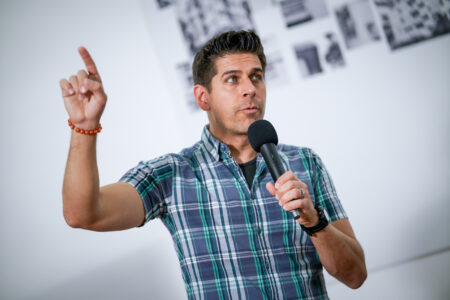
Photo credit: Eloi Scarva
Note: This is an edited transcription of an interview conducted over Zoom. The full interview, featuring more in-depth answers and back-and-forths, is available below. Gómez reads his poem “Fillers” from 11:06–13:17.
Tell us about your relationship to writing, especially poetry.
It was a very, very long shot for me to be a writer at all; I didn’t learn to read until I was nine years old. I had a very hard time learning how to read and write, and a very hard time learning how to actually speak English (which, for anyone who’s tried to learn English after knowing another language knows, it’s a very maddening, nonsensical language). The premise of literacy gave me a lot of anxiety through most of my childhood; it felt like an impenetrable fortress.
When I was seventeen years old, two catalysts radically changed my relationship to reading and writing. The first was this independent film called Slam, starring Saul Williams and Sonja Sohn; it gave me a glimpse into a way that poetry could be embodied and expressed that I didn’t know was possible. A couple of months later, Martín Espada came to my high school and read from his collection Imagine the Angels of Bread, and I just sat in the back row and wept. I bought a copy of his book and he signed the inside cover and wrote, “Para Carlos, poeta del futuro —Martín Espada.”
Poetry was something that I think found me at a time in my life when I was really, really struggling, and really lost and really depressed, and it kind of pulled me back from the precipice. That was about twenty-seven years ago at this point, and it’s been a lifeboat for me ever since.
Will you talk a little about the themes of the poem? Masculinity in language, language as violence, but then reckoning, also, with language as the thing which inhibits or defers violence. . . Were there other ideas you were grappling with during writing “Fillers”?
I’d be remiss to not mention that we’re meeting on the day after Trans Day of visibility, and this poem is reckoning with transphobia. There is so much embedded in language that is inherently racist and classist and sexist and transphobic and on and on and on, things that reinforce hegemony and patriarchy and capitalism. . . And thinking of reconnecting with somebody very dear to me whom I hadn’t spoken to in a long while, thinking of a throwaway aside that I say all the time and noticing how I perceive her clocking it. . . Considering the weight and the consequence [of this language], which is separate from the intention.
It’s like the curtain is pulled back. I think I tell myself these stories about how much work I’ve done, or how much I’ve unlearned, or how much I’ve counteracted so many of the deeply destructive and horrifying and toxic narratives around how I was taught to exist as a man in the world, and then you have a moment like this, and you think, Oh my gosh, look. Look what I’ve done.
Often, when I’m trying to take on something so big and unwieldy as white supremacy or transphobia or colorism or something else, is, I want to kind of peek through a really narrow shred of light—a window that’s slightly ajar—and look at a precise, specific moment to consider these things. I think my inclination is also to put the mirror on myself, or to think about, How am I implicated? How am I complicit?, rather than pointing at somebody else (which feels dishonest to me, because I think that’s that’s most of what I see in the world).
Form-wise, how did you settle on couplets for this poem?
I feel like [a poem] organically finds its way as I’m drafting. I’m not going to start with couplets, but then it sort of finds its way there. And it seemed to just make sense, considering that it was me and this other friend and the shared moment; two people, two-line stanzas. There’s something that feels very classic about that, and very simple and very spare that I think I wanted. I didn’t want anything to get in the way of the thing that I was holding up to the light. I wanted to invite people to bring their attention and reflection and examination to this moment. I didn’t want it to be cluttered. I was never planning it to be a prose poem or to be quatrains—not that you can’t tell a great story in quatrains, but—something just felt like it needed to be couplets.
What are you reading right now?
You should see the books piled up on my bedside table. It’s madness. And my partner’s a librarian, so it’s just—oh my gosh. We adore books. (And then, any time we move, we just hate books so much.) What am I reading? Holy Dread by R. A. Villanueva, which is spectacular; One Day, Everyone Will Have Always Been Against This by Omar El Akkad (which is incredible, I know it’s won everything); Patricia Smith’s book, the one before she won The National Book Award; Hanif Abdurraqib’s There’s Always This Year. . . That’s a short list of where I’m at right now.
What are you working on now?
There’s a lot in the works. The closest one to being able to say anything about (that’s meaningful and that I’m allowed to) would be my full length poetry collection. That’s kind of the the one that’s been cooking for about for about five years, and that’s usually the earliest I’m going to release another poetry collection. . . I know. I know it seems like all my friends put out a new book every nine months, but I’m five or six years at my fastest.
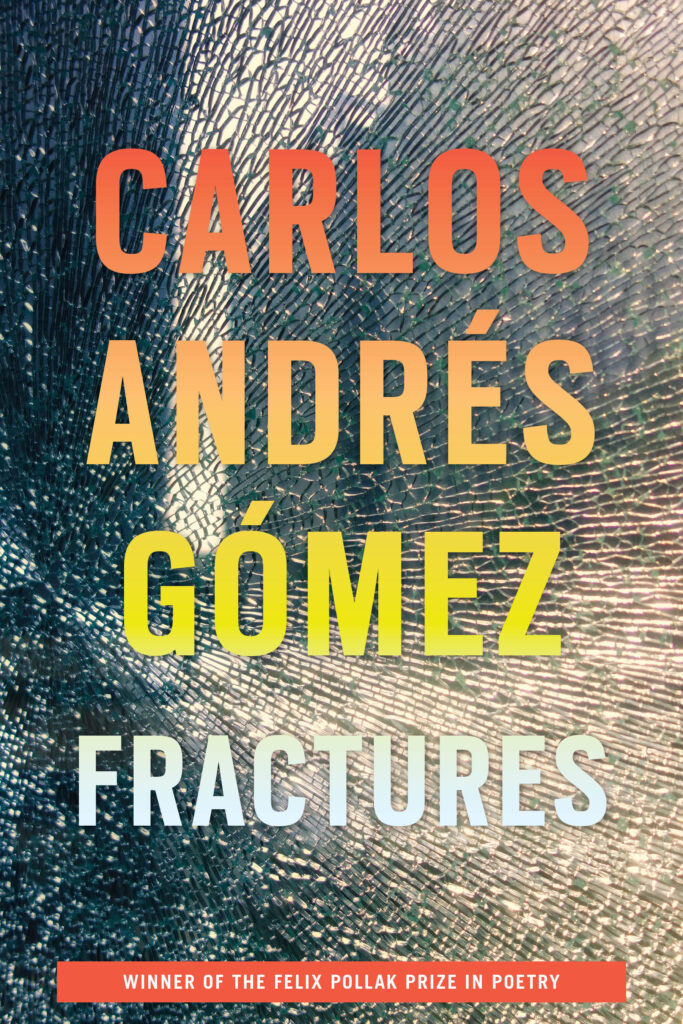
CARLOS ANDRÉS GÓMEZ is a Colombian American poet from New York City. His poetry collection Fractures (University of Wisconsin Press, 2020) was selected by Pulitzer Prize winner and 19th U.S. Poet Laureate Natasha Trethewey as the winner of the Felix Pollak Prize. Winner of the Foreword INDIES Gold Medal and the International Book Award for Poetry, Gómez has been published in The Nation, New England Review, Academy of American Poets’ Poem-a-Day series, The Yale Review, BuzzFeed Reader, Poetry Unbound: 50 Poems to Open Your World (W.W. Norton & Co., 2022), and elsewhere. Carlos is a graduate of the University of Pennsylvania and the MFA Program for Writers at Warren Wilson College. He can be found @CarlosAGLive or CarlosLive.com