
Tangled Voices of Colonialism: Gabriela Cabezón Cámara’s We Are Green and Trembling
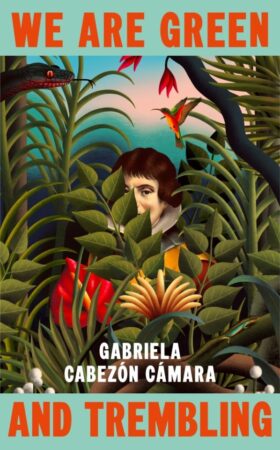
A review of We Are Green and Trembling by Gabriela Cabezón Cámara, translated by Robin Myers (New Directions, June 2025)
We Are Green and Trembling (2025), Robin Myers’s award-winning English translation of Gabriela Cabezón Cámara’s latest novel Las niñas del naranjel (2023) has already received significant international recognition, winning the 2025 National Book Award for Best Translation and earning a place on the longlist for the 2026 International Booker Prize.
At the center of the novel stands Antonio de Erauso—born Catalina de Erauso—the historical Basque explorer and conquistador who escaped a Spanish convent where he had been raised as a little girl and crossed the Atlantic in pursuit of adventure and reinvention. However, We Are Green and Trembling is less interested in heroic conquest than in memory, remorse, and the tangled afterlives of colonialism, as Antonio must help Mitãkuña and Michī, two young enslaved Guaraní girls, regain health and find their families. Through Antonio’s retrospective narration, the text reconstructs the colonial encounter not as a triumphal epic but rather as fragmentation: a world of overlapping voices, competing cosmologies, and irreparable violence.
In addition to emulating the English cadences of the late-sixteenth century, Myers’s translation preserves expressions in Guaraní, Latin, and Basque from the source text, developing a striking linguistic polyphony already familiar to readers of Cabezón Cámara’s other works. The result is a textual environment where multiple languages and registers coexist: the girls’ expressions in Guaraní, Antonio’s letter of atonement to his aunt, the Latin of biblical references, old Basque songs, and literary allusions ranging from Don Quijote to The Little Prince. Even the flora and fauna of the Misiones region of present-day Northeastern Argentina register their own forms of language through sensory imagery:
They melt into each other. They form a mountain that becomes a spring, bathing the brush in ferns and hummingbirds and caimans and little blue frogs, and they transform once more into two daughters with their mother. (189)
Sounds, smells, and tactile feelings blur the distinction between human and non-human experience. Friends, enemies, plants, and animals alike coalesce within the dense jungle environment through which Antonio moves and remembers. Like the vines intertwining around them, the novel’s multiplicity of narratives and registers wrap around one another to create a textured and immersive reading experience.
The novel operates across multiple genres. At its core, we find an epistolary structure, as Antonio writes a letter to his aunt while reflecting on his life and actions. Simultaneously, the text adopts the form of a colonial chronicle, recounting encounters in the New World from the perspective of a remorseful colonizer vis-à-vis the unexamined gruesome violence retold from the perspective of colonial authorities. Layered onto these forms are genesis narratives: the Christian creation story is told alongside the Guaraní creation story. The coexistence of these traditions destabilizes the singular worldview historically imposed by colonial discourse, and, instead, the novel foregrounds a plurality of origins and ways of understanding the world.
In terms of its formal elements, the novel is equally ambitious in its handling of time. Its multi-temporal narrative weaves together Antonio’s present act of letter writing, the events that led him to compose the letter, memories of his girlhood in the convent, his passage across the Atlantic, and the perspectives of the Bishop and his men as they enact brutal violence against Indigenous peoples, animals, and the environment itself. The result is a narrative in which past and present constantly merge into one another, suggesting that colonial violence cannot be confined to a finished historical moment but rather that it continues to reverberate across time and space.
Ultimately, We Are Green and Trembling participates in what I like to call subaltern historical fiction: fictional narratives grounded in historical events but told from the perspective of actors whose voices and/or actions are excluded from official history. In this sense, the novel enters into conversation with classics such as Chinua Achebe’s Things Fall Apart (1958) and Jean Rhys’s Wide Sargasso Sea (1966), as well as more contemporary works likeThe Moor’s Account (2014) by Laila Lalami, which reimagines the Narváez expedition of Florida through the perspective of Estebanico, the first Black explorer, erased from the colonial archive, or Jaime Manrique’s Our Lives Are the Rivers (2006). The novel also resonates with The Adventures of China Iron, Cabezón Cámara’s widely acclaimed feminist retelling of José Hernández’s Martín Fierro, which I reviewed for the MR Blog back in 2020 as well. Like that earlier work, We Are Green and Trembling interrogates the myths underpinning national and colonial histories, but it does so through a darker and more fragmented meditation on guilt, gender, language, and the will to survive.
Manuela Borzone is assistant professor of Spanish at Occidental College in Los Angeles, California. She received her Ph.D. in Comparative Literature from the University of Massachusetts Amherst in 2021.