
Repair Beyond Property: On Kyle T. Mays’s When We Are Kin
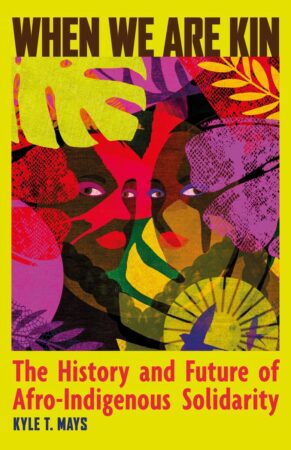
A review of When We Are Kin: The History and Future of Afro-Indigenous Solidarity by Kyle T. Mays. Haymarket Books, 2026.
A book subtitled The History and Future of Afro-Indigenous Solidarity might be expected to open on a scene of communion. Kyle T. Mays opens instead with its breakdown. In his first pages he recounts serving on a 2025 Santa Monica task force convened to address the harms the city had done to its Black and Tongva communities (1) — work that fractured almost at once, over who may claim Indigenous ancestry, whose injury counted as the worst, why Tongva land claims belonged in a conversation about Black redress at all, and whether solidarity was even the goal (2-3). Some people, Mays concludes, do not actually want to end white supremacy; they want a better seat at its table (4). It is a striking, almost perverse way to begin, and the book’s thesis in miniature. Mays refuses to romanticize Black and Indigenous kinship or mourn a solidarity some wish existed; he is interested in the fraught version that does exist, and in what it might require of people already divided by racial capitalism, anti-Blackness, settler colonialism, competing claims to injury, and a state that manages repair so that it never threatens the order repair was meant to address.
That refusal to romanticize is the strongest current in When We Are Kin, and it marks the book’s distance from the hopeful coalition-talk it might easily have joined. Mays is a professor of African American Studies, American Indian Studies, and History at UCLA, and an Afro-Indigenous (Saginaw Chippewa) writer who argued in his earlier book An Afro-Indigenous History of the United States (2021) that the nation was founded through the linked processes of enslavement and dispossession. This book takes up a question that one left open: when, exactly, did Black and Indigenous people actually unite against oppression?
Pressed on the “when,” Mays offers a long, intermittent, self-undermining arc. The earliest instances are colonial: the maroon communities of Spanish Florida, who fortified Fort Mose by 1739. Yet by the nineteenth century, the Five Tribes were enslaving Africans, and an 1823 treaty paid the Florida Seminole to return self-emancipated people to their enslavers: proof, for Mays, that Black and Indigenous peoples are “not natural allies” (p. 14). The pattern recurs with some Indigenous activists joining Martin Luther King Jr.’s 1968 Poor People’s Campaign, but many Indigenous peoples still felt marginalized within the campaign; Kwame Ture and the Black Panthers insisted the land claimed by the U.S. belonged to the Natives; down to Black Lives Matter and Standing Rock in 2016 and the brief solidarity of 2020, which Mays still calls momentary.
The book, therefore, shifts registers from historical recovery toward political theory, critique, and, finally, a manifesto. Its horizon is not policy but mino-bimaadiziwin, an Anishinaabe phrase Mays renders as “the good life”: not stable middle-class comfort while empire grinds on, but “an end to settler capitalism, a return of all Indigenous land, and an end to antiblack racism” (p. 120). Repair, in other words, must mean more than the liberal state can offer.
The argument moves through four compact chapters: beginning with a history of Black–Indigenous solidarity and its limits, a chapter on reparations that is the book’s analytic heart, a third chapter that carries Land Back discourse into the city, and a fourth gathers everything into a vision of co-resistance and co-belonging. Readers of Mays’s earlier work will recognize recurring concerns — above all, the uneasy relationship between Black freedom struggles and Indigenous dispossession — though their reappearance reads less like repetition than as the consolidation of a decade’s worth of thinking pressed into one short, portable volume.
The book’s most original move is to turn reparations and Land Back against the property logic that underwrites both. In the reparations chapter titled “How Much Are Our Ancestors’ Bones Worth?” Mays reads the Black demand for land, from “forty acres and a mule” through the Freedmen’s Bureau to the Southern Homestead Act, as at once just, historically grounded, and bound from the start to Indigenous dispossession, since the land on offer had already been seized from Native nations. He holds two truths together without flinching: the United States, he writes, “had no right to exploit Black people on Indigenous land, and it had no right to give Black people land usurped from Indigenous peoples” (p. 41).
His reading of the loss and partial return of Bruce’s Beach is the chapter’s centerpiece. The return of that Manhattan Beach property to the Bruce family’s descendants — celebrated nationally as reparations achieved — becomes, in Mays’s hands, a parable of repair recaptured by capital: the family ultimately sold the land back to the county for some twenty million dollars, recycling the “capitalist goals of justice” while leaving the colonial property regime intact, and the prior dispossession of the Gabrielino-Tongva was acknowledged at the ceremony only to be set aside (pp. 56–60). “Private property ain’t nothin but colonialism,” Mays writes — not a flourish but the chapter’s argument compressed (p. 64). It is a genuine contribution to reparations debates, refusing the cash-versus-land binary in favor of the harder question of whether justice can be built from conquest’s own materials at all.
The third chapter, “Landback and Indigenous Claims to Urban Territory,” performs the same operation on Land Back — and on sovereignty itself. Most Native people now live in cities, Mays reminds us, yet Land Back discourse still fixates on rural and reservation land; he wants urban territory recognized as treaty land and a site of return. He reads the displacement of poor Black and Mexican residents from Section 14 in Palm Springs — land held by the Agua Caliente Band of Cahuilla Indians — as evidence that tribal sovereignty itself can harden into what he bracingly calls “neoliberalism with an Indigenous face” (p. 103): the tribal council sought development and longer leases, and dispossession unfolded through, not against, the exercise of sovereignty under conditions of domination (pp. 93–102). Sovereignty, Mays argues, “by itself is not radical” (p. 100). This is the book at its most uncomfortable and most necessary — a refusal to treat the existing apparatus of sovereignty as automatically liberatory.
What lifts these chapters beyond critique is Mays’s rejection of the thin vocabularies of “coalition” and “allyship” in favor of kinship as the more durable form. Filtered through the Anishinaabe dodem, or clan system, kinship is a set of obligations one actively assumes. Extending even to newcomers drawn into the nation, rather than a passive sentiment, one simply feels. The final chapter, “Toward Mino-bimaadiziwin: Envisioning Black and Indigenous Co-Resistance and Co-Belonging,” presses the harder claim that tribal nations cannot truly decolonize within the United States, “the archetype of empire” (p. 130), and builds a constructive vision from the Black radical tradition: Huey P. Newton’s intercommunalism, in which the world’s economies are so bound into empire that any return “to the former conditions of existence” is foreclosed (p. 129); Beatriz Nascimento’s quilombismo; and Olúfẹ́mi Táíwò on becoming good ancestors. From these threads comes the book’s signature proposal that Indigenous nations, drawing on their own protocols of kinship, adopt the Black people in their territory, doing the opposite of what the slaveholding Five Tribes once did (pp. 120–21, 142).
It is worth saying plainly that the sovereignty critique is both the riskiest and perhaps the most necessary discussion in the book, and it deserves a careful reading rather than a reflexive defense. Mays is not declaring Indigenous sovereignty meaningless; he is asking whether sovereignty mediated through federal recognition, trust status, constrained jurisdiction, and capitalist development can be mistaken for decolonization itself. For anyone who has followed federal-recognition battles, land-into-trust litigation, and the plenary power the United States still claims over Native nations, the challenge is hard to dismiss. And yet its force raises a question that the book leaves open: if existing sovereignty is structurally compromised yet remains materially indispensable — a hard-won shield for Native survivance — how should communities wield it for protection without mistaking it for liberation? Mays gestures toward “the possibility of liberation, bubbling under the surface” (p. 131), but the distance between that horizon and the cases he has just analyzed is left, by design, for the reader to contemplate.
That same gap opens widest in the closing manifesto, seventeen points “for Black and Indigenous Reparatory Justice” offered in the mode of the Black Panthers’ Ten-Point Program and the 1972 Twenty Points and presented, Mays insists, as a draft to argue with rather than a platform to ratify (p. 142). The first demand to “Return the land. And I mean all of the land” rejects the comfort of symbolic reconciliation and, with Eve Tuck and K. Wayne Yang, insists that decolonization is not a metaphor: repair cannot be reduced to curriculum, apology, or inclusion. The points that follow — abolish racial capitalism, imperialism, settler colonialism, the police and the carceral state, and patriarchy; reeducate the miseducated; provide free housing and resources; undo the borders of our minds and geographies — are forceful precisely because they decline to bargain. The practical labor of navigating land return, jurisdiction, and the messy realities of belonging under abolition is left to the reader; in the book’s most expansive reading, that refusal to resolve is the point — a provocation to imagine reparatory justice at a scale that actually threatens the order which required repair in the first place.
If the book has a productive opening rather than a flaw, it lies in the regional elaboration its national framework invites, and here I write from a particular positionality. As someone whose research concerns Black and Indigenous histories and reparative justice in southern New England, and who was raised in a Black and Wampanoag family on Cape Cod, I read When We Are Kin as both a national intervention and an invitation to think regionally. In southern New England, the histories of Mashpee, Aquinnah, Narragansett, Mohegan, Pequot, and other Indigenous peoples have been braided with African-diasporic communities through generations of intermarriage, maritime labor, shared land tenure, and racialized contests over recognition; here, Afro-Indigenous kinship is not only modern movement politics but family, law, and survival across centuries. In the long fight over federal recognition, opponents weaponized Black–Indigenous intermarriage as supposed evidence against Indigeneity; and as recently as 2020, the federal government moved to disestablish the Mashpee Wampanoag Tribe’s reservation and remove its lands from trust, a decision undone only after sustained litigation. That history near-perfectly illustrates Mays’s insight that Black and Indigenous futures cannot be built through colonial racial logics that sever kinship from land, belonging from sovereignty, or repair from the structures that made dispossession possible. Future scholarship might extend his framework precisely into such places, where Blackness and Indigeneity have been inseparable for centuries.
What When We Are Kin finally offers is not the resolution of its tensions between abolition and the achievable, between sovereignty as shield and sovereignty as horizon, between family memoir and manifesto, but the insistence that we not resolve them prematurely. Even the prose argues the point: in a brief “Note on Writing,” Mays rejects “proper English” and defends his “uncensored mode,” so that humor, profanity, and Black vernacular become part of the argument rather than an accessory to it (7-8). The book’s gift is to make the reader ask whether repair can ever mean more than compensation, inclusion, recognition, or property, and whether kinship, rather than policy, might be the precondition for any justice worth the name. It belongs in conversation with the work of Tiya Miles, Alaina E. Roberts, Tiffany Lethabo King, Olúfẹ́mi O. Táíwò, and Robin D. G. Kelley, and it will reward scholars of Black and Indigenous studies even as it stays open to the general reader. That accessibility is not a lowering of the stakes. It is Mays’s wager that the people who most need this argument should be able to hear it in their own voices.
Makhai Dickerson-Pells is a PhD candidate in the W. E. B. Du Bois Department of Afro-American Studies at the University of Massachusetts Amherst. His research focuses on Afro-Indigenous histories, Black and Indigenous reparative justice, Land Back, and reparations in southern New England. A Mashpee Wampanoag citizen raised on Cape Cod, he works at the intersection of Black studies and Indigenous studies, tracing how kinship, land tenure, and recognition have bound African diasporic and Native communities across the region’s history.