
The Great Enclosure: How Global Capitalism Broke the People’s Game
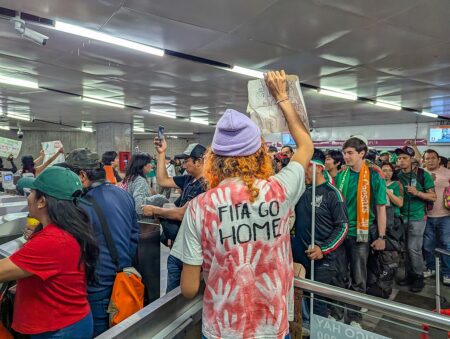
Photo by ProtoplasmaKid, courtesy of Wikimedia Commons
The 2026 FIFA World Cup was sold as a celebration of North American unity. Host governments promised growth, prestige and international visibility. The tournament arrives at a moment when North American integration itself appears increasingly fragile. Trade disputes, hardened borders, migration conflicts and growing distrust of public institutions have replaced the optimism that accompanied the original United Bid. The World Cup was conceived during an era that celebrated continental integration. It is being staged during one marked by fragmentation. Jennifer Hargreaves has long argued that sport should be understood not merely as entertainment but as a social institution through which wider struggles over power, exclusion and belonging are expressed. Football’s commercial transformation therefore matters not simply because the game has become more profitable, but because changes in its governance reshape access to one of the world’s most important cultural institutions.
Historian Amira Rose Davis reminds us that sport is never separate from struggles over labour, citizenship and belonging. And as Naomi Klein has argued, spectacles can obscure the political and economic arrangements that make them possible. The 2026 World Cup reveals precisely those arrangements and generates value not simply because people watch football, but because it converts cultural attachment into economic, political and reputational power.
Across Mexico, the United States and Canada, the tournament exposes three tensions at the heart of contemporary globalisation: development without equitable distribution, mobility without equal access, and growth without democratic control. Together, they illuminate not only the contradictions of North America but the changing political economy of football itself.
Mexico: Development for Whom?
Mexico has long been presented as a success story of North American integration. Yet many of the tensions surrounding the World Cup reflect a familiar question: who creates value and who captures it?
In Mexico City, community organisations have challenged redevelopment projects linked to the tournament, warning of pressure on water resources, rising property speculation and displacement. Their concern is not football itself but a model of development in which communities absorb social and environmental costs while economic benefits are concentrated elsewhere.
The cultural theorist Anamik Saha argues that contemporary cultural industries often transform local identities and histories into marketable assets while ownership and value remain concentrated in distant institutions. Football increasingly operates through a similar logic. Communities become part of the brand while rewards flow disproportionately towards broadcasters, sponsors, developers and governing bodies.
Relatives of Mexico’s nearly 135,000 disappeared persons have also used the World Cup spotlight to challenge official narratives of success, asking what it means to mobilise extraordinary resources for global visibility while thousands of families continue searching for answers.
For Zimbabwean sociologist Manase Chiweshe, football’s significance lies in the communities, memories and forms of belonging produced around it. That is precisely what many communities fear losing when the game becomes subordinate to commercial imperatives.
United States: Mobility for Some
If Mexico reveals the contradictions of development, the United States reveals the contradictions of mobility and deep hostility towards visitors.
The United States hosts the majority of matches and the tournament’s most lucrative commercial opportunities. Yet football’s celebration of global movement unfolds alongside heightened immigration enforcement, expanded security infrastructure and increasingly restrictive mobility regimes.
Sponsors, investors and media rights move across borders with ease. Migrants, asylum seekers and many ordinary people do not.
The geographer Ruth Wilson Gilmore has argued that contemporary systems of power distribute mobility, security and vulnerability unevenly. The World Cup reflects precisely that reality. It promises a borderless global community while operating within a world organised through permissions, checkpoints and exclusions.
The same contradiction appears inside the stadium. Escalating ticket prices and premium hospitality packages have transformed attendance into a luxury experience. Working-class communities that helped build football’s popularity increasingly encounter the game from outside the gates.
As Ben Carrington observes, sport often presents itself as universal while reproducing the inequalities of the societies in which it operates.
Canada: Sovereignty and Public Wealth
Canada reveals a third dimension of the story. The tournament takes place on the unceded territories of the Musqueam, Squamish and Tsleil-Waututh Nations. The issue is not simply recognition but authority over land, development and the distribution of benefits generated by major projects.
In Vancouver, public authorities have committed substantial resources to tournament-related infrastructure and operations while taxpayers remain exposed to potential cost overruns. The debate therefore concerns who bears financial risk, who exercises decision-making authority and who receives long-term benefits.
Sports scholar Jules Boykoff’s concept of celebration capitalism is useful here. Mega-events create exceptional political moments in which public resources, corporate interests and extraordinary governance arrangements converge under the cover of spectacle. Public money frequently underwrites private gain while democratic scrutiny is softened by the language of national prestige. The Canadian case asks whether recognition alone is sufficient, or whether sovereignty must also include meaningful authority over development, land and the wealth generated from them.
FIFA and the Enclosure of Football
Across all three countries, a common thread emerges. The issue is not simply corruption but commercialisation. Football’s transformation mirrors broader shifts in global capitalism. As traditional avenues of growth have slowed, capital has increasingly turned towards culture, media, data, intellectual property and entertainment. Sport sits at the centre of that transition. Football is no longer valuable primarily because of ticket sales or matchday revenues. It generates value through broadcasting rights, sponsorship contracts, data analytics, gambling markets, merchandising, tourism, real estate development and the monetisation of global audiences. What is being sold is not simply a game, but attention, emotion, identity and belonging. In this sense, football has become part of what some political economists describe as an “experience economy“, where cultural attachment itself becomes a source of profit.
Historian David Goldblatt has documented how football evolved from workers’ clubs and neighbourhood institutions into one of the most profitable cultural industries on earth. FIFA increasingly resembles a transnational platform whose revenues depend overwhelmingly on broadcasting rights, sponsorships and hospitality products.
The question is no longer whether football generates profit. It is whether the priorities of profit increasingly determine how the game is organised, governed and experienced.
The Democratic Promise of the Game
Yet the World Cup also reveals why football continues to matter. Even nations that did not ultimately qualify reveal something important about football’s enduring significance. Palestine’s qualification campaign unfolded while Gaza was being devastated by genocide. Forced to play home fixtures in neutral venues and train across multiple countries, the team became a symbol of resilience under extraordinary circumstances. South Africa’s hosting of the Palestinian squad in 2024 underscored football’s capacity to serve not only as spectacle, but also as a vehicle for solidarity , recognition and compassion.
Some of the tournament’s most compelling stories belong to nations appearing on football’s biggest stage for the first time. Cabo Verde, a country of fewer than 600,000 people, qualified for its first World Cup after decades of perseverance. Uzbekistan became the first Central Asian nation to reach the finals. Jordan secured a historic first appearance.
For countries such as Cabo Verde, qualification is not simply a sporting achievement. It is an assertion of visibility within institutions historically organised around larger economies and greater resources. With a population under 600,000, it is one of the smallest countries ever to qualify for the World Cup. Its success was built not through enormous domestic resources but through decades of football development, diaspora networks and sustained investment in local talent. In a tournament increasingly defined by commercial scale and corporate value, Cabo Verde’s presence serves as a reminder that football’s appeal still rests on stories of collective aspiration rather than market power alone.
Cabo Verde forward Dailon Livramento captured that spirit: “Let’s have some fun. We got ourselves into the World Cup, now it’s time to have fun together.”
As Nana Adom-Aboagye argues, African experiences remain marginal within many global sporting conversations despite Africa’s central contribution to global sport. The growing presence of countries such as Cabo Verde challenges that marginality and reminds us that football’s future will not be written solely in Europe’s boardrooms or North America’s broadcast studios. African players and migrant communities continue to reshape global football far beyond the continent.
More Than a Tournament
The World Cup has become one of the clearest expressions of contemporary capitalism: a system capable of converting culture into capital, identity into brand value, attention into profit and belonging into economic opportunity.
As Manase Chiweshe reminds us, the value of football ultimately resides in those social worlds rather than the markets built around them. The challenge revealed by the 2026 World Cup is not simply how the game is governed, but whether the communities that give football meaning can continue to shape its future in an era increasingly defined by commercialisation, enclosure and extraction.
Dr. Lebohang Liepollo Pheko is an activist scholar and feminist political economist. She has roots in South Africa, Lesotho, and Zambia and works at the intersection of decolonial feminism, global political economy, and reparative justice. She analyses power and dispossession, viewing racial capitalism as a foundational entry point of contemporary dysfunction. Liepollo works in community with many social movements. Find her on Twitter/X at Liepollo9