
Against the Flattening of Solidarity: On RISING FOR PALESTINE
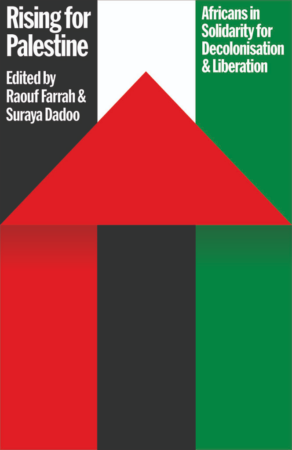
A review of Rising for Palestine: Africans in Solidarity for Decolonisation and Liberation, edited by Raouf Farrah and Suraya Dadoo. Pluto Press, 2026.
During a 2025 residency in Lagos, I met with some of the local LGBTQ organizers hosting me. I was wearing a Free Palestine bracelet when someone asked me a question I hadn’t been prepared to answer: “Why should we care about what happens in Palestine when we have our own struggles to deal with?” The question shook me to my core. After all, who was I to speak on the African struggle from the safe periphery of the diaspora? This question had implications about the impact of local crises and whether solidarity is viable when people are simply trying to survive. Rising for Palestine: Africans in Solidarity for Decolonisation and Liberation provides an answer to that very question. The collection does not ask Africa to turn away from itself to see Palestine, but rather argues plainly that Palestine is one of the places through which Africa can see its own struggles for liberation more clearly. The same colonial logics exercised in many African countries are not disconnected from those exercised in the occupation and ongoing genocide in Palestine.
One might expect a book called Rising for Palestine to open with an appeal to conscience. Instead, the anthology begins with an even more challenging idea: the genocide in Palestine is not happening because the world doesn’t know, but because it does, yet the fact of that knowledge has not been enough to stop it. The genocide, here, is not hidden from view. It is in images, livestreams, testimonies, court documents, destroyed buildings, and on our screens. The problem is not a lack of evidence, but a political order that can witness such evidence and still justify, rationalize, and enable the destruction of a people.
Rising for Palestine considers solidarity not only as recognition but also as a process that must be understood in relation to memory, law, state betrayal, religious ideology, surveillance, climate, media, and feminist organizing. Its opening section, “Legacies of Violence: Genocide, Colonialism and Oppression,” sets the tone of the book’s approach. The aim is not to dissolve Gaza into Namibia, Congo, Algeria, Rwanda, Sudan, or Western Sahara—as if all colonial histories are to be abandoned—but rather to sit these stories next to each other to see the same colonial logics at play: land seized under the guise of security, violence against resistance, whole populations displaced or decimated.
Ariella Aïsha Azoulay’s “Seeing Genocide, Ending Genocide” asks one of the collection’s most important ethical questions. She proposes that the Palestinian people have documented their own destruction in real time since October 2023 in Gaza, and they have been asking the world not only to see it but to do something about it. Azoulay insists on the failures of witnessing without action, stating that photographs are not just records of suffering but efforts to restore the conditions for truth-telling against certain forms of erasure. Her essay links the current devastation of Gaza to 1948, when Palestinian cities, homes, archives, and lives were violently remade in the image of a settler state. This is one of the anthology’s most important moves: Gaza is not treated as a sudden exception, but as part of a longer regime of dispossession and extermination. As Azoulay writes: “Genocide under colonial regimes . . . surpasses the event and consists of an attack on human diversity” (19).
The anthology’s historical reach is one of its greatest strengths. It is not simply a celebration or an epic story of African solidarity; it directly addresses complicity. The book thinks back to a time when anti-colonial formations around the continent saw Palestine as part of a common liberation struggle. Saleh Hijazi states in her essay, “The 2024 ACHPR Resolution on Palestine,” “To make solidarity meaningful, it must be rooted in the principle that justice is indivisible. As Nelson Mandela famously stated, ‘our freedom is incomplete without the freedom of the Palestinians’” (116). Here she tracks the erosion of that clarity under neoliberalism, security partnerships, development deals, and normalization. “Africa” is not regarded as morally innocent, as African governments, elites, churches, and institutions are implicated in the weakening of solidarity. In this way, an empire does not always come in the form of conquest; sometimes it comes as aid, counterterrorism, agricultural expertise, police technology, or biblical destiny.
In the chapters on Nigeria, faith and queer organizing are inextricably linked. Suraya Dadoo’s “Weaponizing Faith: Christian Zionism in Africa” demonstrates that solidarity is a contested point not only in the streets and at the UN but also in churches, pulpits, voting booths, and the political imagination of believers. Dadoo notes that Nigeria is a place where Israeli diplomats have developed relationships with Pentecostal leaders, even as the Nigerian government has continued to advocate for Palestinian self-determination at the UN. This contradiction matters. It tells us that Nigeria can never be reduced to heroic solidarity or religious supremacy. The struggle persists. Dadoo’s chapter makes clear that faith can be and has been a vehicle through which foreign policy seeps into the hearts and souls of communities. In other parts of Africa, Christian Zionism not only teaches believers to support Israel but also turns criticism of Israeli violence into an attack on Christianity itself. Dadoo writes that “faith is weaponised as foreign policy” (190). Nigerian Reverend Kolade Fadahunsi’s warning that Christians must not “throw the Palestinian people under the bus of Israeli oppression” if they are to seek divine favor is one of the chapter’s most direct repudiations of that ideology.
Rosebell Kagumire’s “Our Struggles Are One: Pan-African Feminists Keeping Palestine Solidarity Alive” offers the most intimate answer to the opening question of this review: “Why should we care about what happens in Palestine when we have our own struggles to deal with?” Kagumire writes from a place of grief, witnessing, and feminist organizing to hold many different crises with careful consideration without making them into a competition. “The settler-colonial state and the truth are always strangers” (242). For Kagumire, the attack on Palestinian journalists is also an attack on the record, on testimony, and on the possibility that the colonized might narrate their own destruction before power can rename it.
The essay becomes even more urgent in its section about queer solidarity and pinkwashing. Kagumire writes of how Palestine and queer freedom have been fused by Israel’s use of LGBTQ symbolism to sanitize its occupation. An Israeli story of a pride flag raised by a soldier over the ruins of Gaza is obscene because it turns queerness into imperial decoration. At the same time, queer organizers have sought to make visible and fight Israeli pinkwashing campaigns. For example, Kagumire points to Global South queer organizing against an Israeli organization’s bid to host the 2027 ILGA World Conference—the largest global gathering of LGBTQ leaders—which has now been canceled.
Kagumire notes that some African queer organizers see solidarity with Palestinian queer people as crucial when queerness is painted as divisible and foreign to African identity. In this way, the Lagos question is turned on its head. To ask why an African queer person should care about Palestine assumes that these struggles can be separated cleanly. But the forces that make African queerness look foreign, disposable, or punishable are not unrelated to the forces that make Palestinian life available for occupation, pinkwashing, and erasure. In both cases, power determines who counts: who counts as civilized, who counts as a victim, and whose freedom is forfeit for the comfort of the state.
If I could go back to that moment in Lagos when that question was posed, this is the answer I would give: Solidarity is not a distraction from local struggles, but one of how local struggles become more discernible. As the anthology presents, Palestine is not asking us to care less about ourselves. It’s asking whether any of us can become free in a global system that seeks to divide us, a task made easier when we abandon one another.
RICHMOND WILLS is a Nigerian-American writer, and professor at UMass Amherst. A Point Foundation Scholar and Prose Editor at the Massachusetts Review, his work is grounded in African Diaspora, marginal and queer migrant narratives, and exploring what remains unsaid. He is currently at work on his first novel.