
Interview with Cindy Juyoung Ok

Describe the first time you translated from another language. Where were you? What sounds or smells or sights do you remember? Do you remember anything happening to you in that moment?
In preschool I could write my cursive well so my teachers would prompt me randomly to the page like a wind-up doll. One asked me to write about my summer on the first day back, so I wrote that my cousins and I got to be in an RB with all our family and drive around town and have sleepovers on it. The teacher said, I think you mean RV, which I’d never heard of, so I explained I must be talking about something different and what I was referring to was called an RB, as our parents had called it and as we called it too. We were referring to different experiences even if gesturing at the same object, or shape of an object, especially in a first act of written translation.
You mentioned in an interview with the Hopkins Review that your first on-paper translation involved translating DACA paperwork. Is there a parallel between that paperwork and the manifold nature of poetry?
There was a form in front of us and translation is a bit like that: something exists. There is less of that Big Bang narrative of a poem’s fantastical existence.
What other professions have you done?
I was an assistant and I was super at it. I miss being a teacher at a big public high school very much.
I was re-reading your translation of Kim Hyesoon’s poem “That Place 5,” which appeared in our summer 2025 issue. How has translating Kim’s work impacted your own definitions of power, subjugation, resistance, and/or despair?
The poem is one of seven she wrote after being slapped seven times. Frustratingly and glamorously, at the end of language, there is only language.
In your last interview with us, you talked about the “automation and outsourcing of mass death by the state and its supremacists” and how that is reflected in communication tools such as automatic transcriptions, specifically how the errors they produce in their work have violent implications. Given how exponential AI has grown since then, how do you as an artist and human being cope with this growing bond of dehumanization found between cultural institutions, governmental bodies, and technocratic corporations?
I don’t cope with it. It really disturbs me and it should. In my airlocked world I forget (the automatic transcriptions you mention now off) and then my doctor asks me about being recorded and transcribed (by a company that always shares actors with so called “defense” technologies) or I get a generated email from an administrator that makes no sense (with a saccharine tone meant to feel frictionless that I experience as hostile and empty). It’s interesting I said that three years ago. The developments do feel yoked to (the yolk of . . .) the violence of “you matched a description.”
Is there a ‘useful distance’ in your work as translation? Another way of putting it, how does the act of translating swing between living in the words of another writer and studying the craft of one working in another language?
Living probably requires studying and studying requires living. Translation tends to be likened a lot; it can be fun to think through how it is scholarship or editing or reading or writing, but collation can also limit. Being a guardian to a child includes some of the same tasks and intentions as being a babysitter, a lifeguard, or a pediatric oncologist, but most don’t find it that useful to focus on the similarities between these roles.
In what ways does translating a piece of writing into English allow a different group of readers to access a work? Is there a kind of liberation—either for the poet, the reader, or even the translator—to be found in poetry?
English is not a language of liberation. Translation into it is not in the best interest of most people globally.
How do you approach selecting pieces to submit to various journals or magazines, especially considering how they might appear in a forthcoming collection? Is there something specific you look for when matching pieces to journals?
In this case I think I had the former translation editor Mona Kareem in mind when I decided to submit and chose poems to send. I rarely submit now, once or twice a year if that, but before we last talked, I submitted widely. All my publications came from general submissions, including both books. To students wondering about those mechanics, I recommend reading the journals they consider.
What’s the funniest thing you’ve seen, heard, or thought recently?
My friend made an expressive noise while telling a critical point of a story at dim sum the other day and I could have kept reenacted it all night. I still think it was so funny and perfect and wish I could recreate the moment.
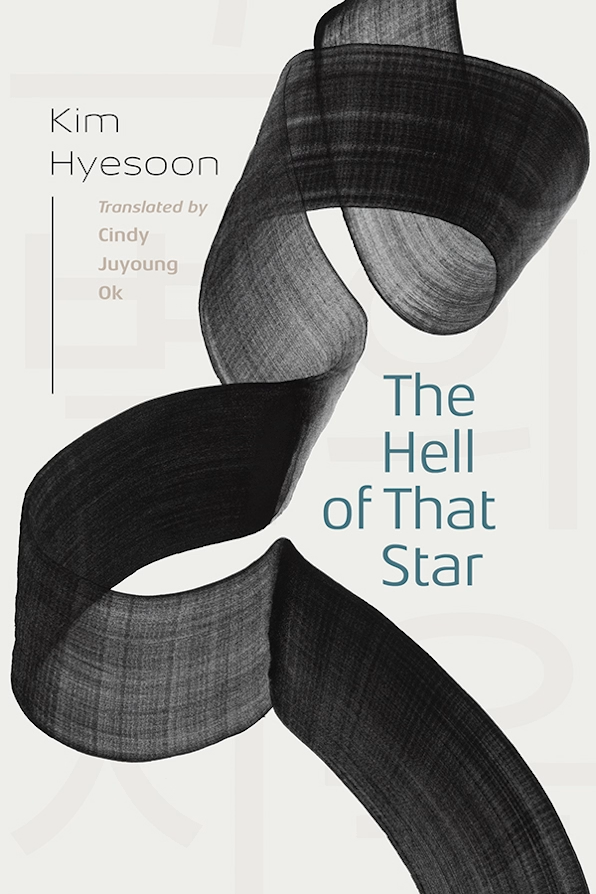
CINDY JUYOUNG OK is the author of Ward Toward from the Yale Series of Younger Poets, translator of The Hell of That Star from the Wesleyan Poetry Series, and an assistant English professor at UC Davis.