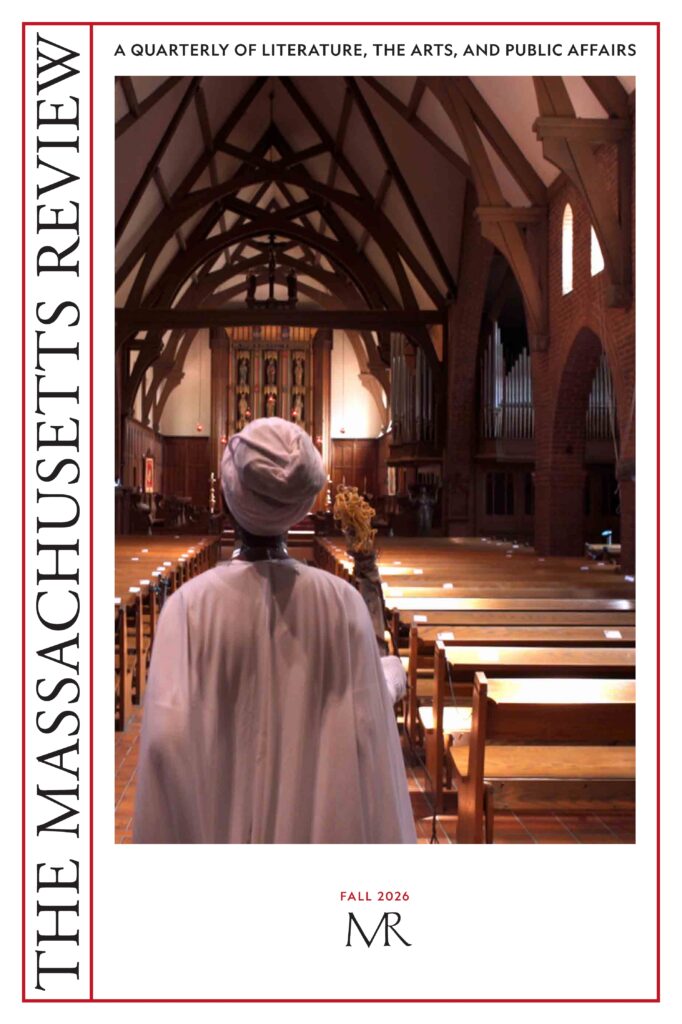

Interview with Emily R. Daniel
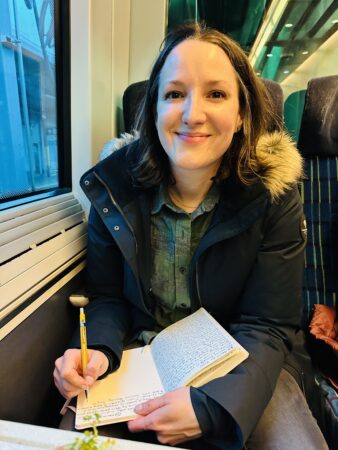
Tell us about your relationship to writing.
My relationship to writing began by being a voracious reader. I had a pivotal fourth grade teacher who instilled in me a practice of continuously engaging with books and reflecting on them after completion by submitting book reports. That same teacher also gave her students writing assignments that asked us to put into words what only we could say. I clearly remember writing about seeing myself as a writer as if the practice itself had already made it so. This simple belief is at odds with the sense that who we are—based on what we do—can only be true once it has been affirmed externally through an income, publication, being a household name, or various other label requirements I might have come to expect before I could say to others as confidently as I did at age eight that I am a writer.
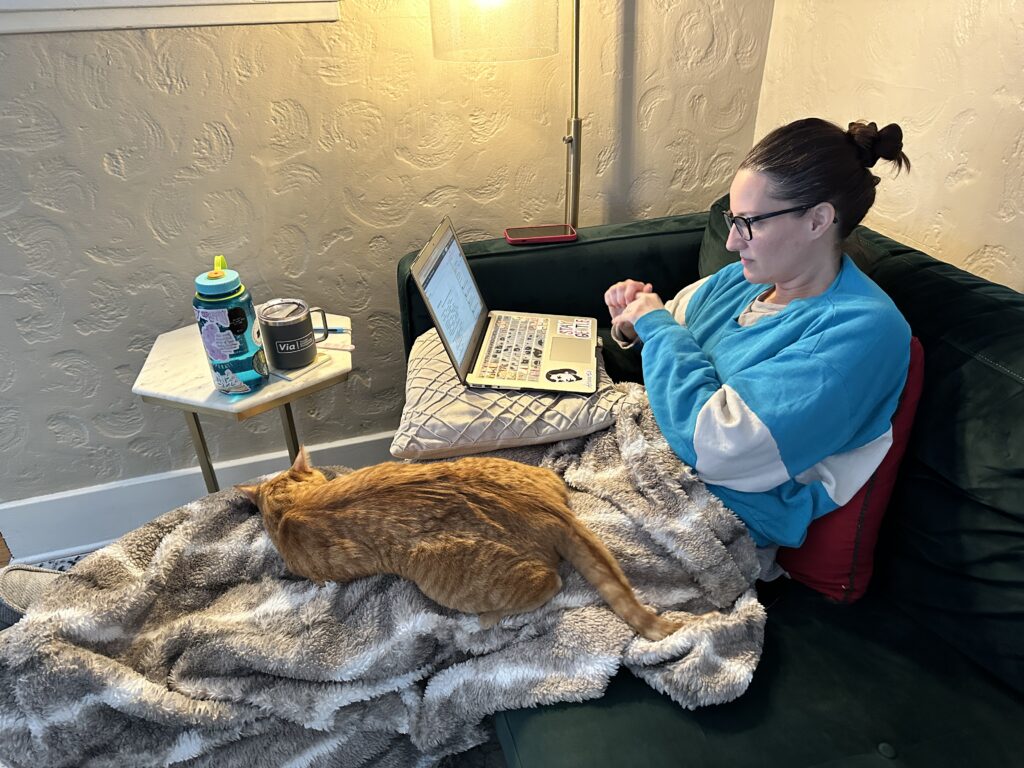
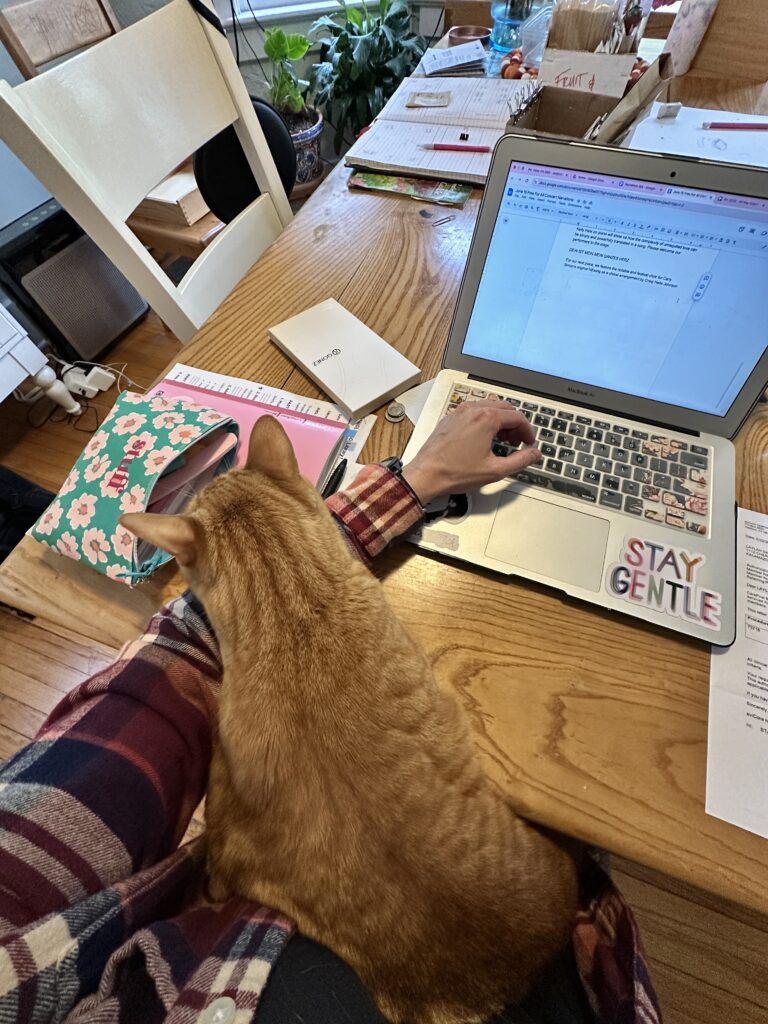
While I was completing my MFA in Creative Writing, devoting the majority of my time and attention to writing and reading for the first time in my life, I realized that those two endeavors are essential to my happiness and wellbeing and therefore must be done for their own sake without attachment to what follows. I regularly pursue publication of my work, and I will continue to do so, but my commitment to writing and reading as among the most necessary pursuits of my life is not dependent on the decisions editors make. Having my work published is a very welcome affirmation, and one that I am moved to celebrate each time, but I write through rejection, an occasional scarcity mindset, and endless uncertainty about when and how those blessed affirmations will come. I write at home, sometimes playing binaural beats through headphones, often with my cat on my lap, often while nail-biting. I’m not proud of that last part.
Who have been the most influential writers in your life?
Andrew Collard, Alyssa Jewell, Alen Hamza, and Scott Bade.
Tell us about your writing process and your approach to craft.
I was assigned Elizabeth Bishop’s collected poems in a poetry workshop. At the time, I was frustrated that I wasn’t connecting with her work when it seemed like something I should be able to do as a person who studies, loves, and writes poetry. Different teachers kept assigning her poems, and I never felt anything after reading them and couldn’t tell what the poet felt or wanted her reader to feel. Learning more about her background and her distaste for confessional poetry, it made sense to me why it was difficult to access the emotions of her guarded, metaphorical, and vague references to her sexuality and alcoholism. It has taken me a while, and a lot of practice, to write what are appropriately categorized as confessional poems, and those are often the poems I most readily attach to as a reader.
Is “My Therapist Asserts…” accomplishing what you set out for it to do at the beginning of writing it? What’s your favorite line or image from it?
I started writing this poem with the title in place and the image of a coffee mug with vulva fruit depictions on it in my therapist’s office, both of which are real experiences. Ultimately, the poem attempts to unravel shame, while demonstrating that even in the act of confessing, the chorus of “what will they think” questions cannot be entirely quieted. I feel sure I would have immediately sung the praises of Bishop’s work had she been more explicit, more open, more raw, but I understand that historical context matters, and that every writer has to determine what to reveal and how to reveal it. Here I am also conveying that confessional poems can still be self-conscious, which is one way of being guarded.
My favorite line is “whose pointers I memorized the tips of” followed by the fourth wall break, “oh no, look what I’ve done / another confessional poem.” There is tenderness when I read it, like the speaker doesn’t know how to accept that she gets to claim a truth about herself and her sexuality without simultaneously answering to an audience with countless wagging fingers. There is something of a passive rebellion to it because no one is actually there shaming her in that moment, but she has internalized those collective messages so completely that it’s as if she’s performing liberation to get back at them.
What’s been inspiring you lately?
I’ve been working my way through the recently released collected poems of Larry Levis (Swirl & Vortex), and I finish most of his poems with my mouth open in total awe at his ability to present everyday events with careful attention to their deeper meanings. His poems send me on searches for other examples in poetry of extracting understanding of ourselves and others through common encounters and seemingly meaningless details we overhear that we can’t shake from our recurring thoughts. So much of our lives are made up of unexpected interactions, conversations, mundane work tasks, and many other things we would never include in an answer to the question, “how was your day?” Each and every life, no matter what it contains, is fodder for poems like Larry Levis wrote. That is endlessly inspiring.
Do you have any non-literary talents/hobbies?
I am a singer, which exists in tandem with my writing life. There were swaths of time in my twenties when singing and writing seemed in conflict with each other, like I had to pick one, but I have long since reconciled that both deserve my time and attention, and both make meaningful contributions to my happiness.
What are you reading right now?
In addition to Larry Levis and poetry collections by Iliana Rocha and Monica Youn, I am reading The Years by Annie Ernaux. I’m undertaking a large creative nonfiction writing project, and I am intent on reading a variety of approaches to memoir throughout the writing process.
What are you writing?
I recently began submitting my first full-length poetry manuscript to publishers, and I am continuing to write and submit poems while the collection makes its way into the hands of readers and editors. I’m also in the early stages of drafting a memoir that is structured around Parts Work therapy as a way of understanding my relationships with others, namely my father who passed away nine years ago from a short battle with primary brain cancer. As a poet who normally has no reason to keep track of word counts or page counts, and who is used to drafting a whole poem in one sitting, I am a bit intimidated by a longer project that could realistically take years to fully draft. I am still compelled to do it, so I am drafting in sections with titles that begin with “The Part That…” such as, “The Part That Is Body Bound.”
EMILY R. DANIEL’s chapbook, Life Line, was selected as a winner of the 2020 Celery City Chapbook Prize. Emily is a Best of the Net nominee, and her work can be found in The Penn Review, Beloit Poetry Journal, Waxwing, Porter House Review, and forthcoming in Crab Orchard Review, among others. Emily lives with her family in Kalamazoo, MI where she earned an MFA in Poetry at Western Michigan University and was Poetry Editor for Third Coast Magazine. For more information, visit www.emilyrdaniel.com