
Interview with Caroline Crew
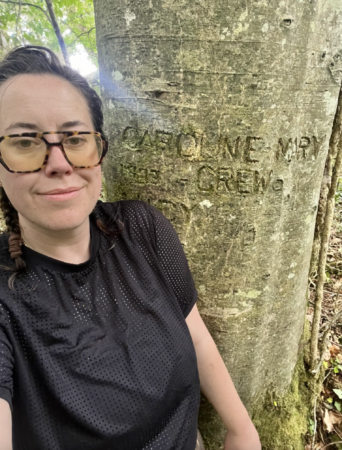
Crew, at “her tree” on the farm, after her dad’s death.
I’m interested in how “Feast: Fruits of the Land” came to exist. How did you decide on the format (namely: the altered sonnet structure, and the beginnings of passages picking up the preceding last lines)?
This piece is one “course” of seven—the titular mourning “feast.” Initially, this piece took the form of a long serial poem—based around the refrains “I had wanted to build a door for this grief” and “Any table is a ship.” After losing Molly Brodak, a poet, baker and thinker I admired deeply, Zoe Rana Mungin, my grad school roommate and cherished friend, and my father in the space of a year, when I finally began to write again in the following summer, what sputtered out was very chewy and very sea-faring. Confusingly so!
I spent the next academic year not writing at all, but rather running up a mountain and back down (I lived in Asheville, North Carolina at the time). I’ve always been a curmudgeon about writers who evangelize about running’s ability to metabolize thinking, but it turns out they’re right (apologies to Matt Bell!). The repetition, the rhythm, the forests and the altitude all made grief’s cyclical and circular nature apparent while wearing me down to honesty. We are our obsessions. Before anything else, I am an eater.
As a poet, I’ve always been obsessed with the sonnet as inheritance that one can shatter your way into—my first book used Elizabeth Barrett-Browning’s Sonnets from the Portuguese as a source text, and I’ve long loved the Victorian revival of the sonnet sequence and the sonnet crown that creates a cyclical echo. In particular, George Meredith’s Modern Love sequence that adopts a 16-line sonnet to embody the sheer drag of his divorce and the weight of contempt he held towards his wife, gave me the door into the prose sonnet.
Tell us about your relationship to the mythologies of Medea/Jason/the Argonauts and/or to Molly.
Medea’s garden—a real archaeological site—was fertile ground to dig into the complicated legacy Molly Brodak left behind without having to reduce that legacy to a single monument. Moreover, Apollonius of Rhodes’s Argonatica is one of the first written epic poems (as opposed to oral epics—though the story itself was widely known) and as such allows for interiority. Medea herself considers suicide to escape her fate as Jason’s bride, and views it as an act of love because she does not want to betray her family. The Molly-Medea latitude came as an utter surprise to me—emerging only when I reached this section, the fourth section. I am a research hound, and I dove headfirst into the Jason myth, specifically the Argnonautica as a way to understand the watery motif of the initial poem. Ironically, my college roommate had written her classics thesis on this text, yet it took me another eleven years after graduating to finally read it! It’s one of the pleasures of research for me, the connections that foment in the subconscious.
What are the best or most memorable potatoes you’ve eaten in your life?
Well, of course the best potatoes I’ve eaten are my dad’s. His favorite variety was Sharpes Express, a new potato variety known for its elongated oval shape, white skin, and pale lemon flesh. As a child, I once had a full crying tantrum at the digging of these spring delights because it marked the end of mashed potato season. The best mashed potatoes are the leftovers, and in particular Bubble and Squeak. To make Bubble and Squeak (and the noises for which the dish is named), leftover mashed potatoes and chopped cabbage (I prefer savoy cabbage, but any brassicae will do) are shaped into a large patty the size of your pan and fried to a deep brown crust. I recommend using a plate to flip it!
An honorable mention must be made to tattie scones, the Scottish breakfast griddle cake. You’ll find these in the supermarket bread aisle as well as on any fry up plate in Scotland, where I was lucky enough to complete my undergraduate studies. My preferred recipe is this one, from Baking with Granny. You’ll want floury potatoes– waxy is no good– and self raising flour, plus a healthy dollop of butter. For 18oz of potatoes, you’ll cut them in half and boil. Once fork soft, drain and let the spuds air dry for a good few minutes. (This is also the secret to crispy roast potatoes.) Once they’ve dried out a bit, mash them up with a dollop of butter, and then mix in your flour with a wooden spoon to a dough-like consistency. Tip your dough onto a flour surface and briefly knead. Split into three even balls, and then roll out to about a quarter inch thickness. Cut the circle into four quarters. Fry in a dry pan til golden on both sides.
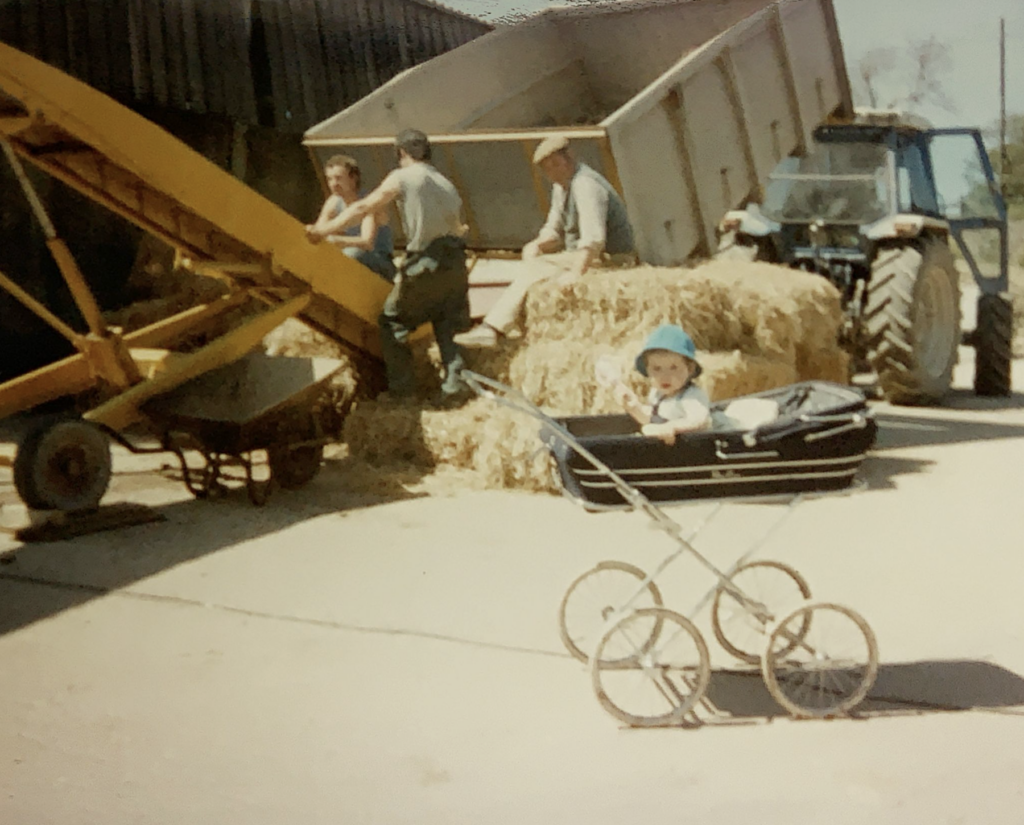
Crew, grading potatoes on the farm as a baby.
Do you still farm?
My family still lives on the potato farm where I grew up, though the land is now farmed by neighboring families. While I don’t farm myself, I’m lucky enough to have taught (and currently teach) at colleges that have their own farms. At the University of Central Missouri, my creative writing classes visit the farm every semester—they’ve stuck their hands into the stomachs of research steers, met the mules who double as mascots and working animals, and explored prairie restoration. I view teaching and writing as a kind of farming: the seasonal ebbs and flows, the insanity of repeating with tweaks each year, the stubborn optimism of yield.
When I first encountered the Seamus Heaney poem “Digging” in high school I hated it—I wanted poetry to be what made me different and took me away from my rural existence, all very necessary teenage angst. Heaney positions the speaker looking out to his father digging up new potatoes, as his grandfather had, and reconciles his own labors with, rather than against that lineage: “But I’ve no spade to follow men like them.//Between my finger and my thumb/The squat pen rests./I’ll dig with it.” Now, I cherish that poem like a prayer.
What are you writing? Any upcoming projects?
“Feast” is still an active project, though perhaps it’s more honest to say dormant: the final section, “Leftovers,” remains a blank page. It is a fool’s errand, I think, to make grief finite. It’s also a question of form—the meal has ended, broken down, and as my dear friend, the writer Gina Nutt, wisely said: leftovers look different on the plate. Aside from “Feast,” I’m somewhat nebulously working on a perfume project. What form this will take, I have no idea, but I’ll smell myself into something!
I first got interested in perfume through Medea, both the fragrance of her garden and the way in which scent functions as magic in classical texts (for more on this, Britta Ager’s The Scent of Ancient Magic is superb). As a mode of sensory research and writing practice, Lindsey Webb, author of the incredible and smelly poetry collection Plat, taught a “Writing Perfume” class that inspired me to experiment more broadly with scent. Most recently, the niche perfumer Hex Mundi has been a constant source of inspiration! We’ve collaborated on several classes at my bookstore, Turnsol Books, and for my birthday she brought to life “The Dusty Larder,” a perfume with notes of dust, lemon and carrot.
CAROLINE CREW is an Assistant Professor of Creative Writing at the University of Central Missouri, where she serves as editor-in-chief of Pleiades: Literature in Context. Her poetry and prose appear in POETRY, the Kenyon Review, and The Believer, among others, and she will publish her next poetry collection, Don’t Cut Your Own Bangs, with YesYes Books. Originally from Kernow (Cornwall), Crew lives in Kansas City, where she co-owns the bookstore Turnsol Books.