
Interview + Reading with Patricia Waters (audio + text)
Editor’s note: The text here is an edited transcription of a larger conversation conducted over Zoom, which appears in full below. Waters reads her poem “—And Also Sex” (Volume 67, issue 2) from 11:40–13:19.
Tell us about yourself and your relationship to writing. What do you normally write about?
What do I usually write about? Anything and everything that crosses my little brain. I’m at the point where the world is material. I just get up in the morning and I start thinking, Did I retrieve anything from the night? Does anything come to me? I read something, I start a letter, just anything to get that pen on paper and get it moving.
I’m originally from Nashville, Tennessee. In high school I worked for the newly created Country Music Hall of Fame. To go into the Country Music Foundation and Museum and to see all that sort of stuff was very interesting. I met people like Mama Maybelle and Tex Ritter. There was a wall of artists, famous country music artists, with that twang and some of those singing the high lonesome sound. You would hear this onslaught of language going and going and going. And you’d realize this is what our culture is: these songs, these words, this language. And I loved it. I just loved it.
I also love museums, and I love art institutions.
My parents went to a meeting in Chicago when I was fourteen. By myself, I walked up Michigan Avenue and into the Institute of Art. It was wonderful. It was just wonderful. And it meant to me that I could encounter art. I could look at it as long as I wanted to. Nobody was saying anything. Nobody was trying to interpret it as anything, for anything, to any purpose. It was just sheer pleasure. I have written a great deal about art in response to paintings, which is part of what this poem [“—And Also Sex”] is doing.
Your poem references Thomas Hardy’s “The Convergence of the Twain.” Are you a big Hardy fan?
The poems are so problematical, because he can be writing about a thrush, a song, this or that, but it’s always about some psychodrama that is going on, from his interior struggle with himself. Hardy can say it’s about the Titanic, but it can also be his expression of his own inner incapability of connecting with another person in a non-destructive way. (And by another person, I mean with women, particularly.) So it can be two contradictory things at the same time. I mean, Hardy was not a nice person, and he knew it.
He also knew that in writing, he could take whatever it was within himself, and look at it and hold it out there. I don’t know what he was hoping for. You never know what people who create things hope for. I maybe went through a Hardy phase. Right now, I’m a lot more invested in more contemporary poets.
Who are some of these poets?
I mean, my god, Glück. I remember taking Averno and just living with it for two weeks, annotating it. It’s just such an immersion.
My oldest friend in poetry is Alice Friman, who is originally from New York, but who lives in Milledgeville, Georgia. Alice is 92. She’s just published her seventh or eighth book, LSU Press, very prestigious. She is something else. I have read with her many, many times; she’s primo.
Zbigniew Herbert is somebody I keep on my desk next to me. He’s always within reach. “Report from the Besieged City“ is one of the great ones.
From your bio, you have a history of collaborating with visual artists. Can you speak more on these relationships?
I’m still in touch with several of the artists from Penland, Kathy Steinsberger, Frank Hamrick, I’ve kind of lost touch with Udala Peters. I went to see her in Antwerp more than several times. And Frank Hamrick is from Macon, Georgia. He’s so interesting. He got his start in photography. He wanted to control the process, and he wanted to control how the print was organized, so he got into bookmaking. Now he runs the Master of Arts program at the University of Louisiana.
Having those relationships where that visual world feeds my world—and I hope my world feeds their world—this is the great gift of art. It’s an open door.
Do you have a favorite or most memorable project that you’ve worked on?
I walked into the museum in Philadelphia on the Fifty Days at Iliam, and on the wall it said, Cy Twombly, Lexington, Virginia. I didn’t know who he was. I had no idea. I wrote him a letter, care of the Lexington Post Office. I sent him some poems, and I didn’t hear back. Sent another letter, sent some more poems.
I came back home one day, it was in the summertime, I reached my mailbox, and there was this hand-laid blue notepaper, and this black ink. In his letter he quoted “that first flawless moment over the lawn,” from “To a Friend Whose Work Has Come to Triumph” by Anne Sexton. I thought, What are you doing quoting Anne Sexton to me? But I was so dumbfounded to have this [letter], and then at the end: “I love your poems.” And that’s what started it. I started writing it, he gave me his address in Rome, and we wrote to each other.
Cy called me once. He said, “You gotta send me some of those little Greek things, those little short ones, you know I’m a sucker for them.” He hung up, and I wrote to him.
Every once in a while I got a postcard or something. This is how Cy worked. I got this letter, and inside it was a check, and I mean, it was a very nice check. And a copy of my poem that he had changed, and he asked, “Is this okay?” I said, “Why not. Sure, it’s okay. Thanks for the check.”
Well, it turned out it was the Coronation of Sesostris. He had used my poem in the central panel of his painting cycle. I didn’t even realize what was going on until I got the invitation through Gagosian to come for the opening—which I did. I mean, I was gobsmacked.
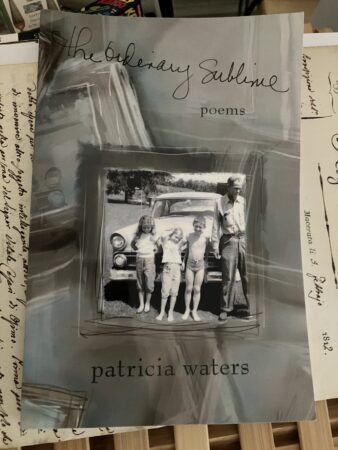
PATRICIA WATERS published two books of poetry with Anhinga Press: The Ordinary Sublime (2006); Fallen Attitudes (2014). Born and reared in Nashville, she lives in a small town in East Tennessee. A maker of small books and mail art, she completed graduate course work in Book Arts at UA Tuscaloosa and several book arts workshops at Penland School of Crafts. Having a history of collaboration with visual artists [Cy Twombly] and print artists [Goedele Peeters, Antwerp], she has had recent work published by Schirmer/Mosel [Munich], also contributing to a gallery catalogue and other texts for painter Max Renkel.