
On Disabled Rage and Pleasure: What Last Ditch Gets Right
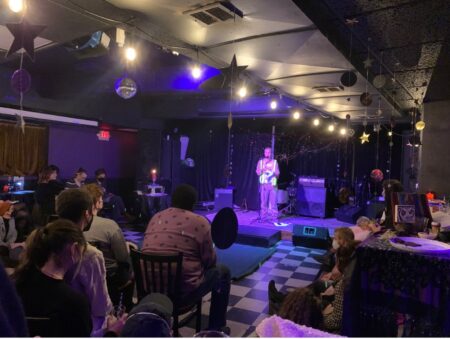
Poetry and ritual event at 10 Forward (now Last Ditch) in 2022, author’s own collection.
A little over two weeks ago, the small town where I live—Greenfield, Massachusetts—made national news. The Boston Globe had caught wind of community conflict at our local lesbian bar, Last Ditch, and was airing it out to eager audiences. For those unaware of this story, it goes something like this: the bar had recently announced a decision to relax their mask mandate; controversy ensued. While the bar had previously required masks for all of their operating days, they had decided to make Saturday mask-optional, and some of their clientele voiced their unhappiness with this change. Readers across the nation got a glimpse into our niche tenderqueer universe and—they were losing it. According to a tweet by Max Tani, the story “generated 1,000 subscriptions to the paper” in one day, with the Globe’s managing editor remarking that it appears to be “on pace to shatter all sorts of Globe records.” It seemed that few people knew, to quote comedian and Mount Holyoke alum Woodlief McCabe, that Western Massachusetts is just “like that.” Shortly after the story dropped, a student in the disability studies class I teach at Smith College asked if we could put it on our agenda. It was time for me to enter The Discourse.
What does a disability perspective add to this already oversaturated landscape of hot takes? How might we better understand the bar’s decision to implement a mask mandate in the first place, as well as the disabled fury that followed its relaxation? Much has already been written lamenting the left’s tendency to self-cannibalize, so instead, I’d like to offer some context.
Despite the seemingly antagonistic relationship between Last Ditch and its unhappy patrons, they are both responding to the same set of conditions: the absolute abandonment of disabled people by the state and the public writ large. Put plainly, if you become sick or disabled as a non-wealthy person in the United States, there is very little support for your survival. What’s left of our meager social safety net is gatekept behind mind-numbing layers of bureaucracy and surveillance. Universal healthcare does not exist. This is not new news; in 1986, Audre Lorde criticized “the economics of disease in america,” where “the first consideration concerning cancer is not what does this mean in my living, but how much is this going to cost?”[1]
But as recent developments show, the conditions of livability for disabled people in the United States are being eroded at an even more accelerated pace. In addition to the Trump administration’s ongoing attacks on Medicaid, on June 18, 2026, the Department of Justice issued a memorandum targeting Olmstead vs. L.C., a 1999 U.S. Supreme Court opinion that affirms the rights of disabled people to live and receive services in our own communities. As the Last Ditch news entered circulation, a federal judge in the case Texas v. Kennedy entered an order vacating the community integration provisions of section 504, a civil rights law that protects equal access to education for people with disabilities. While Olmstead has, as of this writing, not been overturned, the legal opinion re-affirms the troubling belief that disabled people do not belong in our social fabric, but rather, warehoused out of sight.
It is within this context of enforced social isolation that I return to the Last Ditch. I want to note, briefly, that this is a place that I visit, both under its current name and in its previous form as 10 Forward. It is a charming basement dive that is equal parts punk house and Twin Peaks’s Black Lodge. The current owners are graduates of Hampshire College, a now-defunct liberal arts institution devoted to experimental education. And while I have never personally taught a member of the Last Ditch crew, they are of an age that I certainly could have, and so I am inclined to meet them with a spirit of generosity.
In their vision for the space, the bar’s founders decided to prioritize solidarity with disabled people. Putting profitability and business sense aside, this feels significant in a culture that largely believes disabled people would be better off dead. Anything beyond the bare minimum feels unthinkable under current conditions, and yet, there exists in my small town a disability-forward lesbian bar. I want to note that the Last Ditch owners are not the first to do this, as Kevin Gotkin and Aimi Hamraie have documented—disabled nightlife exists, and yes, it matters.[2] However, Last Ditch is the first to go viral to this degree, and to be met with utter disdain.
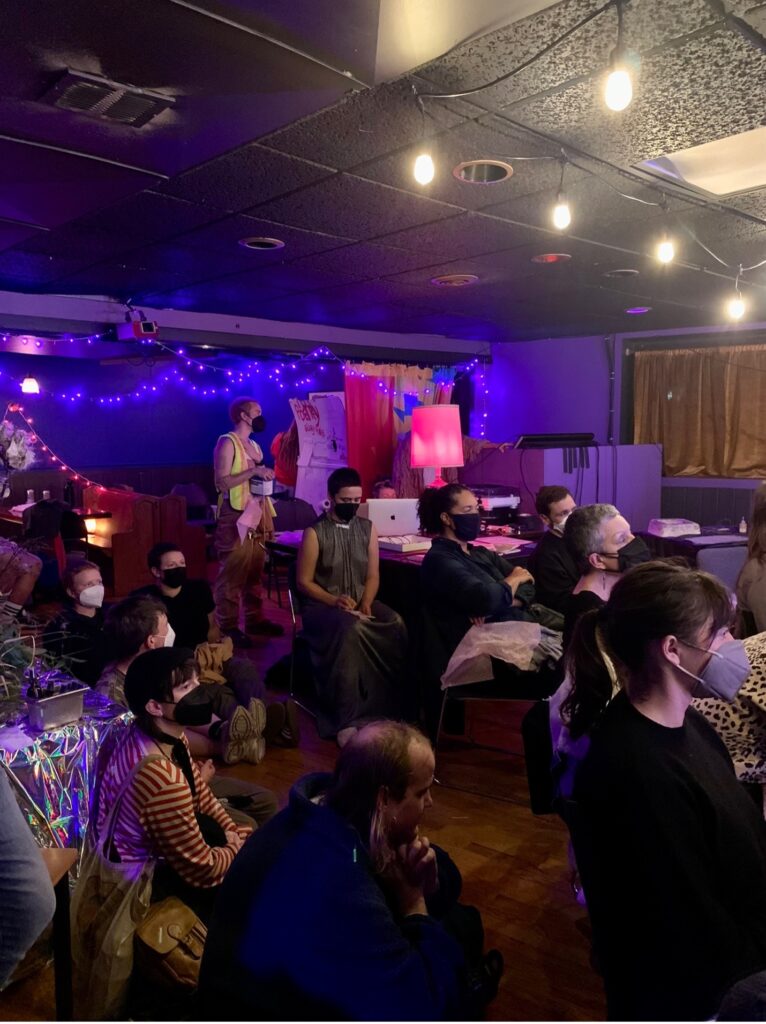
Poetry and ritual event at 10 Forward (now Last Ditch) in 2022, author’s own collection.
There are multiple reasons why such a vision might not survive long term under capitalism, many of which have already been pointed out. Yes, maybe their dream might have been better supported as a non-profit; Julia Golda Harris and others have written compellingly about alternate paths. Yes, it is difficult to sustain a community space in the context of private business. Yet, what matters to me is that these young people wanted to make this little slice of nightlife happen at all. As a lover of “access fantasy,” in the words of disabled artist Finnegan Shannon, I think the dream itself is important, even if the execution is subject to critique.
This is even more true in a time when youthful cynicism runs rampant, and understandably so. The possibilities for a viable life are being further and further foreclosed, and survival increasingly translates to one of two paths: inherited wealth or working for the corporate class. It is not lost on me that institutions that support unorthodox thinking, such as Hampshire, Goddard, and Marlboro Colleges, are folding at a rapid pace; that my own fields of literary, ethnic, and gender studies are under active attack; and that the Department of Education soon plans to deny student loans for degrees that fail its “earnings test.” As poet Diane DiPrima once wrote in “Revolutionary Letter #75,” “THE ONLY WAR THAT MATTERS IS THE WAR AGAINST/ THE IMAGINATION,” and here we are, experiencing the hyper-privatization of the imagination in real time.[3]
But I don’t want to end on that note. Instead, I want to return to the dream. I want to say: it’s OK to dream of disabled and queer utopia, even (and especially if) Ted Cruz doesn’t get it. Massachusetts has long been a place for utopian experimentation, from Brook Farm to Fruitlands to the Northampton Association of Education and Industry. Of course, utopia (or at least the physical realization of it) is most possible for those with access to property. But when the vision comes together, even if fleeting (and they are often fleeting), it is something to behold.
In August 2026, before the Globe story blew up, I was hosting a close friend who I know through disability and queer studies circles. Prior to COVID lockdown, we built our friendship over bars, clubs, and queer nightlife more generally—I remember enjoying pickleback shots while a drag queen complimented us on our matching John Waters crop tops. With the onset of the COVID pandemic, and after the world dismantled COVID protections piece by piece, we thought that chapter of our friendship was over. That is, until we entered the doors of Last Ditch.
Gazing upon a sea of masked Gen Z queers, my friend looked visibly moved: “There is nothing in my town like this. I know people who would travel to be here.” We sipped cocktails under our masks as a drag queen gyrated onstage, inviting members of the audience to “lip sync” through suggestive eyebrow movements and physical gestures. Momentarily, we were taken to a little slice of heaven, where disabled and queer pleasures ran the show. Outside, the world thinks we’re better off dead. But here, in the club, we felt more alive than ever.
Acknowledgments: I want to thank the students of SWGS 300lr: Beyond the Grind, who helped me meet the young people of Last Ditch with empathy and compassion. I also want to thank Casey Lou Wait for connecting me through Instagram stories to the disability reels that allowed me to keep on top of relevant news. Finally, thanks to Emily Lim Rogers, whose new book Sick Work allowed me to frame these structural issues concretely and succinctly.
NOTES
[1] Audre Lorde, “A Burst of Light: Living with Cancer,” I Am Your Sister: Collected and Unpublished Writings of Audre Lorde, ed. Rudolph P. Byrd, Johnetta Betsch Cole, and Beverly Guy-Sheftall (Oxford: Oxford University Press, 2009), 81.
[2] Kevin Gotkin and Aimi Hamraie, “Remote Access: Crip Nightlife, Artistry, and Technoscience.” Leonardo 57.2 (2024): 197—202.
[3] Diane di Prima, Revolutionary Letters (Last Gasp of San Francisco, 2005), 104.
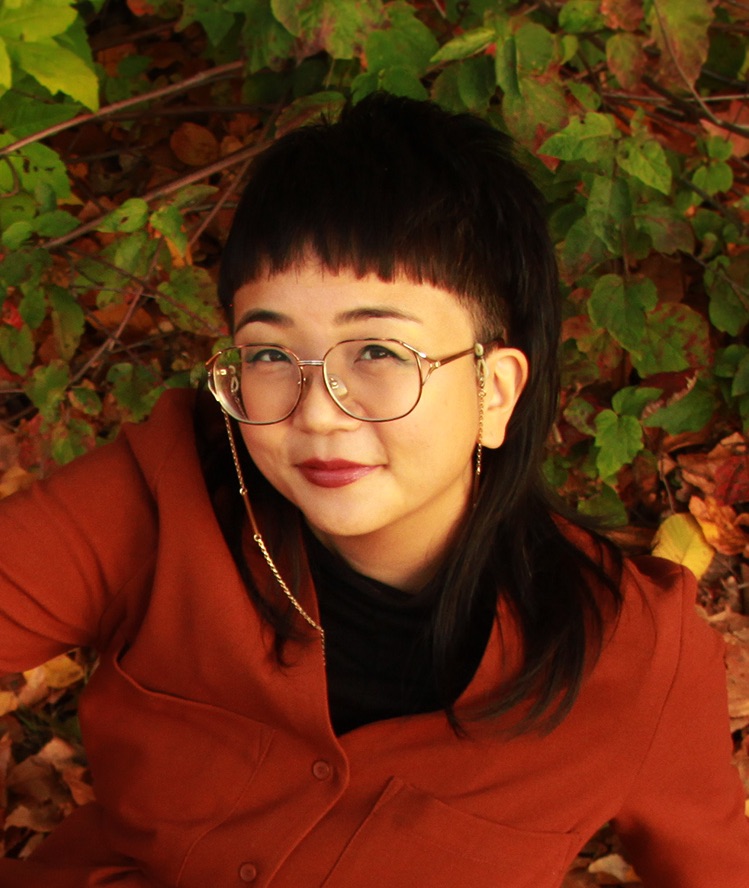
JINA B. KIM is a scholar of feminist disability studies and associate professor of English and the Study of Women, Gender, and Sexuality at Smith College. Her book, Care at the End of the World: Dreaming of Infrastructure in Crip-of-Color Writing (Duke UP, 2025) demonstrates why we need radical disability politics and aesthetics for navigating contemporary crises of care. Her book was awarded sole honorable mention for the Lora Romero First Book Prize from the American Studies Association. Jina has published in Signs, Social Text, American Quarterly, MELUS, Disability Studies Quarterly, and South Atlantic Quarterly. She is a founding member of the Disabled Scholars of Color Collective.