
Interview + Reading with Sean Murphy (text + audio)
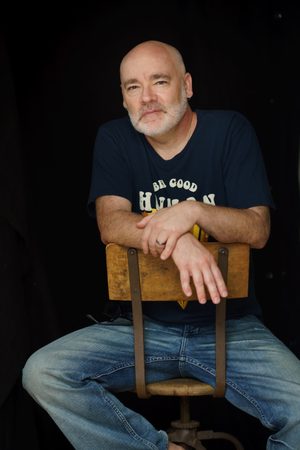
This is an edited transcription of a longer interview conducted over Zoom, available in-full below. Sean Murphy reads the opening of his story “Going to Graceland” (Volume 67, issue 3) from 11:38–14:41.
Tell us about your relationship to writing.
It started at a young age: something about poetry spoke to me. You just begin this journey where you like it, maybe it becomes a hobby, becomes a little bit of a compulsion, and as you get older, if you keep after it, it really does become the kind of thing like: “What else am I good at? What else do I enjoy?”
My engagement with the world seems to make the most sense kind of through the written word. All the things I do are utilizing this compulsion and ability to write to solve (and sometimes create) problems.
How has your work at 1455 Literary Arts changed your approach to writing?
The process of writing at a certain point is not romantic: You have to get the work done. It is oftentimes by necessity a very solitary, quiet endeavor, and it’s fraught with rejection and silence and frustration. Being able to channel some of that passion and energy into other writers seems like a really healthy outlet for keeping things very creative, keeping things mission-driven. It’s been very invigorating just being part of a community, and creating communities. I can always learn from that, and ultimately that feeds the writing itself, at least for me; it keeps me keeps me curious and keeps me engaged.
You did a lot of work in previous years related to the “Manosphere”: interrogating masculinity, and the role of male writers/characters in combatting this cultural wave of toxicity. Will you talk a little about fitting those politics into “Going to Graceland”?
What it really boils down to: Not only have men traditionally been taught not to be emotional or open, but it’s reinforced in our movies and in our culture. What this leads to is the lack of ability to communicate. Of course, if you can’t do that, bad things are going to happen.
I think a lot of these damaged men we see in positions of power are deeply unhappy, have been taught it’s a zero-sum game, and they get to a certain point in their life, even if they’ve been successful, where they realize, “None of this is bringing me happiness.” It’s like, well, what does bring happiness? Having friends, being honest, being authentic.
For this story, I try to have fun with the idea that a medical event that has resulted in a change of behavior that is unexpected. A son who grew up not getting anything from his father, suddenly getting everything from him and not being comfortable with it. It’s this inversion of roles. How do they make sense of that?
If there’s a moral to the story, it’s that we shouldn’t need or want a force majeure to have an epiphany. We can live authentic lives, and certainly it’s not too late for men to understand: You can have better relationships with the women and the men in your life, with yourself, if you’re willing to be open and honest.
How did this story come to be?
I’ve written stories that just arrived fully formed, miraculous: Something came to me, and I ran with it, and it somehow came out almost in one sitting. This was one where I’d written down something that ended up being the last line, and I knew that was the closer.
I feel like you get to a certain point [in writing a short story] where there’s no turning back. I’m invested. I need to figure out a way out of this mess that I’ve created. That happened with this. It was very hard work, but it was joyous excavation because I believed in what I was trying to do. On this one, I got far enough in, I knew what I wanted to accomplish, so then it really just became, “How do I capture this as economically as possible?”
I’m really fascinated with this seeming dichotomy of trying to cram in as much as possible but then exercising compression because the short form doesn’t give you the luxury of a novel. It’s this amazing balancing act where every sentence matters. If you suddenly have a moment that doesn’t feels authentic, everything can be derailed.
When you explicitly write with and through music—Paul Simon, in this case—how do you strike the balance between simply rewriting the source material and actually engaging with it? Do you ever worry about “ripping off” the artists?
I haven’t done it often for that very reason. I mean, I can personally scratch that itch writing about music in the essay form, doing reviews and criticism.
I wanted to have fun with very judiciously weaving in some Paul Simon stuff in order to talk about the role of music, and how we can talk about it and use it as an epiphany. I like to think—I’ve never thought this before, honestly—but I mean, I think if Paul Simon read the story, he wouldn’t be offended.
In a story like this, when the song itself or the album itself is woven in, then it just becomes [a question of] how you can do this in a way that hasn’t been done, or at least not effectively. You’ve got to pass your own smell test, right? For any honest writer, if you know you’re doing it badly, that hits the cutting-room floor.
And then it was a series of how much do you go in on it? How much do you not go in? I think if I put any more Paul Simon in, it would have been too much. And any less, it might not have been enough.
Tell us about your approach to this story’s (ambiguous, but I think hopeful!) ending, or to endings in general.
There is a certain respect for the reader, which I think should precede anything, no matter what you’re writing. Readers pick up right away if you’re pandering or patronizing. With short fiction, what I’ve always responded to is an ending that’s not deliberately ambiguous, but where there’s almost the unspoken assumption that the reader is entitled to draw their own conclusions.
Something I learned in early workshops is that a character has to undergo some kind of transformation [by the end of a story]. And it’s like, really, do they? Is that what we respond to with literary fiction? I think the answer is no. But if the reader is going to take the time, whether it’s a half hour or several weeks to read something you’ve written, there has to be an invitation, breadcrumbs, an unspoken dance: I’m not gonna tell you how you should feel. You’re gonna be bringing your own baggage. If [the ending is] something that makes you uncomfortable, that could be a gift; if it’s something that makes you feel more comfortable, that could be a gift. But it’s just leaving this possibility. And you certainly picked up on it: I think that the breadcrumbs [in this story] indicate that we’re on an upward slope.
What are you reading right now? What are you listening to?
I read more now than I’ve ever read, which is a great thing. There’s so much content: a lot of it freely accessible, a lot of it amazing. I’m reading all day every day. But I’m reading fewer books.
All these Substacks I’ve discovered is how I felt when Twitter first came out: when you realize how many smart, awesome people are in the world, all you want to do is read their stuff.
On streaming services, the discovery of one artist I like leads to another artist that I never would have heard of in the more analog era, where you had to buy an album. If there’s an upside [to digitization], it’s lessening the barrier to being discovered for some of these artists, and I think that includes writers as well as musicians.
There are so many talented people out there that aren’t getting paid or aren’t getting paid a lot and are still doing it. We’re trying to discover beauty. We’re trying to learn things. We’re trying to meet new people, hear new sounds.
I feel very young and engaged when I’m discovering all this great writing and all this great music. And there’s no envy. It makes me wanna be a better writer. It makes me wanna be a better person. Just seeing all this talent and beauty out there energizes me a great deal.
SEAN MURPHY is an author, founder of the non-profit 1455, and director of the Center for Story at Shenandoah University. His podcast Some Things Considered features writers, critics, musicians, and industry leaders. For more visit seanmurphy.net.