

“Dilli Chalo!”: Protests and Public Space in Delhi
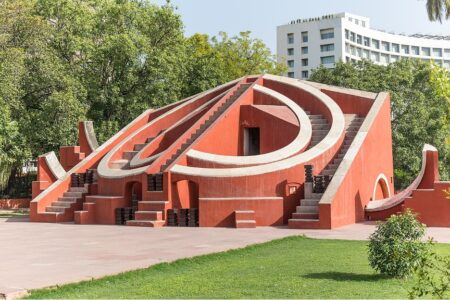
Jantar Mantar Observatory in Delhi, Courtesy of Alessio via WikiCommons
“Dilli Chalo!” or “Let’s Go to Delhi!” is the historic refrain with which protest leaders urged Indians to gather in the nation’s capital, Delhi. Responding to this call, anti-government protests have electrified the city since October 10th. Led by a broad, sometimes unsteady, coalition of youth political activists, this protest is one among a spate of recent protests on similar issues across the world including in Serbia, France, Bangladesh, and Nepal. Government reprisal has followed swiftly, but the protests have persisted deep into November.
Following hot on the heels of a wave of protests in July and September (against many perceived injustices including exam paper leaks and sexual violence), the protests in October focused on government accountability around irregularities in electoral rolls across the country. These irregularities, stewarded by the Chief Election Commissioner Gyanesh Kumar, include unchecked corruption, the deletion of 130 million voters through a distorted Special Intensive Revision (SIR) of electoral rolls, and the resultant disenfranchisement of Muslim voters. Protestors have demanded Gyanesh Kumar’s resignation and the review and reversal of the SIR process.
The political unrest of July and October has been centered in the historic site of Jantar Mantar, a medieval observatory in the heart of Delhi. Jantar Mantar on Sansad Marg, or Parliament Street, is a prime protest site for its proximity to Parliament House where India’s elected representatives sit. Protests that originate in Jantar Mantar can easily—and do!—turn into marches to Parliament, where citizens demand to be heard by their elected representatives.
The Government’s Response
The Hindu ethnonationalist Bharatiya Janata Party (BJP) government led by Prime Minister Narendra Modi has responded to these protests by having protesters brutally beaten and detained under murky charges. On October 11th, the Modi government-controlled Delhi Police took a leaf out of the British colonial handbook and “denotified” Jantar Mantar from its status as a designated protest site. “Denotification” has effectively rendered illegal any kind of political or protest activity at the site.
Alongside the “denotification” order, the Delhi Police offered three alternative sites to protest organizers, each increasingly further from Parliament House and marginal to the city’s center. While Jantar Mantar is a mere 1 mile from Parliament House, the alternative sites—Ramlila Maidan, CBD Grounds, and Burari Grounds—are about 4, 9, and 12 miles from Parliament respectively.
The “denotification” orders were widely received as a craven attempt by the government to dismantle the protests. First, the “denotification” seeks to control the terms of protest by curtailing the movement and assembly of protesting citizens. Second, the forced relocation of the protest to distant parts of the city separates protesting citizens from the very group they seek to address: the Members of Parliament. Third, the spectacle of the protest—the swelling, roaring crowd—is obscured and muted when the protest is tucked away. Fourth, the alternative sites are more expensive for organizers and have been booked up for other events months in advance.
Perhaps most perniciously, “denotification” is an attempt to strike at the symbolic strength of citizens gathering in the thousands in the heart of the nation’s capital to demand accountability and transformation.
Jantar Mantar Meanings
Jantar Mantar is an emblem of civic action and solidarity, having served as a potent protest site for the past three decades. In 1993, the (Congress Party-led) government offered it as an alternative to the Boat Club Lawns, which had since Independence in 1947 been the preferred site of protest in Delhi. Jantar Mantar’s origins as an alternative protest site portend its fate. But in its decades of success, perhaps, lies a more optimistic vision for the future relationship between urban space and political protest.
Jantar Mantar was built in the early 1700s as a celestial observatory by Maharaja Sawai Jai Singh II. While it fell into disrepair in the 19th century, restoration efforts in the 20th century transformed it into a noteworthy tourist attraction in Delhi. In the Merchant-Ivory film The Householder (1963), adapted from Ruth Prawer Jhabvala’s novel, Jantar Mantar is the focal point of a conversation on development versus spirituality between the Indian protagonist and his American friend. In their conversation, Delhi and Jantar Mantar serve as stand-ins for India as a whole.
Similarly, Jantar Mantar-as-protest-site takes on some of Delhi’s microcosm-like qualities. Just like Delhi—which is a city in its own right, the nation’s capital, and the seat of the Indian government—Jantar Mantar is not just a local tourist site but also a site with national resonance. So to strike at it with “denotification” is to strike at India and Indian citizens at large.
Protests, In Spite of
Fortunately, the “denotification” of Jantar Mantar has not silenced this movement. Instead, the protest has taken on new forms through the creative use of space.
Criticism of the Modi government is loud, explicit, and unfettered online. This is a refreshing departure from the fearful hush that had become characteristic of the Indian internet since Modi’s election in 2014. The government’s shadowy troll army, popularly known as the BJP IT Cell, seems unable to douse the online critique and mockery of the government.
While the Opposition Parties do not have the numbers in Parliament to bring an Impeachment Motion against the discredited Gyanesh Kumar, they do have a flair for spectacle. The Opposition organized a public impeachment of Gyanesh Kumar at the Congress Party President’s official residence (a little over 1 mile from Parliament) in Delhi. This impeachment has no legal validity, but it is a strong moral condemnation of the government’s many corruptions and it brought Parliament to the public.
This mock session suggests that protesting citizens should not be turned away at the door of Parliament and instead Parliament should extend itself to attend to the demands of discontented citizens. Following this public hearing, the Opposition embraced one of the alternative sites by staging a massive rally Ramlila Maidan almost 4 miles from Parliament on November 1st.
Meanwhile, the idea of Jantar Mantar has travelled across the country. November 7th saw robust participation in Jantar Mantar @ Kochi, a rally organized by protestors in the southernmost Indian state of Keralam, some 1600 miles away from Parliament in Delhi. This rally was explicit in its solidarity with the protestors in Delhi’s Jantar Mantar and reinforced the demands made in the capital. Defiant, this protest doubles Jantar Mantar and gives the protest a precious second wind.
Besides, protests in the recent past have been impactful even without access to Jantar Mantar. In 2019-20, protests against the Citizenship Amendment Act had as its core Shaheen Bagh, a neighborhood in the southeast corner of Delhi, 10 miles from Parliament. The sit-in here, led by Muslim women, drew vigorous support until it was disbanded in the early days of the Covid-19 pandemic.
A year later in 2020-21, incensed by a series three anti-farmer acts passed by Parliament, Indian farmers’ unions tried to march to Delhi from the neighboring northern state of Punjab. The Modi government closed domestic, inter-state borders to prevent the protests from reaching Delhi, forcing the farmers to protest along the Shambhu Border (150 miles from Parliament, between Punjab and Haryana) and Singhu Border (20 miles from Parliament, between Haryana and Delhi). Although neither protest achieved its demands of repealing unjust Acts of Parliament, both are crucial to the ever-growing archive of dissent against the Modi government.
There is something ineffable about the protests in Delhi in 2026. Against the global backdrop of bold student protests and stunning electoral reversals (such as in Brazil and the USA), it’s hard to ignore the resilience of dissent and dissidence in Delhi. Whether they are 1 mile or 1600 miles from Parliament, protesting citizens are making themselves heard. Ultimately, denotifying one protest site will not stifle the anger, mistrust, and desire for change that is simmering in Indian society.
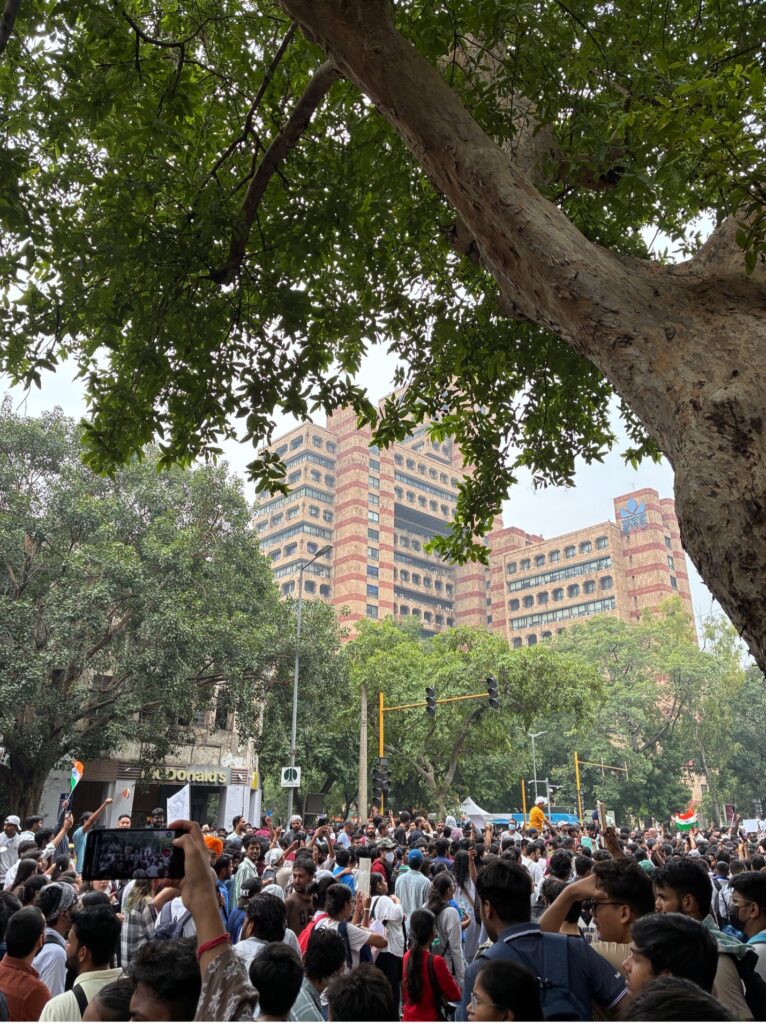
Photo by author
Note: The author wants to thank Brenna Casey and Asha Nadkarni for invaluable conversations on Delhi.
MEENAKSHI NAIR is PhD candidate in English at the University of Massachusetts Amherst where she works on postcolonial literature, cities, and visual culture.