
10 Questions for Jennifer Jang
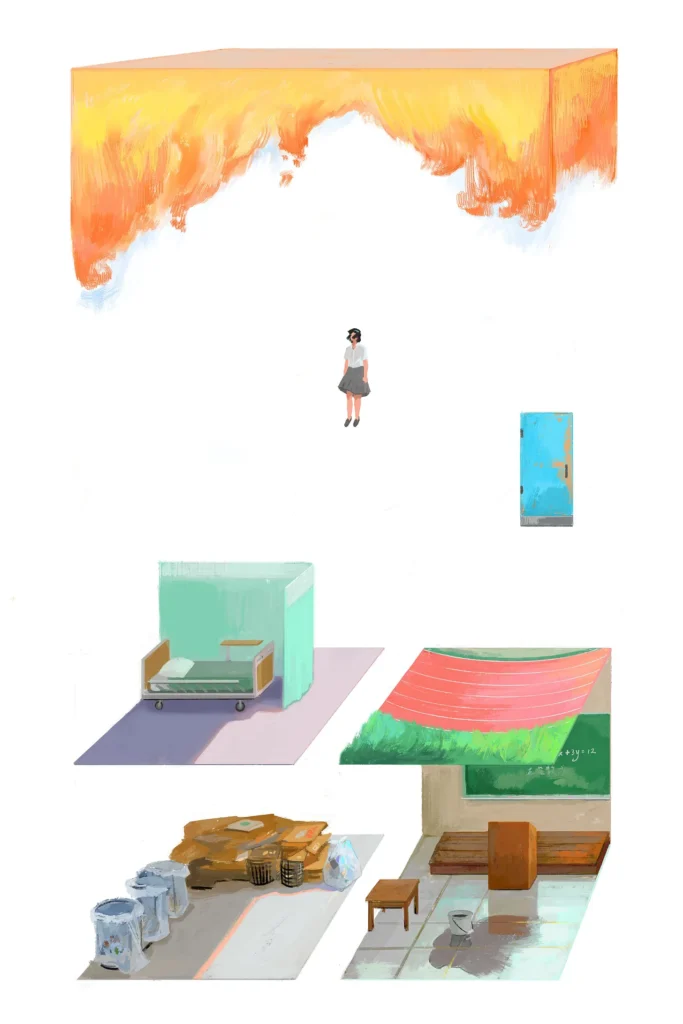
MISS TANG was a plump woman in her thirties and our seventh-grade homeroom teacher. She had a kind, matronly smile but sprung into tantrums over trifles. Her punishment of choice was meditation. After school, we’d sit at our desks with straight backs, knee-bound palms, and closed-tight eyes while Miss Tang surveilled us from the podium and doled out minutes for minor infractions.
—from Jennifer Jang’s “Dumpster Children” (Vol 66, issue 3)
What writer(s) or works have influenced the way you write now?
There were two writers that showed me the tremendous power of the short story. I recall the devastation I felt after reading Jhumpa Lahiri’s A Temporary Matter. I remember the pleasant tingle that lingers after reading Chekov, when he captures an emotion that I’ve felt before but hadn’t been able to put into words.
Thematically, the works I admire are psychologically incisive, philosophically ambitious, and delightful to read, such as Milan Kundera’s The Unbearable Lightness of Being, Francoise Sagan’s La Chamade, and Ursula K. Le Guin’s The Dispossessed. Since I don’t have a background in literature, from time to time I discover “new” writers that excite me—I’ll never forget when I first read Gabriel García Márquez, Jorge Luis Borges, and Joan Didion. I’m always analyzing or emulating their styles, like a child trying on grown-up clothes, and learning through this process.
What other professions have you worked in?
I’ve worked as a part-time pharmacy technician, a Mandarin Chinese translator and interpreter, a UX designer, and a frontend developer.
What did you want to be when you were young?
I’ve always wanted to be a writer. Not just a writer—a writer in English, my non-native language. I was (and still am) conscious of how ludicrous this sounds, and so I never told anyone about it growing up. But I kept on writing in secret.
I like how Natalia Ginzburg presents her relationship to writing in the essay My Vocation: “The important thing is to be convinced that this really is your vocation, your profession, something you will do all your life.” That’s how I feel about writing.
Do you have any rituals or traditions that you do in order to write?
I like making edits on paper. Printed stories are spatial stories; I could better see their structure and move things around. Whenever I begin to feel too precious about my words, I change the text to a different font; it helps me get unstuck.
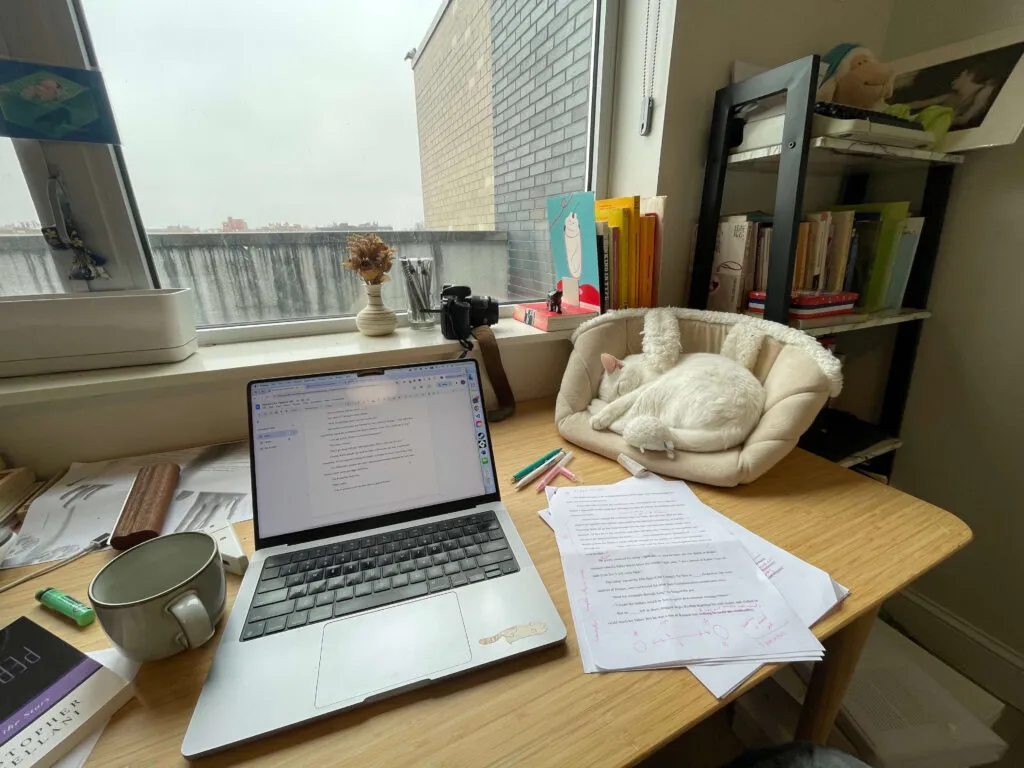
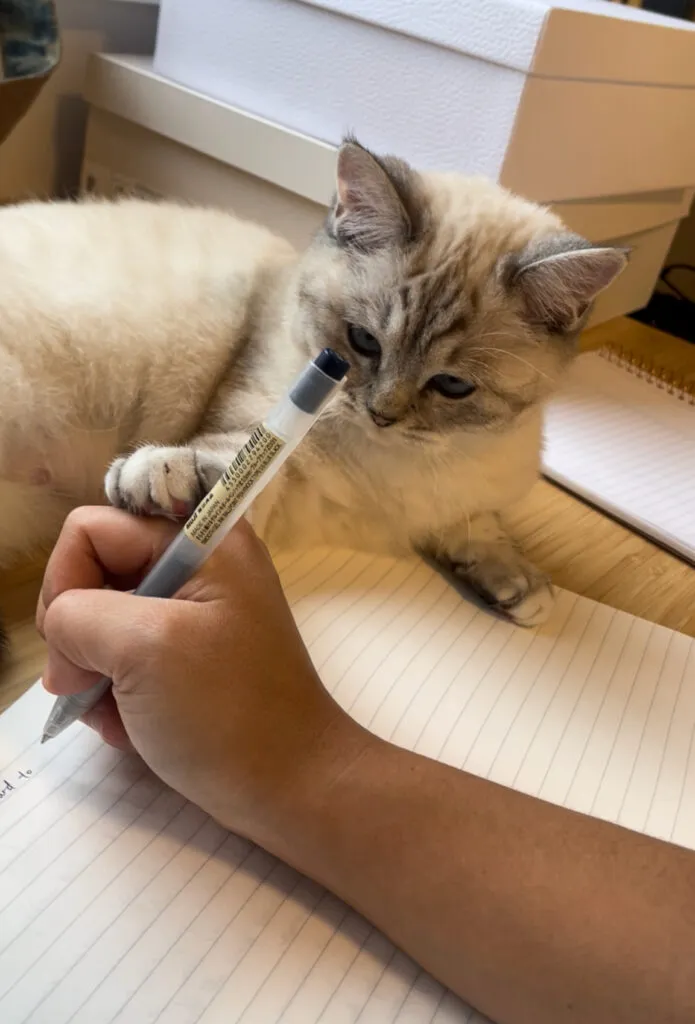
Jang’s workspace and cats: Milu (sleeping) and Maki (writing).
What inspired you to write this piece?
This piece was directly inspired by Mylene Fernández Pintado’s Hard Water, translated by Dick Cluster and published in AGNI 98. The story uses the first person “we” to represent a raucous high school class in Cuba, in the seventies. I loved the idea of the Classroom as Microcosm, and wanted to explore this against the backdrop of Taiwan.
In my piece, I drew from my own experiences living through the Taiwanese education system. I still remember the vulnerability, susceptibility, and frustration of youth, and how much difference was resented and suppressed. I was interested in exploring this collective “we”: who belongs in it? Who gets to belong in it? How does it start to unravel?
Who typically gets the first read of your work?
Shoutout to my friends Evie, Daniela, and Andrea! Our weekly writing meetings have become the highlight of my week. Every writer needs friends that can give it to you straight, while being sympathetic: “I’m sorry—I know you love this story, but it’s not working.” After which you’d cut whole pages, sew back the laceration in your heart, and dive into a tear-soaked rewrite—and come up with a story that is much more focused.
If you could work in another art form what would it be?
I’d love to learn oil painting. I am comfortable painting plein air with watercolor and gouache, but never moved into oil painting due to how demanding it seems to be, on time, space, and money. But I’d love to one day, and paint like my art heroes: Edward Hopper, John Singer Sargent, and Mary Cassatt.
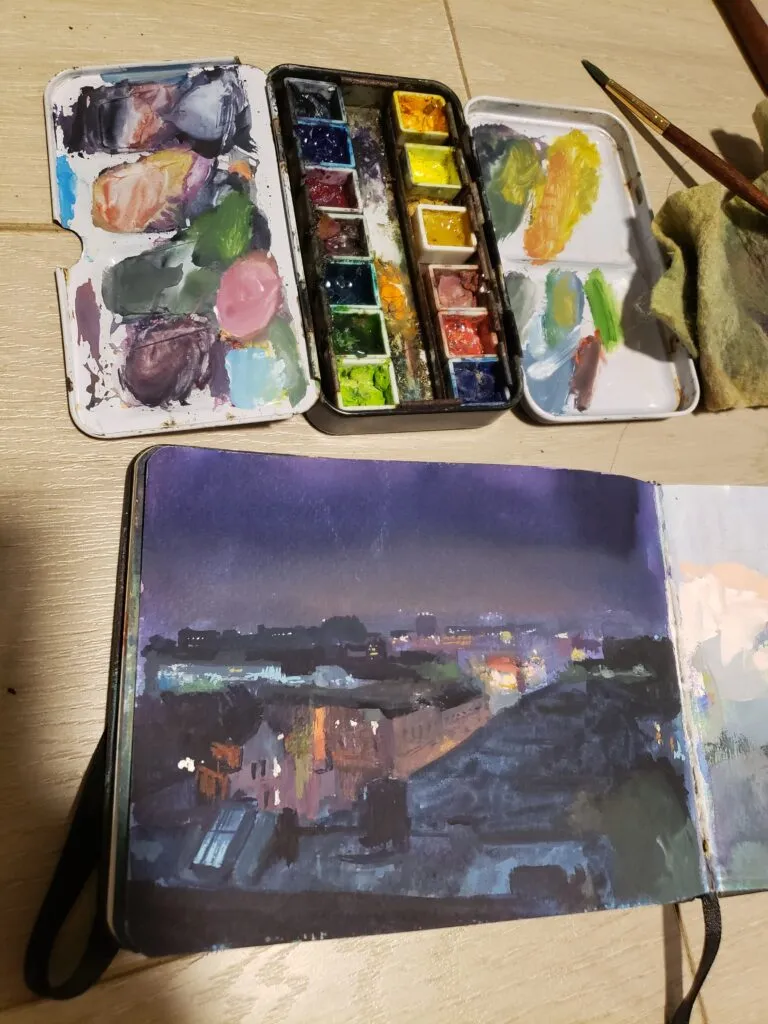
A recent plein air painting done by Jang in Brooklyn.
Is there a city or place, real or imagined, that influences your writing?
I love the idea of America, as often described through my mother’s nostalgia-laden lens: “There are carpets everywhere in America, so that one’s feet don’t tire after hours of walking.” Or, “In America, if you are good at something—doesn’t matter what it is—you will be honored.”
Thus, all my life, I pined for that miraculous birthland of which I have no memory. Trusting in my mother’s words, I thought America was a place where all were equal and free from poverty and racism. What a shock I had when I arrived, still in love with the promise of freedom, only to realize that many Americans do not feel free! That’s why, even though now I live in NYC, I don’t quite feel like I’m in America yet.
In addition to that imagined America, my memory of Taipei and Taiwan still influences me, as much as I want to be free of it. I guess that leaves me dangling over the Pacific Ocean, caught between a concrete tiny island and a fiction on another continent.
What are you working on currently?
I’m working on a collection of short stories that explore connection and alienation in close relationships. Strangers from the same country meet abroad, and mistake nostalgia for love; an abused girl turns to her sister’s party friends for connection; a young man humors an older woman’s request to playact as her first love. Shared by all is a desire for reconnection, which is tackled with obsessive zeal, or complete denial. These are tender stories; though their protagonists do not always succeed in what they set out to achieve, they are driven by hope and not despair.
What are you reading right now?
Trusting a tip from an anonymous library receipt, I checked out Romain Gary’s The Life Before Us and loved it so much that I picked up his memoir, Promise at Dawn. I’m also reading Deborah Levy’s third book in her Living Autobiography series, Real Estate. There are some other books I’ve been slowly gnawing through, such as The Art of the Personal Essay, an anthology edited by Phillip Lopate, and Hannah Arendt’s The Human Condition.
JENNIFER JANG (she/her) is a writer, coder, and web designer from Taipei. Her work has appeared in JMWW. She now lives in New York City, where she’s at work on a collection of short stories.