
7 Questions for Ibrahim Fawzy
Not just one death,
one victim tells another:
they killed me by the roadside.
—from Ibrahim Fawzy’s translation of Maya Abu Al-Hayyat’s “Not Just One Death” (Volume 65, issue 4)
What role does language play in resisting colonialism and precipitating liberation? How does your piece engage with this question?
Language is not merely a medium of expression; it is a terrain of struggle. Colonialism has always been linguistic. It begins by dictating what may be said, and in which tongue it should be spoken. Literature, in this sense, becomes humanity’s first archive, its record of what people can do to one another, and for one another.
The stories of the genocide in Gaza are unbearably difficult to tell, but I believe they are most truthfully carried in a poem, surrounded by an expanse of white space that mirrors both silence and grief.
In such a landscape, translation becomes an act of solidarity. It is one of the few ways we can wield language to echo voices that have been deliberately muted, ensuring their stories are heard, shared, and remembered. Every act of translation is an attempt to reclaim narrative sovereignty from systems that flatten, mistranslate, or erase marginalized voices. Translators do not simply carry words across linguistic and cultural borders; they return them to a public consciousness from which they were exiled. “Translation is the common language of languages. But languages seen in terms of hierarchies of power and domination distort its full function as a common heritage of languages,” writes Ngũgĩ wa Thiong’o.
My own translation practice occupies that space between languages, a space where misunderstanding and revelation coexist. I try to let Arabic speak on its own terms, even if it unsettles English rather than conforming to it. I see translation not as domestication but as resistance, a way of allowing the voiceless to insist on their right to be heard.
Are there cultural or literary traditions from Palestine that particularly inspire your work?
Like many Arab writers/translators, my work has been profoundly shaped by the Palestinian poetics of steadfastness (ṣumūd), a tradition carried in the voices of Mahmoud Darwish, Ghassan Kanafani, and so many others who transformed dispossession into a literary homeland. What moves me is not only their resistance to occupation, but their lyrical reimagining of place and exile. In Darwish’s hands, geography becomes a metaphysical inquiry; in Kanafani’s fiction, narrative becomes an act of witnessing.
I’m equally haunted by the oral traditions that endure through song, proverb, and the shared reservoir of collective memory. To translate or reimagine them is to enter a lineage that refuses erasure, a tradition that survives through repetition, reinvention, and the stubborn act of remembering.
How do you envision the relationship between art and activism in your practice? What responsibility, if any, do you feel as a writer to document the lived experiences and resistance of Palestinians?
For me, art and activism are two dialects of attentiveness. Art bears witness; activism insists on change. They are not opposing forces but parallel languages that converge whenever a poem restores the human face behind political abstraction, whenever it insists that a statistic once had a heartbeat.
As a translator of Palestinian writers, I don’t see my role as speaking for them, but as amplifying their voices, their untranslatable griefs that, in some way, fracture and remake language itself. My task is not to repair rupture, but to hold it open with integrity, to show that resistance can reside in syntax, in cadence, in silence. Translation, thus, becomes another form of witnessing, an act of carrying truth across borders without letting it fracture.
However, this responsibility is not only thematic; it is also formal. While working on Maya Abu Al-Hayyat’s “Not Just One Death,” I experimented with the piece’s formation. Abu Al-Hayyat intended the witnesses’ voices to merge—to blur and echo one another—yet in my first draft I separated them for the sake of clarity. Later, with guest editor Mona Kareem, I searched for a middle ground where clarity and continuity could coexist, where the text might breathe without losing its choral force. I then experimented with removing punctuation altogether to see what it feels like when voices bleed into each other without end-stops, without borders. I played with spacing, enjambment, and the rhythm of interruption. Much of this work was done with Geoffrey Hill’s “September Song” in mind, his mastery of how spacing, silence, fragmentation, and punctuation shape meaning. Following this back-and-forth, the poem ultimately took on its current form, born of a long negotiation with the text.
The form is never ornamental; it is political. The way a line breaks can echo breathlessness; the absence of a comma can mimic collapse; a blank space can carry as much grief as a sentence.
For me, that is where art and activism meet. In the careful, ethical choices of form. In allowing Palestinian voices to inhabit the page on their own terms. In letting the text resist both erasure and simplification. In crafting a structure spacious enough for grief, silence, and defiance to coexist.
What challenges do you face when writing about Gaza for international audiences? How, if at all, do you address these challenges in your work?
The hardest challenge is the fetishization of Palestinian suffering in Western discourse—how Gaza is turned into an emblem rather than a home, a spectacle rather than a community. International readers often approach Gaza as crisis, not continuity. And yet, the Israeli occupation of Palestine is nothing new; nor is the systematic erasure of Palestinian life, culture, and narrative that has persisted since the establishment of the State of Israel in 1948. This is not an exceptional moment but the latest chapter in a long, deliberate project of dispossession.
To write about Gaza, then, is to push back against both exoticization and exhaustion. I try to translate the everyday alongside the catastrophic. By foregrounding the texture of life rather than the grammar of tragedy, I hope to remind readers that Gaza is not a metaphor but a living geography, a place where people dream, argue, cook, sing, and create. A place where art continues to rise, stubborn and luminous, from beneath the rubble.
How do you nurture yourself and practice self-care throughout the writing process? What role has your community played in helping you endure during this profoundly challenging time? In what ways have you seen grief and anger act as an impetus for change? How have these emotions manifested (or served as powerful drivers) in your own creative process?
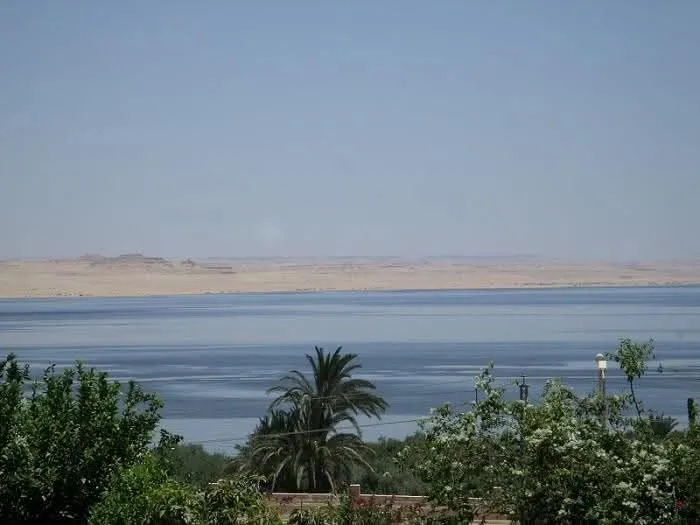
I return to water—the Nile in Cairo, the Charles River in Boston, Lake Qarun in Fayoum. Water reminds me that grief, too, must keep moving if it is to remain bearable. Community sustains me. Students, translators, friends always remind me that language still matters, even when the world burns. Teaching literature feels like a form of care; it renews my faith in the quiet, redemptive power of stories.
And I find solace in the small, tender acts, like reading Darwish aloud, letting his cadences steady my breath. Most importantly, I tend to silence—the kind that gathers at the edge of dawn, or settles beside a river, or lingers after a poem has ended.
In what ways have you seen grief and anger act as an impetus for change? How have these emotions manifested (or served as powerful drivers) in your own creative process?
Grief and anger are the twin engines of witness. Grief teaches humility; anger demands transformation. With each new assault on Gaza, I’ve felt the weight of despair, but also the urgency of writing and translating as a form of emotional reclamation. When everything around me felt untranslatable, I found my way back through the words of others. Translation became my shelter, the place where I could breathe again. For me, every translation begins as a survival story.
In my work, anger finds its form in shorter sentences, and fragments that echo dismemberment. Grief lingers in repetition. Together they create a rhythm of mourning that insists on endurance. To grieve collectively is itself an act of resistance. It keeps the dead among the living, insisting on memory where erasure is the colonizer’s most persistent weapon.
Who are the artists, writers, and activists you currently follow or admire?
I draw strength from Maya Abu Al-Hayyat, Najwan Darwish, Batool Abu Akleen, Alaa AlQaissi, Ahmed Bassiouny, Haider Ghazali, Omar Hamash, Mosab Abu Toha along with others—voices that transform witness into art, blurring the line between testimony and beauty. I believe that beautiful writing can cut through the noise in ways other forms cannot. As Du Bois once wrote, it is “beauty [that can] set the world right.”
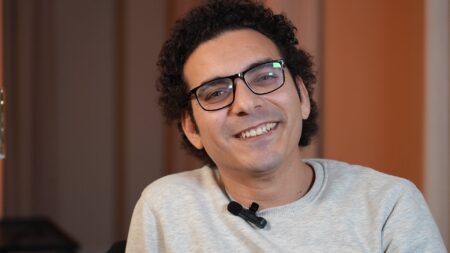
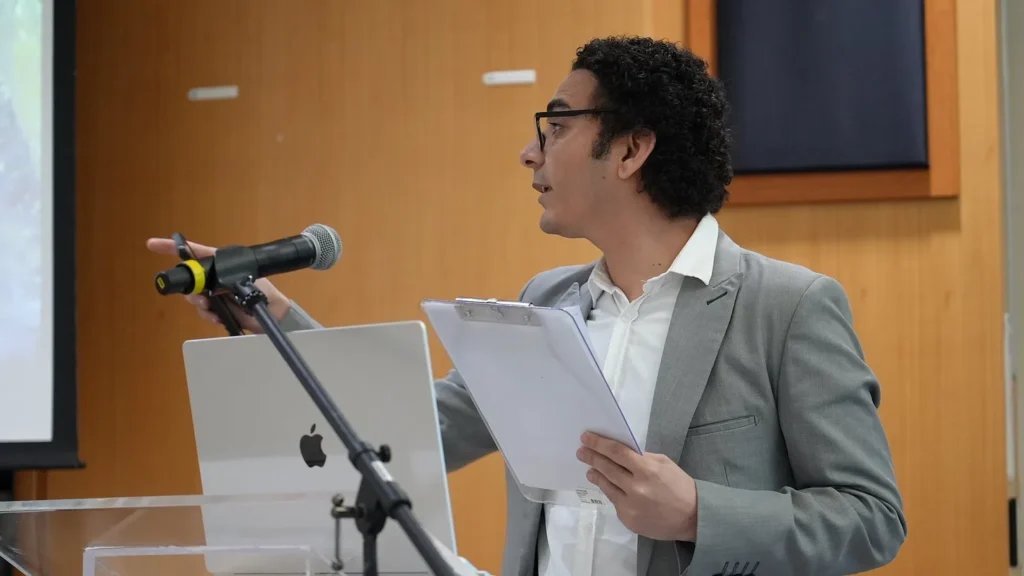
IBRAHIM FAWZY is currently pursuing his MFA at Boston University. He’s a two-time graduate of the British Center for Literary Translation (BCLT) Summer School. He was awarded a mentorship with the National Center for Writing, UK (2022/2023), as a part of their Emerging Literary Translators Program. He was a recipient of Culture Resource’s Wijhat grant. His translations, reviews, and interviews have appeared or are forthcoming in ArabLit Quarterly, Words Without Borders, PEN Transmissions, Consequence, Modern Poetry in Translation, Poetry Birmingham Literary Journal, Poetry Ireland Review, and The Markaz Review, among others. Ibrahim won a 2023 PEN Presents award for his Arabic-to-English translation of Kuwaiti author Khalid Al Nasrallah’s The White Line of Night.