
9 Questions for Caroline Stevens
What I mean is, there are ways
back in when your brain has checked you out:
singing badly, for example. Making ugliness
a god of sorts. Knowing yourself as a person that
can be unwillingly split, and learning how to
keep a sewing kit on hand.
—from Caroline Stevens’ “Sewing Lesson” (Volume 66, issue 3)
Tell us about one of the first pieces you wrote.
I don’t remember any specific piece I wrote as a child, probably for good reason. One of the earlier poems I remember writing in my first poetry workshop in college was for an assignment to write a poem using a news article as the starting point. I chose an NYT article from that month titled “Airbag Flaw, Known but Unaddressed, Led to Recalls” and developed an extended metaphor about a breakup with my high school boyfriend. It was as heavy handed as you’d expect. But the challenge of the extended metaphor was a useful tool to learn.
What writer(s) or works have influenced the way you write now?
Some of the first poetry collections I read cover to cover that still sit with me are Sharon Olds’ Satan Says and Li-Young Lee’s Rose. They both have such intimate voices, though completely different tones and projects. Both Olds and Lee have a way of exposing the shadow that has influenced my work.
Later on, I found myself pulled into Rilke’s lyricism—it’s as if he’s speaking from the dead straight into my soul. I feel this way about a lot of contemporary lyric poets too, the way they transcend contemporaneity to speak to a timeless self. Linda Gregg does this especially well.
When I was 21, I took a queer literature class where we read texts like Audre Lorde’s Zami: A New Spelling of My Name, Rita Mae Brown’s Rubyfruit Jungle, Sarah Schulman’s People in Trouble, along with excerpts of queer theory, plays, and films. This was the first time I thought critically about queer cultural output, and how queerness enables specific explorations of intimacy, violence, and community. So much of my writing now is indebted to the patterns of thought I was first introduced to in this class.
What did you want to be when you were young?
I wanted to be a writer pretty early on, starting in grade school, but before that, I had a phase of wanting to be an actor. I took acting classes and loved entertaining adults at family parties with jokes memorized from an inappropriately mature joke book I had. I think the same part of me today enjoys reading poems aloud—the performance aspect can be electric. I love using breath and pacing to change the mood of the room, to cultivate anticipation.
What inspired you to write this piece?
Most of my poems are born from a series of moments and images that are swirling around the back of my mind until they coalesce into a draft: here, the daily oranges I was eating at the time, the gravel of my apartment’s parking lot as viewed from my kitchen table. These images work in service of the larger question of how we wrestle with the inevitable moral failures of ourselves and our loved ones. How do you maintain relationships to people you know have harmed others? What does repair look like, or forgiveness? When are we complicit? I think a lot about the messiness of relationship, of friendship, what we owe each other, how we fail each other, how we keep trying.
Is there a city or place, real or imagined, that influences your writing?
Place is very present in my writing. I’m deeply influenced by the landscape of the Midwest, specifically northern Minnesota, but also Minneapolis, Chicago, rural Wisconsin, and rural Illinois. Lakes and rivers often make an appearance in my work, as do distinct seasons and all the emotional tenor they convey. I’ve also lived abroad in Montevideo and Madrid and traveled through South America and Europe during those time periods, so foreign landscapes frequently mark my poems too.
Do you have any rituals or traditions that you do in order to write?
Ideally, I need quiet and time alone for at least an hour before I begin drafting. Reading is almost always the way in to writing for me—I’ll start by reading a few poems from whatever collection I’m in until I’m feeling pulled to say something. I always write the first draft by hand, usually with pencil, in a thin, unlined notebook, then refine it as I’m typing up the draft. The drafts are usually formless—sometimes I consider line break and stanza on paper, but usually that comes in the period of transcribing from paper to computer.
Who typically gets the first read of your work?
My girlfriend Noelle usually hears poems as soon as they move from notebook to Word doc. I’ll also text my friends Andrea and John pretty much immediately—Andrea writes prose and has the best ear for poetry, and John is an incredible poet who I was lucky enough to meet during my MFA.
If you could work in another art form what would it be?
Definitely something body-oriented, like modern dance. There’s so much that can be felt but not expressed with words, and while poems attempt to bridge that gap, they inevitably fail (as posits Ben Lerner in The Hatred of Poetry). I’m always moved beyond words when I see dance performed, and even in casual dance spaces there’s an alchemy from everyone’s freedom of movement, both in watching others and moving yourself.
What are you reading right now?
I’m always in the middle of several books so I can pick up whichever is calling me on a given day. For poetry, I just finished Fanny Howe’s Gone, which pulled me back into reading poetry collections after a long series of novels. I love her gnomic mysticism. I’m also reading Mary Helen Callier’s When the Horses, which is excellent, and Philip Levine’s What Work Is, which is pulling me to write some long narrative poems. For fiction, I’m reading Virginia Woolf’s To the Lighthouse and Lauren Oyler’s Fake Accounts.
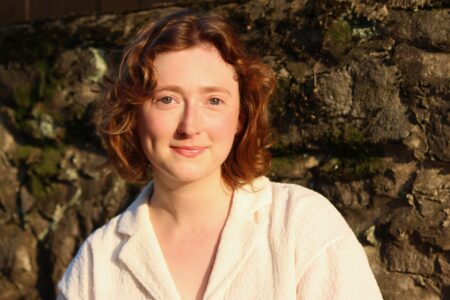
CAROLINE STEVENS is a Chicago-based poet from Minneapolis. She holds an MFA from Vanderbilt University, where she won the 2022 & 2023 Academy of American Poets University Prize and served as the editor-in-chief of Nashville Review. Her work can be found in The Journal, Parentheses Journal, and elsewhere.