
10 Questions for Dong Li
Two middle-aged men before an ancient map
Look for where they are
The bronze birds are now rotten
Closer to Giacometti
—from “In the Exhibition Hall” by Ye Hui, Translated from Chinese by Dong Li (Volume 66, Issue 2)
Tell us about one of the first pieces you translated.
The first full-length book that I have translated into English was the Chinese poet Zhu Zhu’s collection, The Wild Great Wall (Phoneme Media / Deep Vellum, 2018). Zhu Zhu has always treasured his independence, “a wolf look[ing] for the forest of words.” I was learning to write then, so this translation was a companion and a lesson, “not to become a ghost, not to traffic in suffering, / but to clarify life’s wellspring.” As I traced the transformation of Zhu Zhu’s poetics from an early ethereal verse to a visual and visceral composition then to an investigation of history in this compact volume, the poems seemed to burn slow but with great force, from a poet on the periphery reaching for the unrelenting and unstoppable words. Perhaps all of us could see something in ourselves, “questing for that first moving glance.”
What writer(s) or works have influenced the way you write now?
It might be best to leave this question to the readers and critics. I seem more interested in figuring out where the writing might be going and attending to scrambling a path through. The greatest influence of writers and works that I admire is probably to try not to be influenced by them but to become the writer I am. As a translator, I want the total immersion and enjoy forgetting myself and my words as I navigate the poetic force between languages, and if I am insistent and lucky, I might stumble upon something surprising but that which seems to be already waiting in the language of arrival.
What did you want to be when you were young?
Probably a singer. To express myself differently than in speech. To annunciate words with my own cadence and music. To feel a various rhythm of time. To embody the dynamic and be spent. As I quickly discovered that I had little talent, I turned to the text, in the hope that it sings its curdled heart out.
What drew you to write a translation of this piece in particular?
Ye Hui is a master in weaving the contemporary quotidian into myths and mysteries, which strangely do not confound but elucidate the interconnectedness of all things and times. In the poem “In the Exhibition Hall,” history becomes alive as “thunder, lightning, fire / Coughs and frozen brushes,” and a stone statue turns “vivid, unlikely sculpted” with “delicate mouth, nose, hairdo.” And the past seems to always accompany the present, “By his side, an ancient river boils / Bursts of thin mist.” In the poem “The Highway,” we witness the metamorphosis of the highway from “an allusion” to “a bright and black ribbon” and to a “[b]ottomless river.” Ye Hui then goes on to ask, “can our souls / Leave like this,” probing the endless cycles of transformations. Ye Hui’s poems are not just highways to contemporaneousness but also bridges from the smallness of our being to potent splendors of transcendence if we allow our consciousness to ask the right question.
Is there a city or place, real or imagined, that influences your writing?
A path. Nothing is a dead end.
Is there any specific music that aids you through the writing or editing process?
The voice of the writer and the subtle variation in the rhythm of their texts are music enough and become clearer with another and then another look and listen.
Do you have any rituals or traditions that you do in order to write?
Whatever gets me a clear head would work. Like in the dreamy wake of the morning light. Like listening to a thunder turning into sheets of hard rain. Like smelling a cup of green tea as the tea leaves unfold into small, slender hands.
If you could work in another art form what would it be?
Likely en plein air. The overwhelming intake of nature could be disorienting, and the senses are re-aligned into pockets of cohesion. The frame slowly comes into view. Then there is the act of moving the hand and the whole body to brush paints into movements on the canvas, which becomes a portal of seeing and making that seeing seen.
What are you working on currently?
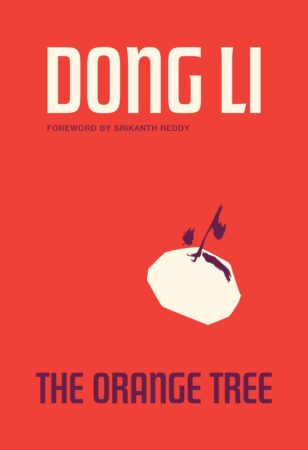
I am preparing the publication of the Chinese poet Ye Hui’s first collection in English translation, The Ruins, forthcoming from Deep Vellum later this fall. My Mandarin Chinese translations of Victoria Chang’s OBIT from East China Normal University Press and Eliot Weinberger’s The Life of Tu Fu from The Chinese University of Hong Kong Press were just out. I have also been working with the German poet Ron Winkler, whose German translation of my English debut The Orange Tree (University of Chicago Press, 2023) should be coming out from Matthes & Seitz Berlin next year.
What are you reading right now?
I am reading and re-reading the Chinese poet Liu Ligan’s remarkable book The Dust Museum and translating it into English. I am also enjoying reading All This Thinking – The Correspondence of Bernadette Mayer and Clark Coolidge (University of New Mexico Press, 2024), edited by Stephanie Anderson and Kristen Tapson.
DONG LI is a multilingual author who translates from Chinese, English, French, and German. He is the English translator of the PEN/Heim-winning The Gleaner Song (Giramondo & Deep Vellum) by the Chinese poet Song Lin, and The Wild Great Wall (Deep Vellum) by the Chinese poet Zhu Zhu. His debut collection of poetry The Orange Tree (University of Chicago Press) was the inaugural winner of the Phoenix Emerging Poet Book Prize and a finalist for Poetry Society of America’s Four Quartets Prize.