
When the Past Feels Present: Teaching Argentina’s Official Story in the U.S.
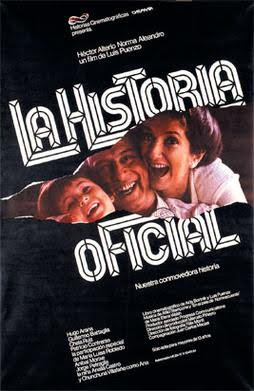
On March 24, 2026, as Argentinians prepare to commemorate the fiftieth anniversary of the coup d’etat that initiated the Proceso de Reorganización Nacional—the country’s bloodiest and most violent dictatorship in its history—I want to revisit La historia oficial [The Official Story] (1985), the award-winning film directed by Luis Puenzo which exposes the consequences of the political events of the late 70s and early 80s in intensely personal terms and think about why I continue to teach it in my college courses. I live in Los Angeles, a city marked by the U.S. Immigration and Customs Enforcement raids that have been snatching mothers, fathers, sons, and daughters off the streets, sowing terror for over a year now. The atmosphere in some parts of the city is marked by a palpable fear, but also by a growing sense of defiance: neighbors warning one another, communities organizing, and people no longer looking away. From this present, The Official Story continues to offer a meditation on the ways in which authoritarianism settles into daily life before it’s named and confronted.
The Official Story is set in Argentina in 1983, months before the military junta called for democratic elections, giving way to the government of Raúl Alfonsín. Alicia and Roberto Ibañez, with their adopted five-year-old daughter Gaby, live in considerable comfort. Their affluence is made possible by Roberto’s complicity with the military regime. The return of Alicia’s childhood friend, Ana, from exile triggers the main plot: Alicia, who thus far has remained seemingly oblivious to the events happening around her, begins to question her daughter’s origins as a potentially stolen child of disappeared parents. By focusing on Alicia’s awakening to the realities surrounding her, what classical narrative theory calls her anagnorisis, the film captures a sentiment felt by many (though not all) in Argentina as the dictatorship came to an end and they were finally able to recognize the truth.
Four decades after its release, the film occupies a singular position in the cultural memory of Argentina’s dictatorship and democratic transition. Beyond its international recognition, its legacy lies in its role as one of the earliest cinematic works to confront state terror while the process of national reckoning was still unfolding (remember our timeline from earlier). To watch the movie in 1985 was not about looking back at a closed chapter, but rather to witness a story whose consequences were still emerging in real time.
Its international success was immediate and historic. It was the first Argentinian and Latin American film to win the Academy Award for Best Foreign Film as well as the Golden Globe. For international audiences, it functioned as an entry point for understanding the dictatorship’s human rights crimes. For Argentine audiences, however, its impact was more complex: it arrived at a moment when the country was only beginning to articulate publicly what had been unspeakable for nearly a decade.
This dual reception partly explains the debates that have surrounded the film since its release. Critics who read the film skeptically have sometimes argued that its focus on Alicia risks reproducing the logic of the “two demons” by centering a character who is neither a perpetrator nor a victim; she’s a bystander. From this perspective, the film’s emphasis on personal awakening might appear to soften the structural nature of state violence.
Yet such critiques risk overlooking the film’s formal and narrative strategies. Rather than absolving complicity, the film stages it. Alicia’s gradual recognition does not excuse her earlier ignorance. Instead, it exposes the conditions that made her ignorance possible. We, as spectators, are not asked to identify with her innocence; we are asked to recognize ourselves in her process of discovery. In this sense, the film does not promote equivalence between opposing forces; instead, it dramatizes how authoritarian regimes depend on ordinary citizens’ willingness—whether motivated by fear, comfort, or denial—not to see.
Another debate concerns the film’s representation of almost thirty thousand disappeared persons in Argentina. Notably, the disappeared are never shown directly. They appear through testimony, photographs, memories, demonstrations, and absences. Some critics have interpreted this indirectness as a limitation, arguing that it displaces victims from the center of the narrative. But this absence is, I think, a powerful ethical gesture. The disappeared cannot be shown because disappearance is the condition of not being able to be shown. What the film offers instead is the experience of searching, which is a process shared by Alicia, Sara, the Abuelas, and by Argentine society more broadly in the 1980s.
The film’s legacy is also inseparable from the evolving politics of memory in Argentina. Since the return to democracy, the country has gone through multiple phases of reckoning: truth commissions, trials, amnesty laws, annulments of those laws, renewed prosecutions, memorial sites, and public commemorations. Each stage has brought new interpretations of the dictatorship and new debates about responsibility, justice, and remembrance. Within this shifting landscape, The Official Story has remained a constant reference point as it continues to capture the uncertainty of accounting for the past.
The film endures precisely because it refuses closure. One way to understand this is that the unresolved ending insists that history itself remains unresolved. Justice may be pursued, truth may be sought, but the consequences of state terror cannot be neatly concluded within a single story.
For contemporary viewers, especially those watching decades after the dictatorship, the film operates simultaneously as a historical document and an ethical provocation. It reminds us that authoritarianism is not sustained by monsters alone, but by structures, silences, and everyday comforts. More importantly, it suggests that recognition is always belated: one understands only after the fact what was happening all along. The Official Story remains unsettling not because it documents Argentina’s past, but because it reveals how easily ordinary lives can coexist with extraordinary violence. The film doesn’t simply tell Argentina’s story; it asks each viewer what stories they are willing to see—and which they would rather keep behind closed doors. Ultimately, what The Official Story bequeaths to later generations is not a lesson about Argentina alone, but a broader meditation on how societies confront violent pasts. Its continued relevance lies in its insistence that the work of remembering is never finished, and that the most dangerous official stories are often the ones people most want to believe. This is why I continue to teach this film. It doesn’t offer answers, but it stages the process of asking questions—about history, responsibility, and memory. Forty years later, it still teaches us how to see.
Excerpted from an invited lecture delivered on February 24, 2026 at the University of North Dakota, Grand Forks, ND.
Manuela Borzone is assistant professor of Spanish at Occidental College in Los Angeles, California. She received her Ph.D. in Comparative Literature from the University of Massachusetts Amherst in 2021.