
10 Questions for Daniel Moysaenko
(after Yusef Komunyakaa)
A broken machine gun
hangs as a wind chime,
rat-a-tat-tat, hugging
a willow climbed by a toddler
who keeps singing
about craters
with American eyes
that overflow.
—from “Toys in a Field” (Volume 66, issue 1)
Tell us about one of the first pieces you wrote.
The first I remember, I was likely about six years old. They were mashed-up emulations of Wordsworth, Whitman, Dickinson, and Frost, of whom I had illustrated editions for children: Wordsworth’s cloud, Whitman’s hawk, Dickinson’s carriage, Frost’s stone wall.
What I remember best about one of those first poems was the serious effort, the concentration. It took me to a center, like a meditation, where the world receded. Many poets have described this, such as Jack Spicer. Many musicians and artists have, too. It’s a channeling. You are barely in control. You’re just an antenna. Your brain is the pen. In such a moment, all there is is the language or sound, and the images and feelings that burst from their coming into being. That’s when it feels amazing, even if the product is utter garbage. It’s a drug. Other times, as many will tell you, the writing goes terribly—no channeling, no flow state, just pure struggle, smashing clay in your hands. And the back and forth doesn’t seem to stop. I still experience this.
Every poem for me now has to feel like the first one.
What writer(s) or works have influenced the way you write now?
It’s hard for me to say who influenced my development or the way I write now, or in what way. Regardless, here’s my attempt at an incomplete list, which some of my mentors or readers might disagree with: George Oppen, Etel Adnan, Paul Celan, Tomas Tranströmer, W.S. Merwin, Alejandra Pizarnik, Amelia Rosselli, Wallace Stevens, Serhiy Zhadan, Wisława Szymborska, Franz Wright, Jack Gilbert, Jean Valentine, Mark Strand, Yannis Ritsos, Rosmarie Waldrop, Chika Sagawa, C.D. Wright, Anne Carson, Nathaniel Mackey, John Ashbery, James Tate, Louise Glück, Cole Swensen, M. NourbeSe Philip, Susan Howe.
What other professions have you worked in?
I’ve almost exclusively worked with language—as a writing tutor; medical office clerk; copyeditor for the Harriet Monroe Poetry Institute at the Poetry Foundation; translator and proofreader of medical records from Poland, Ukraine, Portugal, Spain, Mexico, and Italy; associate web editor at BOMB Magazine; co-host of jubilat magazine’s reading series at the Jones Library in Amherst, Massachusetts; university instructor and adjunct professor of composition, creative writing, poetry, international literature, and history of the English language in Massachusetts, Florida, and Ohio; freelance copyeditor of scientific academic articles; immigration legal writing specialist; and attorney.
What did you want to be when you were young?
Many things. A monk of no religious affiliation. A forest ranger. An astrophysicist. But math didn’t come as naturally to me as I thought it would to a physicist, and language did—so here I am.
What inspired you to write this piece?
I’ve studied and admired Yusef Komunyakaa’s poems since I was about thirteen years old. His much-anthologized “Facing It” made an early impression, through its balance of tenderness and intensity, immediacy and disconnect, which I tried to impart on my students about fifteen years later. At the risk of explaining Komunyakaa’s poem, I will say that it seems his “Toys in a Field” wrestles with the physical and psychological legacy of the Vietnam War on Vietnamese children. (This is a simplification of course, as the poem has layers of implications regarding the treatment of weapons, but otherwise I would just copy Komunyakaa’s poem down here as illustration of its meaning.) I, and many others, have been struck recently by how little changes. Wars proliferate. Children, and others, suffer. I wanted to superimpose the Vietnam War onto the Russo-Ukrainian War. To create that dialogue, I decided to alternate lines: original and my own. But this didn’t communicate enough the distance and strangeness of time passed, of cyclicality. So I inverted Komunyakaa’s original lines, revealing that still nothing has changed, backwards in reverse, or forwards. Those kids could be living a hundred years ago, fifty years ago, or now. They could be Ukrainian, Vietnamese, or American.
Is there a city or place, real or imagined, that influences your writing?
Ukraine, Italy, France, California, Montana, my backyard in Ohio, the banks of a lake at dusk.
Who typically gets the first read of your work?
Years ago, my older brothers who are poets would be the first to read anything—that is, what I was brave enough to let them read, whatever I thought was worthy. That shaped my approach. Then, my wife was the first to see my poems (almost all of them, and I wrote multiple per day), before I would let a professor or workshop peer read them, in case they would throw their hands up in confusion. She simplified my poems.
If you could work in another art form what would it be?
As a kid, I loved painting. I took lessons at the Cleveland Museum of Art. I loved playing music. I took lessons in piano and trumpet from about six to eighteen, and messed around on the drums, playing in bands in school and bands in basements and later in studio spaces. And I’ve loved playwriting and screenwriting, having one of my plays produced in college.
But I know any art form is a discipline. It takes enormous time. And I chose poetry. It combines everything in art I love: sounds, images, language, ideas, feeling.
It would be wonderful if I could return to painting or music seriously. They have a level of abstraction that writing could never have, even considering Language poetry and poststructuralist thought. In music’s and some visual art’s abstraction is a purity of response I gravitate toward, like biting into a peach: it’s either ripe or it isn’t.
What are you working on currently?
I am revising a novel I began in late 2014, set in New England, which I workshopped with Noy Holland. And I am developing a second novel that charts a Ukrainian family’s journey from World War I through the Cold War. Also, I am polishing a third poetry collection largely written during the pandemic about what it means to tend, to take care of the earth, loved ones, yourself, and those who do not want the help you are able to give.
What are you reading right now?
I read many books at once, left strategically or accidentally throughout the house. Recent or in-progress: Victoria Chang’s With My Back to the World, Donna Stonecipher’s Ruins of Nostalgia, Lindsey Webb’s Plat, Arda Collins’s Star Lake, Wendy Xu’s The Past, Paul Hlava Ceballos’s banana [ ], Jenny Xie’s Rupture Tense, Ari Banias’s A Symmetry, Philip Metres’s Fugitive/Refuge, Leila Chatti’s Wildness Before Something Sublime,Jenny George’s After Image, Bei Dao’s Sidetracks, Mai Der Vang’s Primordial, Mosab Abu Toha’s Forest of Noise, Adam Zagajewski’s True Life, Martha Ronk’s Silences, Valzhyna Mort’s Music for the Dead and Resurrected, Susan Stewart’s The Forest, Monica Youn’s From from, Peter Gizzi’s Fierce Elegy, Katie Peterson’s The Accounts, Lisa Wells’s Fire Passage, Shangyang Fang’s Study of Sorrow: Translations, Pierre Chappuis’s Like Bits of Wind, Annie Ernaux’s Getting Lost, W.G. Sebald’s The Rings of Saturn, and Benjamín Labatut’s When We Cease to Understand the World.
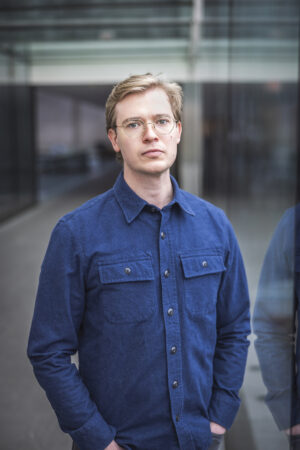
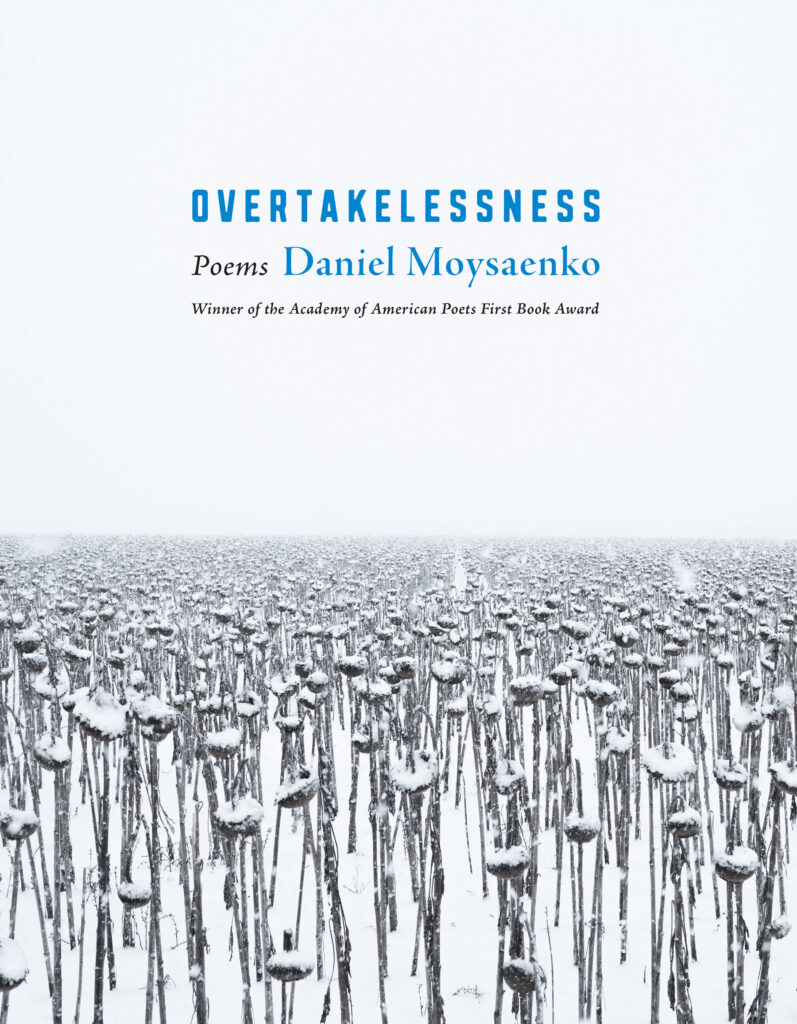
DANIEL MOYSAENKO is a Ukrainian American poet, translator, and critic. His work has appeared in The Nation, Poetry, The Poetry Review, Iowa Review, Harvard Review, and Chicago Review. Recipient of an Academy of American Poets Prize and Emory University Rose Fellowship, he has taught at the University of Massachusetts Amherst, Florida State University, and Ursuline College. He lives in Ohio’s Chagrin Valley.