
Interview with Siamak Vossoughi
“When we got hungry, it seemed very rude to discuss what kind of food we wanted. It seemed like the height of impoliteness. Wherever we went, there would be food. And the important thing there was the people.”
—from Siamak Vossoughi’s “Three Tryers” (Volume 67, issue 1)
Tell us about your relationship to writing.
It started early, that’s for sure. I remember being five or six and there was a girl in my class and she and I would compete to write stories that were so long that we’d have to take several pieces of paper and tape them together and then we would wear our stories like a scarf. I think the truest thing I can say about writing is that I know that when I do it, I like the world more. And liking the world more gives me more that I want to say. As for where it’s headed, one thing I’m always trying to do is to get freer with it. I was pretty good with writing freely when I was five or six, so I’m always trying to get back to that.
I’m curious what “freer” means to you in this situation; how are you defining a truly free story, or author?
My definition of a truly free story is one where the reader feels like the author at no point during the writing of the story said, “Oh, this is what this story is supposed to be,” and then proceeded to shape their writing around a chosen destination. They may have had an idea where it was going, but they never let themselves be entirely bound to that. Rather, they approached the last sentence with as much openness and possibility as they did the first.
My favorite thing [about “Three Tryers”] is that it’s genuinely trying to be free, in some kind of similar way to how going any place with people you love is going to make the place great. I knew the story had to be very intuitive, even more “first thought, best thought” than I normally try to do, to do that, but travel is where we often trust our intuition the most, so it felt right to do that.
I really love the use of California as this load-bearing setting, stretching out and holding together Steinbeck, this road-trip on the Great Highway, Monterey, these people… There’s almost a meta-level to it, too, after Camilo tells the Chucho story: “We’d heard the story before but we hadn’t heard it in Monterey”; as though California changes the importance or quality of storytelling itself. What drew you to California for this story, these characters?
Great question. I knew as soon as I left California (for Seattle) after living there many years that it was going to be easier to write about California in memory. I also knew I was going to romanticize it, but it was all right because I trusted that romanticizing. I knew that I had earned it, somehow. I had a dream of California before I came to California, from writers like Steinbeck and Saroyan, and that dream took on some contours that were entirely my own. Somehow that dream survived many years of living there, partly because I learned that the point was to not surrender yourself entirely to, but also to not dismiss, your literary heroes. And I met people with their own dreams of California, and I tried to let their dreams mingle with mine.
There’s Camilo’s Cuba running parallel to this infinite-California the whole time, too, which I was reading as the more head-on tackling of homesickness, or else the inevitable restarting of always-missing-a-place. Why give Cuba the burden of longing instead of California? Why choose Cuba in general?
The choice of Cuba in full honesty is because of a real friend of mine, with whom a shared notion of our dream-Californias has been part of our friendship. I am interested in immigrant stories in which characters have a poetic vision of both their old and new lands, and the ways in which those visions, maybe counterintuitively but maybe not, feed each other.
Borrowing from your story’s title: What have you been trying recently?
I have been trying to write a few stories that give the world of children and the world of adults entirely equal weight.
Do you have any unpopular opinions about literature/reading/writing?
One person’s perceptions of beauty are another person’s perceptions of cheesiness. Fear of being cheesy is just as limiting as any kind of cheesiness.
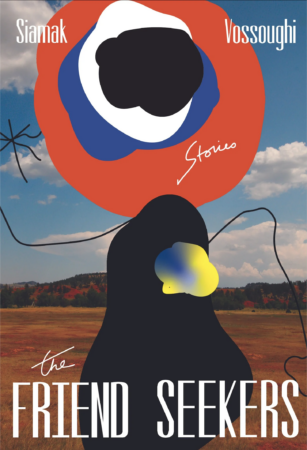
Without giving too much away, tell us a little about your upcoming collection The Friend Seekers. How does “Three Tryers” compare, in tone or subject or genre?
I think that “Three Tryers” would fit in okay with the collection, though hopefully it will fit in with a future collection better. There’s still a fair amount of California in The Friend Seekers, though less explicitly. I would say that The Friend Seekers also has characters who hold their political identities both centrally and subtlely at once. The topic of male friendship is not as directly explored in The Friend Seekers as it is in this story, but there are some hints of it around the edges. And it’s definitely a topic that I want to get into a lot more.
Is there anything else you’d like to share?
I hope reading this story is a fun experience.
SIAMAK VOSSOUGHI is a writer living in Seattle. He has had stories published in Kenyon Review, Missouri Review, Idaho Review, Bennington Review, Gulf Coast, and Copper Nickel. His first collection, Better Than War, received a 2014 Flannery O’Connor Award for Short Fiction and his second collection, A Sense of the Whole, received the 2019 Orison Fiction Prize. His third collection, The Friend Seekers, will be published in November 2026.