
Muzan Alneel (1986-2026): Sudanese Visionary and Revolutionary
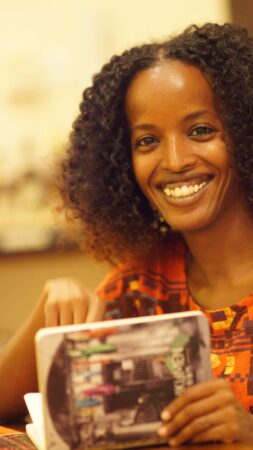
Photos of Muzan Alneel, photographed and shared by her husband Ahmed Mahmoud.
Wednesday April 15, 2026, the third anniversary of the outbreak of Sudan’s counterrevolutionary war, was also marked by news of the death of Sudanese engineer, activist, intellectual, and visionary Muzan Abuobaida Alneel. Born in Omdurman, Sudan in 1986, Muzan was only thirty-nine. Her sudden departure leaves an indelible absence in the souls of millions. Over the past week, those who knew her personally and those who encountered her through her enduring intellectual legacy have gathered to honor her life in Abu Dhabi, New York City, Toronto, London, Brussels, and elsewhere. We are grieving the loss of a singularly brilliant thinker who embodied that rare fusion of political praxis, ideological fortitude, and loving generosity that our world so urgently needs.
Muzan’s accomplishments and political values have invited comparisons to Black revolutionary intellectuals such as Franz Fanon, Walter Rodney, and Claudia Jones. Muzan was not only one of the most insightful theorists of contemporary Sudan, but also at the vanguard of popular action and revolutionary praxis. She wrote with an unparalleled clarity and vigor on topics ranging from neoliberalism, the Sudanese revolution, military rule, democratic empowerment, and people-centered industrial policy, to Sudan’s Resistance Committees, Western nations undermining the popular revolution, reflections on freedom amidst the counter-revolutionary war, and the tensions and solidarities binding Black and Arab solidarity struggles across the Sudanese and Palestinian liberation projects.
On paper, Muzan was a fellow at the Tahrir Institute for Middle East Policy and the Transnational Institute (TNI), a volunteer consultant at the Industrial Research and Consultancy Center (IRCC), and a prolific writer who published widely in venues such as TNI, Jacobin, Al Jazeera, African Arguments, Funambulist, and the Socialist Worker. In practice, she worked alongside grassroots and community-led initiatives, organized teach-ins, led protest chants, and nurtured the political imagination and collective courage that revolutionary struggle demands. Muzan never lost sight of the struggle against imperialist, fascist, patriarchal, and authoritarian systems. For her, ideological resistance and activism were inseparable from the praxis of everyday life. In a 2021 interview for Sudan Bukra, Husam Mahjoub probed, “tell us a little bit about who you are and how you became a political blogger and activist?” Muzan responded with humble and lucid precision, stating:
The question of “how did you become a political activist” is difficult to answer so I flip it around and ask the other person: “How can you not be an activist?” How can you live in Sudan and see the impact of politics in your life, and on the lives of those around you, and see that people live or die as a result of political decisions, they become rich or poor as a result of political decisions, the quality of life goes up or down, they gain or lose opportunities as a result of political decisions. So, it’s not possible not to be part of the political process as a citizen in any given state. At the end of the day, a state is composed of an authority and the people whose lives it impacts. […] If you are not politically active that makes you a recipient of the political process. There are only two options. Either you are an object or an actor in the political process. So, I don’t think being politically active anywhere in the modern world is the position that requires an explanation.
Muzan regarded popular education as a vital instrument of collective empowerment and material transformation. Her dedication to the material improvement of living conditions for the masses is evident both in her writings on multilateralism, economic policy, and structural reform and in her role as cofounder and managing director of ISTinaD, a Khartoum-based think tank advancing initiatives focused on the development of knowledge systems, energy justice, agri-food systems, and people-centered approaches to industrial policy diversification.
During the revolution she distinguished between lower ranking soldiers who helped protect protestors and senior generals from the Bashir regime who worked to co-opt the revolution. When the popular revolution succeeded in toppling Omar al-Bashir’s thirty-year dictatorship she traced the “lack of a revolutionary vision among the protestors” to “the lack of a revolutionary party.” During the transitional period she warned against collaborations with the military, writing “the people of Sudan don’t want to share power with their military oppressors.” More recently, Muzan argued that political movements that are not grounded in a clear analysis of “the state as a tool of the ruling class” are likely to fracture from within. She cited the Resistance Committees’ split between “the revolution’s goal of protecting and prioritizing human life, and the counter-revolution’s goal of protecting the state.” She thus emphasized the critical importance of nurturing the “ideological strength” needed to sustain counter-narratives, that is, narratives that cut through the ruling minority’s promotion of patriotism to confront the urgent needs of the most vulnerable populations and improve the material welfare of ordinary people.
Muzan’s revolutionary fervor, radical humane vision, and commitment to justice are beacons of light and clarity amidst escalating brutalities. As the world faces deepening warfare and unprecedented economic inequality, we should recall her reminder that the Sudanese revolution is not only about gaining justice for the people of Sudan, but that it is also a borderless “battle against the same global system that fuels war, racism, exploitation, and oppression everywhere.” Often, the simplest political stance is the one most dangerous to the status quo. This is encapsulated by Muzan’s insistence: “I believe people shouldn’t be murdered,” and the fact that this, of all her statements, has circulated so widely across social media.
When I first met Muzan in the summer of 2016, she was debating Sudan’s political future with a group of young adults in an outdoor discussion circle. Her message struck a rare balance between maintaining community-centered ideological principles without romanticizing revolution, and while also offering pointed critiques of what had gone wrong in the past. It was immediately clear to me that I was in the presence of one of the most principled and life-affirming minds of our times. As a young Sudanese person who had spent most of my life in exile in the diaspora, I was grateful to be in the presence of Muzan and her friends, and to learn and absorb as much as I could from each of them. I last saw Muzan in person in the fall of 2018, just a few months before the popular revolution that toppled Omar al-Bashir’s thirty-year military dictatorship in April 2019. In the months leading up to the revolution, we were contending with inflation. Countless Sudanese workers had their wages and savings withheld, placing immense strain on an already delicate situation. Cuts to fuel subsidies meant standing outside for hours waiting to catch a bus or van back to El-Haj Yousif, where I was living with my grandmother, aunt, and cousins. During this time, Muzan was a great source of support and inspiration.
The bitter irony is that, seven years after the revolution, and three years into a brutal counterrevolutionary war that has claimed countless lives and displaced 11 million people, many of those young Sudanese friends have been forced to flee the war and go into exile. Brutality and necessity scattered the spores of the Sudanese revolutionary spirit across Egypt, Kenya, Uganda, Saudi Arabia, the UAE, Turkey, Germany, and globally. Muzan was one of the 4.5 million Sudanese people displaced across international borders. However, this did not diminish her conviction that ending the war required breaking elite control over resources and political decision-making, realizing the aims of the Sudanese revolution through grassroots civilian-led governance, and mass redistribution of power and resources through people-centered development.
I have compiled here an abridged list of Muzan’s online writings in English, and interviews and teach-ins in both English and Arabic. She will live on through her writings, her ideas, and the deep impact she has left on countless people. My sincerest condolences to her mother and father, to her sisters Misdar, Marine, and Malab, to her husband Ahmed Mahmoud, and to her close friends and collaborators, for they are grieving the loss of a lively, sincere, and deeply loving soul. Muzan’s quirky side is best encapsulated by a sentiment her husband shared with me:
Right now all I want to remember about her is her silly jokes, and her excitement for a cringy TV show, and her insistence to walk me to the bus stop in the morning, and her infatuation with construction cranes.

Publications Organized in Descending Order:
2025:
- “Back to the Future: Nyerere’s Vision of Industrial Development and its Lessons for the Contemporary Global South,” Muzan Alneel and Gussai H. Sheikheldin, Transnational Institute, December 30, 2025.
- “The Structural Roots of Sudan’s Ongoing Devastation: The brutality of the current war is the result of decades of conflict and repression,” Muzan Alneel. Rosa Luxemburg Stiftung, June 12, 2025.
- “The Arguments for Production,” Muzan Alneel. Atar Network, May 19, 2025.
- “In the eyes of the beholder: The battle over the definition of the war,” by Muzan Alneel. Atar Network, May 19, 2025.
- “Sudan’s Revolutionary and Popular Movements: A Middle East Solidarity research report,” Muzan Alneel, Rania Obead and Khalid Sidahmed. MENA Solidarity Network, April 9, 2025.
- “Towards socialist answers from and for Sudan,” Muzan Alneel. Spring, February 21, 2025.
2024:
- “Yes #FreeSudan, but from What and by Whom?,” Muzan Alneel. The Funambulist, December 17, 2024.
- “Conditionality Breeds Contempt: Donor and Multilateral Myopia in Sudan,” Muez Ali, Muzan Alneel and Mayada Hassanain. African Studies Review 67, no. 4 (2024): 863–887. Published online January 23, 2025.
- “Failing Palestine by failing the Sudanese Revolution Lessons from the intersections of Sudan and Palestine in politics, media and organising,” Muzan Alneel. Transnational Institute, September 19, 2024.
- “Governing Development for Sudan’s Democratic Transformation: Post-war and Sustainable Paths Forward,” Muzan Alneel and Gussai H. Sheikheldin. International Institute for Democracy and Electoral Assistance, July 22, 2024.
- “The Sudanese Revolution in Crisis,” Muzan Alneel. Rosa Luxemburg Stiftung, April 12, 2024
2023:
- “Conditioned to Fail: Donor and Multilateral Engagement in Post-Revolution Sudan,” Muez Ali, Muzan Alneel, and Mayada Hassanain. African Arguments, September 29, 2023.
- “Sudan’s Revolutionary Path against War: While the generals lay waste to Khartoum, the Sudanese people are organizing in defence of human life,” Muzan Alneel. Rosa Luxemburg Stiftung, June 3, 2023.
- “There Can Be No Peace in Sudan Without the Democratic Empowerment of Its People,” Muzan Alneel. Jacobin, May 12, 2023.
- “A Revolutionary Way of Doing Politics Is Taking Shape in Sudan,” Muzan Alneel. New Politics 19, no. 2 (Winter 2023). Published January 30, 2023.
- “Supporting Sudan’s Democratic Transition Through Revenue Transparency,” Muzan Alneel and Matthew Benson. The Tahrir Institute for Middle East Policy, February 7, 2023.
2022:
- “The Charters of Sudan’s Political Landscape,” Muzan Alneel. The Tahrir Institute for Middle East Policy, April 26, 2022.
- “The Future of the Resistance Committees in Sudan: a roundtable with Abdelsalam Mindas, Muzan Alneel, and Magdi el Gizouli,” by Sara Abbas and Shireen Akram-Boshar. Spectre, April 14, 2022.
- “It’s the Economy (Too), Stupid!” Muzan Alneel. Rosa-Luxemburg-Stiftung, March 25, 2022.
- “The West is Waging War on the Sudanese Revolution,” Muzan Alneel. Novara Media, January 24, 2022.
- “The Path Toward an Industrial Policy That Prioritizes People.” Muzan Alneel. ISTinaD, January 2022.
2021:
- “The Burhan-Hamdok deal will not stabilize Sudan,” Muzan Alneel. Spring, December 27, 2021.
- “The Evolution of Sudan’s Popular Political Forces,” Muzan Alneel. Middle East Report Online, December 15, 2021.
- “The People of Sudan Don’t Want to Share Power With Their Military Oppressors,” Muzan Alneel. Jacobin, November 24, 2021.
- “‘It hasn’t fallen yet, the rule is military still’: Lessons from the Sudanese revolution,” Muzan Alneel. Review of African Political Economy (ROAPE), October 27, 2021.
- “Transitioning with Harmony: The Neoliberal Project in Sudan,” Muzan Alneel and Walaa Salah. Amandla 77, August/September 2021; posted by the Alternative Information and Development Centre on September 10, 2021.
- “Toward a People-Centered Industrial Policy,” Muzan Alneel. The Industrial Research and Consultation Center (IRCC) Round table report, April 2021.
- “Strategies and tactics in the Sudanese revolution,” Muzan Alneel. Spring, January 23, 2021.
2020:
- “Which Way Forward for Sudanese Resistance?” Muzan Alneel. Spring, December 8, 2020.
- “The economic and political crisis in Sudan,” Muzan Alneel. Spring, December 3, 2020.
Print Interviews:
- “Building Resistance in Sudan’s Civil War: Interview with Muzan Alneel,” interview by Camilla Royle. Socialist Worker, May 24, 2025.
- “Sudan: From Revolution to War Muzan Alneel,” interview by Red Pepper. Red Pepper, October 20, 2023.
- “The Future of the Resistance Committees in Sudan A Roundtable with Abdelsalam Mindas, Muzan Alneel, and Magdi el Gizouli.” Spectre, April 14, 2022.
- “Interview: prospects for revolutionaries in Sudan.” International Socialism 174 (Spring 2022), April 15, 2022.
Videos, Interviews, Conversations, and Virtual Teach-Ins in English:
- “The Impact of the Sudan Revolution: An In-Depth Discussion with Marc Lamont Hill & Muzan Alneel.” YouTube video, Marc Lamont Hill channel, 2024.
- “What the media get wrong about Palestine.” YouTube video, 2024.
- “The Second Wave of Uprising in Sudan: Revolutionaries Speak.” YouTube video, Haymarket Books event, February 16, 2022.
- “A Revolution Betrayed, Part 2: Lessons from Sudan’s Resistance Committees.” YouTube video, The Institute for Social Ecology, 2022.
- “Crisis & revolt in the Middle East & North Africa – Anne Alexander, Hossam el-Hamalawy, Muzan Alneel.” YouTube video, Socialist Workers Party TV, 2022.
- “Clashes Continue Between Sudanese Security Forces and Protestors.” Muzan Alneel interview with Marc Lamont Hill on Black News Tonight. YouTube video, 2021.
- “Sudan: Revolution & Counter-Revolution: A Teach-in on the coup, the Resistance, and International Solidarity.” Youtube video, Haymarket Books, 2021.
- “Event with Muzan Alneel and Magdi El Gizoul.” YouTube, Video. AL.Berlin, SudanUprising Germany, November, 23 2021.
- “Webinar – The Arab Spring lives on: Uprisings in times of pandemic.” YouTube video, Transnational Institute, June 16, 2020.
Videos, Interviews, Conversations, and Virtual Teach-Ins in Arabic:
- مزن النيل، مهام العاملين على التغيير الثوري (Arabic) | Sudan Bukra | August, 2 2024
- وإن طال السفر مع المهندسة مزن النيل (Arabic) | Sudan Bukra | July 26, 2024
- كمبالا، الطاولة المستديرة، ورقة مزن النيل | Sudan Bukra | April 1, 2024
- السودان: سياسة الولاءات وتركيز الثروات عبر الضرائب (Arabic) | Tax Justice Network | March 14, 2023
- الناشطة السياسية والمدونة مزن النيل، وإن طال السفر، ج1 من 2 (Arabic) | Sudan Bukra | March 17, 2021
- الناشطة السياسية والمدونة مزن النيل، وإن طال السفر، ج2 من 2 (Arabic) | Sudan Bukra | March 17, 2021
- لقاءات الاشتراكي: 5: مُزن النيل (Arabic) | RevSoc TV | May 21, 2020
- الفقرة ب – إعتصام القيادة العامة – ٥ مايو ٢٠١٩ (Arabic) | Tanzeer | May 5, 2019
- المهندسة مزن النيل – مخاطبة في ساحة الإعتصام بالقيادة (Arabic) | April 14, 2019

Umniya Najaer, Ph.D., is an interdisciplinary poet, essayist and Black Studies scholar of Sudanese origin. She is an incoming assistant professor of Ethnic Studies and African, African American and Caribbean Studies at the University of Colorado Boulder. Umniya’s writing is invested in activating the human ability to feel what each other feels. Her work is guided by a profound reverence for our planetary home, a duty to protect all lifeforms, and a commitment to oppose all systems of dehumanization, brutality, and deathmaking. Umniya’s recent publications include “For My Sisters Who Entered the Nile With Open Eyes,” “Disarm Humanity: Meditations from the Third Decade of the Third Millenium,” “Dear Alice: for the Murder of {your} Bastard Child of the Starry-Eyed Tribe Born to Children,” and “Spinning: Zuihitsu Fragment on Ecological and Cosmic Consciousness.” Her poetry chapbook Armeika was published by Akashic Press as part of the First-Generation African Poets series. Umniya is currently at work on a poetry manuscript titled Freedom Dream Inheritance and an academic manuscript titled Sylvia Wynter and Black Study: Experiments in Transscalarity.