
Rafah, My Own Nakba
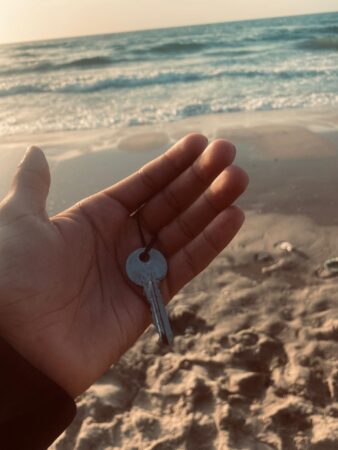
One morning, as I sat on the beach near the displacement camp where I live, I was scrolling through my phone when I came across a post about my city, Rafah. It was written in the past tense, as if the city no longer existed.
I reached into my bag and touched the key to my old room, wondering how something I always thought of as belonging to past generations had become part of my own life. Some weeks have passed, but I’ve been unable to shake the weight of this realization, which feels especially heavy today, of all days.
On May 15 of every year, we observe Nakba Day to commemorate the catastrophic loss of 78 percent of historic Palestine to Zionist military forces in 1948. They accomplished this by murdering 15,000 Palestinians, displacing at least 750,000 more, and destroying 530 of our cities and villages.[1]
But this year, after reading about Rafah in the past tense, I asked myself what marking the 78th anniversary of the Nakba could possibly mean, now that I too was tied by a key to a home I could no longer reach. For many Palestinians in Gaza, the memory of one of the most tragic moments in our history has become a lived reality once again.
Recollecting the Nakba of 1948, our grandparents would always talk about how, when the Israeli occupation first displaced the Palestinians from their villages, homes, and lands, they believed their absence would last no longer than a few days. All they left with was what they could physically carry. They locked their doors behind them and took their keys, expecting to return once the violence ended.
Instead, the days turned into decades. Families were scattered, homes were lost, but the keys continued to be passed down from one generation to another. As a child, I thought the Nakba was an inherited memory which belonged only to the previous generations. I didn’t know I would one day find myself living through the same kind of loss.
Today, everyone seems to have their own way of holding on to what was taken from them. A few weeks ago, I went to visit a friend of mine who lives near the so-called “yellow zones” in Khan Younis. The area did not resemble life in any normal sense: scattered tents, nearly empty roads, and a heavy silence filling the air, punctuated only by the sound of tanks, closer than I’d expected.
I was surprised he still lived there, especially since he was staying in a tent with his family, just like I was. When I asked him why he’d chosen to remain in such a dangerous place, he told me they were trying to stay as close as possible to their homes and neighborhoods in Khan Younis: “We can’t reach them now because of the occupation,” he added, “but being close makes us feel we haven’t been completely uprooted. If we move farther away, we may never be able to return.”
As we spoke, I noticed a small patch of soil beside his tent where basil was growing. “Why basil?” I asked. He smiled, as if remembering something distant. He said basil used to grow in their home, and he loved to smell it every morning. Since being displaced, he wanted to plant something that felt like home.
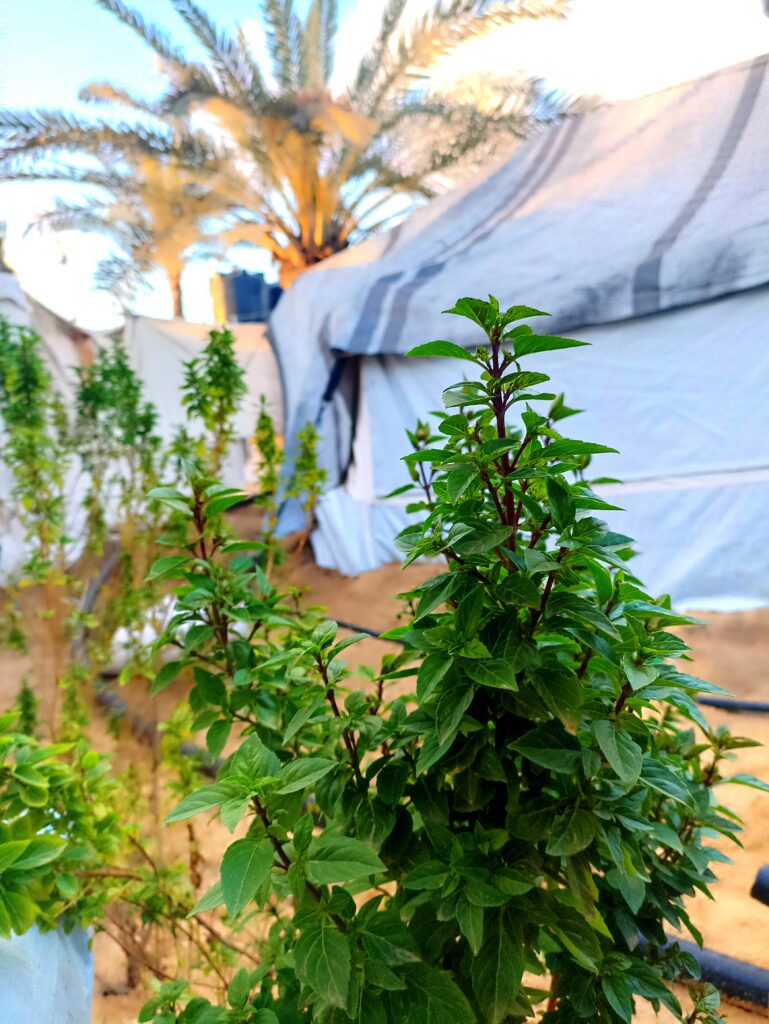
My friend grows basil beside his tent for the same reason our grandparents once carried their keys: to hold on to a home that still lives inside him. I remember how I once had to explain to my younger brother Mohammed why we got days off school to commemorate the dispossession those keys symbolized, and he would listen quietly, as if I were telling him a story from a distant past that looked nothing like his reality.
Today, these stories no longer sound distant to children in Gaza. Mohammed no longer needs anyone to explain to him the meaning of displacement, or the fear of permanently losing one’s home. The school that once gave him days off has itself become a tent.
As for me, I carry my own version of our grandparents’ inheritance every day in my bag: the key to my old room in Rafah, where I once spent long hours studying, writing, and imagining a future that felt far more stable and certain than the one that awaited older generations. Every time I look at that key, I think about how their fears have become my own, and find myself wrestling with the knowledge of what happened to those who stayed, and those who left.
Not long ago, I was applying for scholarships and programs to study outside Gaza. I was doing everything I could, not only because I love studying, but because I wanted to escape the endless search for electricity, internet, and a quiet place to work, the cold of winter and the unbearable heat of summer inside the tents, the constant feeling that my life had become temporary.
But when acceptance letters finally began to arrive, the urgency I once felt to leave slowly began to fade, replaced by something heavier: a deep attachment to this place, to my family, and to the memories still scattered across Rafah.
I realized then that sometimes, even after losing a place physically, it continues to live inside us in ways that are hard to explain. Perhaps that is what the Nakba has always been: not only the loss of our home, but the lifelong struggle to keep it alive inside us, even when, from the outside, it looks as if it has been all but completely erased.
In Gaza, everyone seems to carry their own version of the Nakba. Mine is Rafah, a city I refuse to speak about in the past tense.
HASSAN HERZALLAH is a Gaza-based translator, writer, and storyteller, currently in his fourth year studying English translation. His work covering life under siege, displacement, and daily struggles in Gaza has been published by the London Review of Books, New Lines, The Massachusetts Review, Prism, Mondoweiss, and many other international outlets, and translated into more than seven languages.
1. Facts and figures sourced from: Mohammed Haddad, “Nakba Day: What happened in Palestine in 1948?” Al Jazeera, 15 May 2022. Retrieved on May 11th, 2026. [back to text]