
Storms Ahead
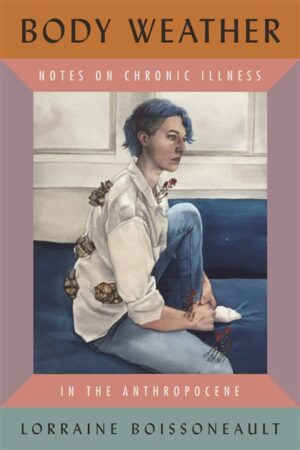
Review of Lorraine Boissoneault’s Body Weather: Notes on Chronic Illness in the Anthropocene (Beacon Books, 2026)
Living with disability, particularly disability that results from a chronic illness, can and often does feel a bit like being trapped in a sudden storm, a hurricane or a tornado, perhaps a blizzard. Some form of natural chaos that batters you from all sides, leaving destruction far worse than you planned for. It makes sense then, that Lorraine Boissoneault, a science writer formerly with the Weather Channel and Smithsonian magazine, chooses to braid her hybrid memoir, Body Weather: Notes on Chronic Illness in the Anthropocene, of her own disability journey (a phrase I actually hate but which does seem to encompass the lengthy, twisting road that her body has taken since she was fourteen), with a clear-eyed, immensely readable exploration of environmental and climate change and crisis in the twenty-first century.
Boissoneault guides readers through her evolving and complicated medical history, starting as a teenager growing up in Ohio, and progressing through thyroid disorder, endometriosis, celiac disease, and intense cardiac episodes that knock the competitive sailor and runner for a loop. Given the complexity of her health and the labyrinthian navigation of the medical system that seeking relief requires, this book should be a tedious slog. But Boisseneault is an able Virgil, guiding us nimbly and lightly through even the darkest of the Dantean depths of medical Hell. I confess that, as an editor, I have been known to complain about the seeming same-ness of illness memoir, but I was riveted both by the surprise of Boissoneault’s symptom-onset, and by the normal, yet alarming treatments she undergoes, including a heart surgery that involves cauterizing part of that muscle.
Combining these experiences with a thoughtful exploration of climate change and ecological devastation widens the scope of the book beyond one woman’s suffering. The title is a phrase that Boissoneault and her partner coined for the unpredictability and dramatic fluctuations of her flares and diagnoses; as the book progresses, however, “body weather” becomes a useful way of thinking through physical illness as well as a planet in crisis. I confess that I was wary of this approach early in my reading: As a writer with a chronic illness, I was skeptical of an author drawing too neat a comparison between the very traceable, human-caused effects of climate crisis and the development of chronic disease, which is not the fault of the individual living with it. But Boissoneault gives readers something more sophisticated than a simple one-to-one comparison. She considers the collateral damage that results from human-caused environmental destruction, and figures the development of disease in a similar vein—not as the direct fault of the person experiencing it, but as the unintended result of actions beyond one’s scope.
This is explicit in her consideration of the pollution of Lake Erie, a place that played a large part in Boissoneault’s life: “I caught perch and bluegill and smallmouth bass. I swallowed accidental mouthfuls of lake water. I watched the glittering curve of the Milky Way appear overhead on dark nights.” This idyll, however, leads her to darker rumination:
For years now, I’ve wondered if the lake’s story of pollution is tied to my story of illness. If we both got sick because we were stuffed full of microplastics; the level of them in the Great Lakes is comparable to those of the Pacific Garbage Patch. If the lead and other heavy metals that concentrated in the flesh of fish was transferred to my own flesh, forcing my endocrine system and circulatory system and immune system to malfunction, uncertain of which molecules belonged in the body and which should be evicted.
To her credit, these questions are allowed to hang over the book, never definitively answered, but coloring our reception of accounts of environmental catastrophe and personal infirmity.
Boissoneault also provides signposts for these possible connections in the book’s structure. Chapters are grouped into sections that explicitly link environmental phenomena with sickened body parts and emotional reactions Boissoneault has felt: “Temperature—Thyroid—Denial,” “Floods—Uterus—Anger,” “Fire—Joints—Radical Love.” In each, she walks the reader through the climate disaster she names and its role in maintaining environmental balance, then shows how it has spiraled into a devastating destructive force through human interventions. She simultaneously parallels her body’s own route from able to disabled, and the emotional state that both ecological and biological damage creates.
In “Landslides—Guts—Grief,” for example, Boissoneault tells of the Oso landslide in Washington in 2014, which killed forty-three people and destroyed forty-nine homes. She points out that landslides were once a rare but necessary means of ecological renewal, leading to “nutrient cycling [and] creating conditions for certain species to thrive.” But out-of-control human intrusion into areas once uninhabitable has destabilized mountains and hillsides, leading to more landslides with increasingly devastating results. In the same section, Boissoneault details her own late discovery of her celiac disease and wonders whether her body’s evolution from sensitivity to gluten to an all-out inability to digest it has led to a cascade of other symptoms. Both the planetary and bodily devastations lead to a similar place: “Here is my magical thinking at work: maybe if I fully understand the processes, I can fully accept all that’s happening. I’ll be done grieving. But grief, like chronic illness, is not a condition one recovers from. It’s something you learn to live alongside.”
This desire to understand both physical and environmental destruction, and to therefore perhaps stop or reverse the damage, runs throughout the book. It leads Boissoneault down the familiar rabbit-holes of alternative medicines and treatments, led by the conviction that such individualized treatments are the only way to cure herself, which ultimately leads to a reckoning with the problematic ethos of “cure” itself. Bringing the reader along on her own reading, she sees, in reading Eli Clare’s Brilliant Imperfection: Grappling with Cure, that “attempted cures are sometimes violent (as when autistic people have been sprayed with ammonia or restrained in chairs)” and that this violence complicates efforts to address both personal and environmental health. The idea of cure as it currently exists, she argues, takes the systems of power that have caused destruction—whether from exploitation of the natural world or the body’s reaction to habitats that are unsafe—and attempts to impose them as a means of remediation. This continues the devastation.
Ultimately, Boissoneault arrives at ambivalence and uncertainty, echoing Walt Whitman:
I value what I’ve learned from illness and I still wish for cure. I contradict myself. I want disability justice, the end of private health insurance, care for whoever needs it whatever their condition, care uncoupled from capitalism. I want all these things because I believe the world will be better when we center the needs of the most vulnerable, but this is also a desire for myself.
In so doing, she links the “exploitative, destructive systems of power” that led to the climate crisis with those that render care for disability and illness more difficult or even impossible. Although Boissoneault thankfully does not offer pat solutions for the realities she has laid bare, she does suggest paths forward, for both human and planetary health. Just as we “don’t have to choose nihilism in the face of certain death,” she writes, we needn’t “choose inaction in the face of ongoing climate crisis. We can choose to change.” Body Weather cogently makes the argument that bodies and weather are in fact inseparable, and that the ability to address the vagaries of both lies in rethinking our connection to ourselves and to the world.
EMILY WOJCIK is the business manager of The Massachusetts Review, as well as a writer and editor. She is the writer of the Substack Wheelchair, Bound, where she explores life and travel as a wheelchair-user.