
A Witness to Genocide
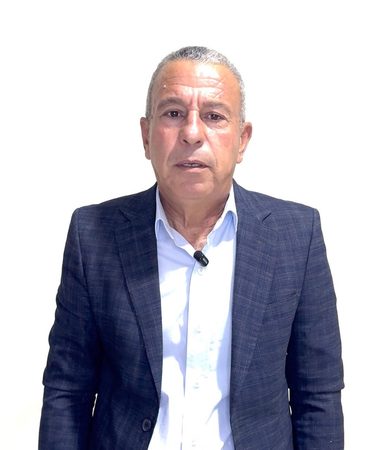
Sami al-Ajrami, author of The Keys to My House: A Gaza Diary
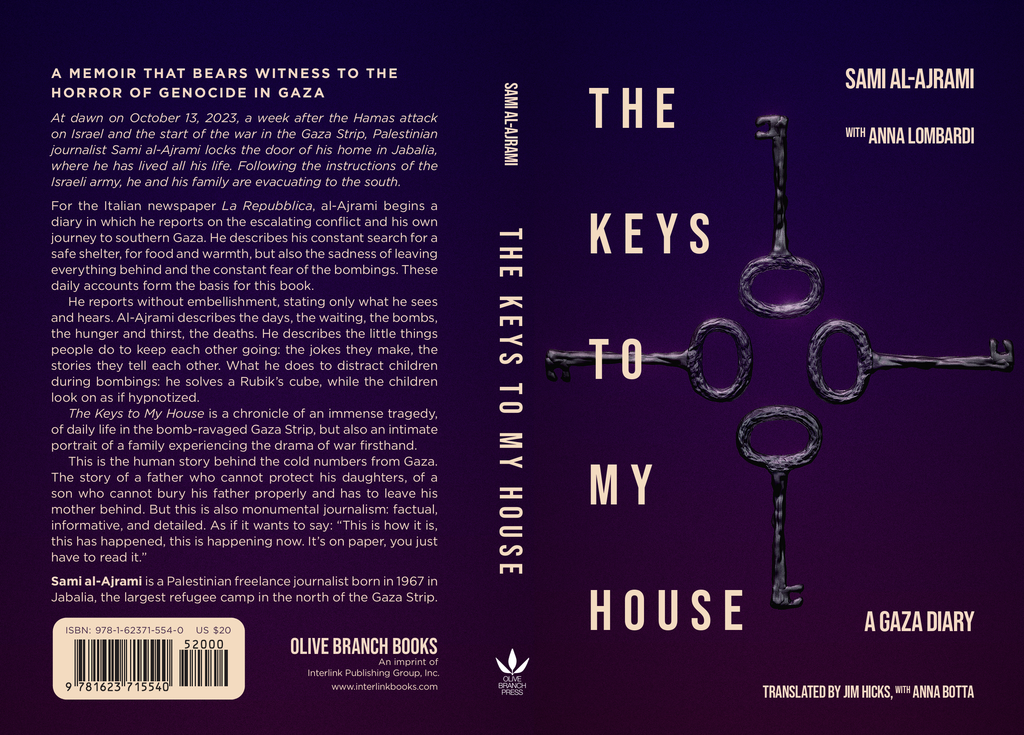
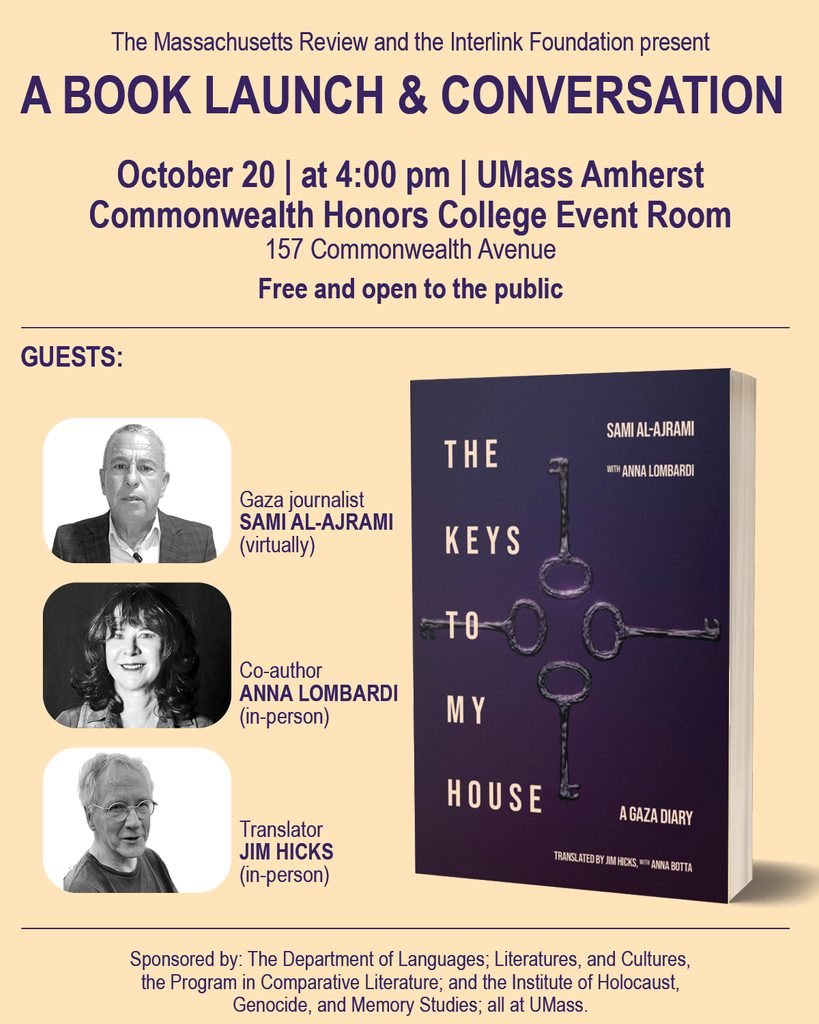
On October 20, 2026, at 4:00 p.m. in the UMass Honors College events hall, I’ll be hosting a presentation by co-author Anna Lombardi (in person) and author Sami al-Ajrami (via Zoom) of the latter’s The Keys to My House: A Gaza Diary. This text began as a compilation of Sami’s reporting from Gaza for Italy’s La Repubblica during the first six months of the genocide, and its story is simultaneously heart-rending, heroic, and paradoxically life-affirming.
In a preface to her translation of eighteenth-century Bengali poetry, Gayatri Chakravorty Spivak famously argues that “translation is the most intimate act of reading.” I believe that this insight, which has been seconded by scholars of translation everywhere, should really be understood as both a blessing and a curse. If translation is an intimate act, what then happens when a translator translates testimony from a witness to genocide?
Surely that translator is blessed to have been given a task of great urgency and lasting historical importance. Yet is this act of translation even possible? Can anyone from outside claim intimate knowledge of unspeakable crimes, especially someone with a privileged, sheltered perspective that never has had, and is unlikely ever to have, experience in any way approximating the lives that such an account must inevitably represent? Moreover, according to this definition, if translation is not intimate, it likely isn’t translation at all, but instead simply betrayal—a false, distant, whitewashed image of the reality it purports to convey. And if the translation fails, won’t readers necessarily fail as well? Or do readers inevitably fail anyway, if they fail to approximate the intimate act of translation?
Sami al-Ajrami’s The Keys to My House: A Gaza Diary responds to each of these questions, and it does so with precision, compassion, and grace. Sami is a reporter who has worked for both Arab and Israeli newspapers as well as a host of other news agencies, both regional and European. We may surely stipulate, without fear of contradiction, that the past three years in Gaza qualify as what Jalal Toufic calls a “surpassing disaster,” and therefore we can also grant that the world will never fully know, that words can never adequately represent, the Palestinian experience—but that does not remove the obligation to report. What it does mean is that every reporter is also by definition a translator, and thus that the weight Sami al-Ajrami shoulders is that of translation on every level: linguistic, cultural, even world-historical. In other words, the intimacy that Spivak intuits is a two-way street: we may read, and understand as best we can, what Sami writes, but we should also remember that, like any good translator, al-Ajrami is also reading us. His intimate knowledge of his audience, of our language, is the true gift within these pages.
In January, 2024, Sami reported on the news that South Africa, in the International Court of Justice, had just filed charges of genocide against the state of Israel. At that time, he commented:
We are grateful to this African country. If this really helps us get back home, some of us promise to fly the South African flag over our doors. We’re well aware that, when the case for international justice against the authors of this genocide was filed, it came, not from any Arab nation, our brothers in faith and blood, but from a people who have experienced apartheid and know what oppression and ghettos are really are. “Hard to imagine they’ll succeed in getting us justice,” people are saying, shaking their heads. Yet we grasp at the hope, that the court might at least succeed in imposing extraordinary measures, capable of putting an end to the brutality of this conflict.
We listen to the closing statements of the South African lawyers on the radio. They explain, in detail, why what is happening qualifies as genocide, the deliberate elimination of a people locked up in a cage from which there is no escape. We listen to raw, horribly real numbers: there have already been 23,000 dead in Gaza. Each day 200 children are killed, 43 mothers, and 3 doctors. From inside the cage, however, we see much more than those numbers. Beyond our bodies, they are killing our minds and our hearts, turning us into barbarians. How else can you explain the horror of a man who, unable to bear seeing his own children sleeping on the street in the cold, takes a pistol and kills an entire family, so that he can put his own in their tent? Perhaps an isolated incident, this serves as an atrocious sign of the insanity of these times. Violence, after all, by now permeates even the most simple, everyday acts. In the street I live on, there’s a bakery where you have to get in line well before 5:00 a.m. to have a hope of getting anything. And that long line of people is turning into a site of ferocious arguments. Gazans—ever more hungry and angry—have quickly gone beyond fistfights and now use weapons. There are many ways to eliminate a people.
Although this is surely clear enough, Sami did not shy away from offering his own assessment. He continued:
For this reason, the South Africans are correct: this is no armed conflict, it’s a form of collective punishment. The Israelis have extremely sophisticated technology. They certainly have the capacity for selective targeting. Instead, they’ve decided to kill indiscriminately. Each day, two million Palestinians are eyewitnesses to their crimes here in Gaza. I, the journalist Sami al-Ajrami, am an eyewitness. And I see not only the physical elimination of individuals but also suffering inflicted with fury on people who are already barely able to survive. Israel keeps the border closed; it starves us by allowing aid in as it pleases. It punishes everyone, children included, for horrors committed by others. One simple statistic demonstrates this: during the hearings, there were 12 more bombings, 126 killed, and 241 wounded.
Children are the weakest link in this war. It’s enough to look at the numbers released by Save the Children: in less than one hundred days, ten thousand have died. In the dark art of bookkeeping, however, the number of disappeared under the rubble goes missing: 4000 young lives, lost. Those who survive are facing a grim reality; thousands have suffered amputations, and there are orphans everywhere. They beg on the streets, or they stand there, listless and silent. They’re all getting sick because there’s no potable water; they don’t eat enough, and they have no clothes to protect themselves from the cold. They are the victims of unspeakable traumas; often you see it when they draw pictures—airplanes with monster faces, spitting fire. A people also can be eliminated by annihilating its children, the seed of its future.
Even the granddaughter of my sister Samya (the daughter of her son), Nejwa, is in the “Indonesian” hospital up north. With a head wound, she risks losing an eye. The hospital in Gaza City that specializes in ophthalmology has been destroyed; nowhere else is capable of treating her, and only abroad will they be able to save her sight. I think about her when I pass by the Kuwait Hospital, where there is a long line of women squeezing in their arms the small, suffering bodies of their sick or wounded children. They’re waiting to be assigned a space, often just some corner on the floor, where at least they’ll be treated. I slip into the jam-packed rooms of the pediatric ward, and, when I see the horrible conditions these little ones endure, I feel an impulse to vomit.
The country of South Africa that defends us today has seen dark days yet managed to find truth and justice. Who knows if, for us, the hour of truth and justice will ever arrive?
If you’re in or around Amherst on October 20th, I hope you’ll join us in welcoming Anna Lombardi (in person) and Sami al-Ajrami (via Zoom) to the University of Massachusetts campus.
JIM HICKS is the Executive Editor Emeritus of the Massachusetts Review, and the co-translator with Anna Botta of The Keys to My House: A Gaza Diary.