
Interview with Robert James Hicks
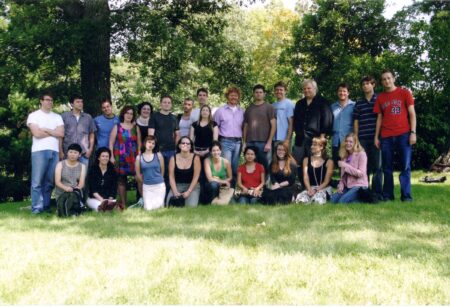
Robert James Hicks (back row, sixth from the left; black shirt) with his Iowa Writers’ Workshop cohort, 2003-2005.
What have you been reading recently? What’s influenced your writing the most over the years?
I just read the latest novel by Ann Patchett, who has long been one of my favorite writers. I often return to J. M. Coetzee for the authority of his prose, Tim Winton for the musicality of his, and Barbara Gowdy for the way her work tilts toward the strange in a way that feels true to me. As for story collections, I come back to Jim Shepard and Tobias Wolff for their perception and precision.
Do you have any unpopular literary opinions?
During my MFA, I was asked to teach fiction writing to undergraduates. I enjoyed it, though I sometimes think back to the class in which I badly phrased a piece of advice: don’t write for therapy. I can still picture their faces—half confused, half horrified—and I’m not sure I managed to explain myself.
What I meant was that writers shouldn’t set out to create stories in which a character, especially one who resembles them, is plainly the hero or purely the victim. Writing can be therapeutic, and writers should absolutely explore the things that needle them. But writing toward discovery—at the boundary of your understanding—is more worthwhile than writing to manufacture affirmation.
If I were teaching now, I’d say it this way: write to find out what you think and how you feel, or—if your mind is already made up—write to consider another perspective. That is hard to do, which may be why attempts to write stories that are too close to my own haven’t worked out. But when I succeed in approaching fiction this way, the process has value for me regardless of the literary results, and it’s also more likely to lead to my best work.
What’s been inspiring you lately?
I think a lot about parenting. Being present and curious, and seeing past yourself, is a challenge, and even then a child’s inner life—like anyone’s inner life—remains mostly invisible. I think about these things because I have a daughter and want very much to do a good job for her. And I think about them as a writer because we’re all shaped so much by our upbringings.
This piece came from an old observation: parents sometimes struggle to see their children as they are. The real child can be eclipsed by a cherished memory, a long‑held hope, or a refusal to acknowledge flaws. How frustrating and isolating that must feel, even—or especially—for someone whose troubling behavior had been left unaddressed. This story became a way for me to explore that dynamic with empathy, to sit with those feelings, and then to imagine someone strong enough to refuse to live with them.
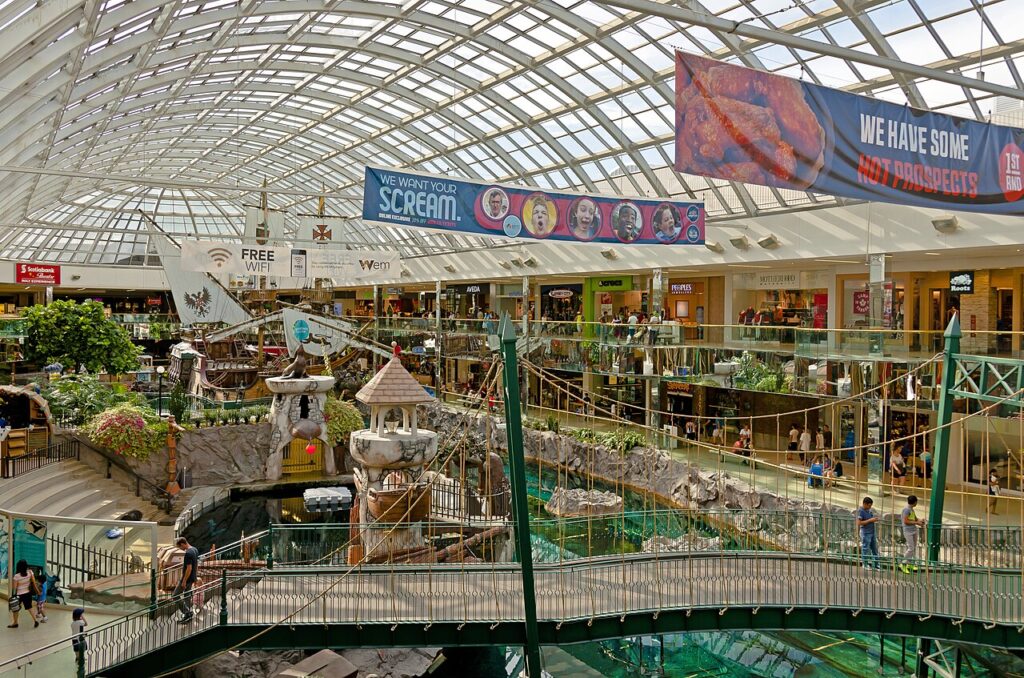
“Sea Life Cavern Wing at West Edmonton Mall.” Courtesy of Wikimedia Commons, 2015.
What’s your relationship to the West Edmonton Mall?
For years, it was the world’s biggest, and people everywhere knew about Edmonton. Growing up around there, I was grateful for that point of reference and connection, but also resentful that it overshadowed everything else about home.
Similarly, inside the mall, I found the stores and so‑called attractions both appealing and appalling. I don’t know if I understood then how products are positioned to draw people in, how they rarely deliver the escape or status they promise, and how instead, in falling short, they expose all kinds of poverty—people’s hunger, dissatisfaction, and desperation. But I remember being swept up in the experience. I enjoyed the dolphin show, watching it at both ten and at two, but left each performance unsettled, complicit in the cruelty of captivity. And the wave pool, with its tropical humidity, whisked me away from winter for the day, but at night my eyes still stung from chlorine and the lingering sensation of rising and falling kept me awake.
In a series of poems about refusing to go there, Heather Spears imagined how hard it is “to dislike the West Edmonton Mall / totally and morally, as is necessary”; the place is too successful at “seducing” people. That’s its purpose and the point of its attractions. As the Edmonton punk band SNFU sang, it consumes its consumers.
So, my relationship with the mall was a cycle of allure and abhorrence, and the tension between those feelings is partly why I thought it would make a great setting for a story.
What non-literary hobbies do you have? How do these inform your writing?
My passion for punk rock shows up in this story through the character of Dustin.
As for other hobbies, I quit playing hockey at thirteen and then took it up again in my twenties. Because of that long break during the years when players usually get instruction and develop skill, I’m not very good, but I’m enthusiastic. A couple of nights a week, at what should be bedtime, I grab my gear and head to the rink.
I also watch the sport. Even though I left Edmonton a long time ago—or maybe because I left and want to hold onto some part of where I grew up—I watch the Oilers. That’s the team that makes a brief appearance in this piece. And to be honest, I don’t just watch them; I follow them with near-religious fervor. I’m being tongue‑in‑cheek, but there is something religion‑adjacent in hockey’s rituals, both for players and fans.
I’ve tried to write about that before and will keep trying, because I’m fascinated by how hockey intersects with various pillars of identity, including race and gender. I think about how the sport shapes boys and men, and how often those stories are reduced to a single note—celebration or condemnation—or left untold. There may be a novel there. But first, I’m working on a few more short stories, and I have another draft novel about which I need to make some decisions.
ROBERT JAMES HICKS is a graduate of the Iowa Writers’ Workshop. His fiction has appeared in journals including The Southwest Review, PRISM international, and Hayden’s Ferry Review. He lives in Victoria, British Columbia, and more of his work can be found at www.robertjameshicks.com.