
Interview + Reading with Melissa Melpignano (audio + text)
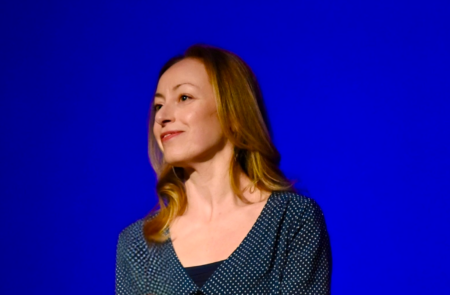
Editor’s note: The text here is an edited transcription of a larger conversation conducted over Zoom, which appears in full below. Melpignano reads her translations of Leonardo Tonini’s poems “6.” from [25:52 – 26:27] and “12.” from [28:16 – 28:40]. Music credit to Nicholaas Stulting, “Everyday.”
Introduce yourself, your relationship to writing and translation to us:
I’m invested in trying to figure out what this thing is that we humans deal with all the time, which is language. As a dance person, I’m also invested in figuring out why the body and corporealities are always so removed from literary discourses. This is how I approach literature and poetry and text. My job, what pays my salary, is to be a professor of dance. Part of my research has been on dance librettos—so really the intersection of textuality and corporeality.
When I want to have fun, I try to translate poetry: from Italian into English, from English into Italian, Spanish into Italian, Spanish into English. I talk about translation, of course, a lot with Leonardo Tonini. [We’ve talked about] Gesualdo Bufalino, an Italian author that we both enjoy. Bufalino said that the translator is the truest, the most authentic reader of a text. Not just because the translator needs to read the text many times and work with it, but he had this defined image, this funny image: The critic of a text is the suitor of, or the person that flirts with the text, while the author of is either the father or the husband of the text. (Of course, he was speaking from a very patriarchal perspective. We’re talking about an older Italian guy…)
But the translator was the lover, the person that keeps questioning and reinventing the relationship with the text. And I think I see translation in that way. Maybe not exactly in the terms of Bufalino (I don’t necessarily see the erotic relationship always at play), but that continuously building the relationship with the text and questioning the relationship with the text, yes.
Do you see overlaps between the act of translation and your interest in dance/corporeality?
I think about dance even when I don’t think about dance. It’s just what I do. There is [constant] movement from my body that informs my thinking and vice versa. We live in structures that still think the body is a barrier, or something that needs to be fought: I don’t think so. That’s how I approach translation. I allow myself to explore.
And I think that I allow—in the case of Leonardo Tonini’s poems—I allow the verses and the sounds and the choices that Leonardo made to inform my movement (which is physical movement, because I always have a physical response while I’m reading, or while I’m thinking about the text), but then also in my written choices, in my lexical choices, the sounds that I chose.
I’m a big reader, big fan, a student of poet Antonella Anedda: She says that it’s inevitable that in translation temporality changes, because one language has a rhythm, another language has another rhythm, or again, the lexical choices activate temporal changes. And with the temporal changes, there are changes in the way we breathe. I can have a certain heartbeat or a certain breathing frequency when I read in Italian, and I might have a different one in English. I know that I use different parts of my chest to speak. In Italian, the air inside my body moves in a way that it doesn’t in English.
How did you and Leonardo Tonini meet? How did you come to translate his Syriana collection?
We come from the same geographical area, the province of Mantua in northern Italy. To me, life here is pretty boring. I think we met in an independent bookshop—there were many of those twenty years ago or so. They were a safe place, a place of exploration for a person who hadn’t left the province yet.
Now that we’re friends, he just hands me anything that he writes. I don’t think I’m his first reader… but I’m one of the first. I read [Syriana] with great interest, as a person that researches and writes about Palestine, and Palestine and Israel; there was also a scholarly interest besides the personal. I immediately thought that the poems were beautiful, were important, were relevant.
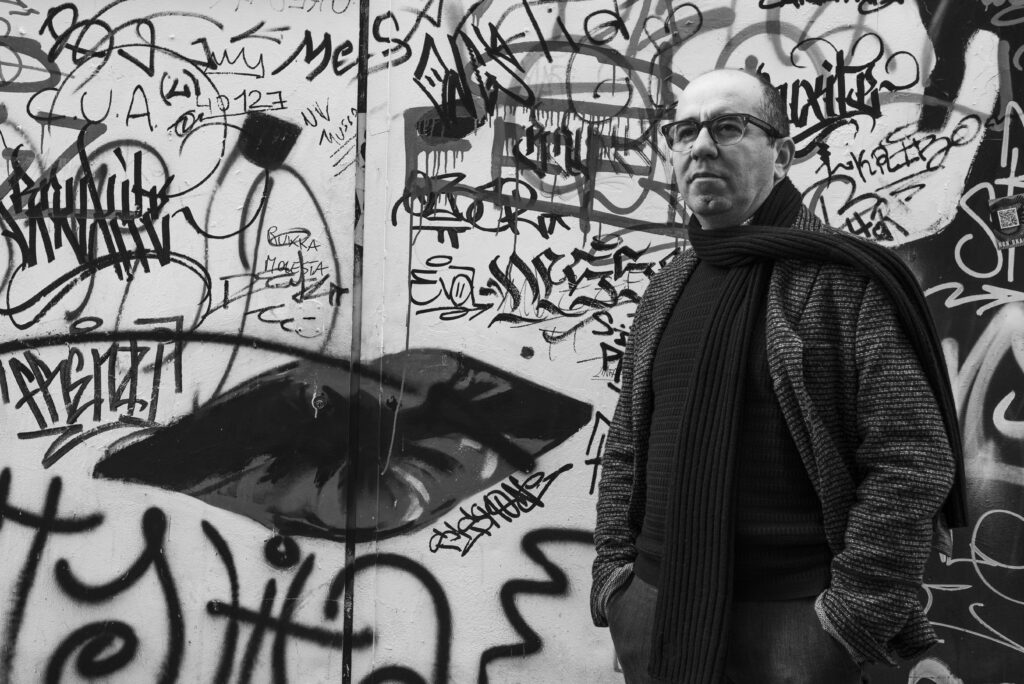
When making the proofs, I was interested in the choice to have the first lines be bolded. How did you two decide upon that, rather than making those titles or plain text? Similarly, how did the larger collaboration work between you two?
Tonini is a prolific writer, but he’s also an experimenter. He plays with form in the most beautiful Baroque way, if I may. This thing of setting the first line of a poem in bold, he said it’s a tendency in European poetry: He saw it, if I’m not mistaken, in a German poem, and the poems are numbered like a part of a trip; they don’t have a title.
I read it also in a different way, like the bold really indicates some sort of threshold. For me, again, we go back to the corporeality and my experience as a dance person. To me, that verse in bold is a step that I have to take into the poem.
[This step] is this kind of labor of the body into the overlapping realities that Syriana keeps presenting. That’s why it was important for me to not to change it—because also Leonardo gave me a lot of freedom, like “translate the way you want.”
It was kind of an ethical demand when translating Leonardo Tonini’s poems. He traveled to Syria right before the beginning of the civil war. Right after he came back, the civil war started, and he followed on TV what was happening. He kept in touch with people he was in contact with there. There are all these discrepancies and differences, and material and symbolic fallings in the poems and in the experience of the poet. And I needed to think about this when translating: What’s at stake in the act of translating?
I need to be aware of the process that informs the writing of the poems to be able to continue the process. For me, translation is also the continuation of the process that the poems and the poet (in this case, Tonini) already activated. Yeah, I can take a poem and translate it in a way to affirm some sort of creative persona: I’m more interested in continuing a process that is already happening.
What are you working on right now?
Leonardo Tonini’s new poetry collection entitled Immorti dell’Astore, or The Dead Ones of the Astore; I want to translate that into English. I’m translating a play by American-Mexican playwright, Georgina Escobar, into Italian from English and Spanish. I’m also working on some critical essays and an edited book with other authors on the poetry of Antonella Anedda, who I mentioned earlier. I would also love to amend some of the English translation that has been made of Antonella’s work.
MELISSA MELPIGNANO is a writer, translator, and dance scholar-artist. She works as Assistant Professor of Dance at The University of Texas at El Paso. Her work at large explores conflict, with a particular focus on the Middle East, through the lens of corporeality, movement, and choreography. She is the author of the poetry collection Lento Notturno (Alla Chiara Fonte, 2012) and of several academic articles on literature and performance.